


Qi He1, Wei Chen2, and Dan He3
1,3College of Art, Hubei University of Education, Wuhan 430205, Hubei, China
1Hubei Cultural Industry Economy Research Center, Wuhan 430205, Hubei, China
2School of Music, Guangzhou College of Technology and Business, Guangzhou 510850, Guangdong, China
Received: May 30, 2026
Accepted: July 12, 2026
Publication Date: August 12, 2026
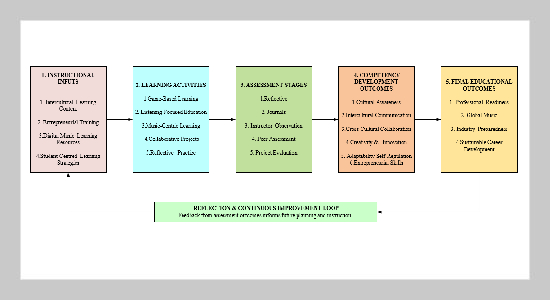
The Input Process Output Educational Workflow of Intercultural–Entrepreneurial Pedagogical Framework
Copyright The Author(s). This is an open access article distributed under the terms of the Creative Commons Attribution License (CC BY 4.0), which permits unrestricted use, distribution, and reproduction in any medium, provided the original author and source are cited.
Download Citation: BibTeX | http://dx.doi.org/10.6180/jase.202611_34.033
The study focuses on developing a new methodology that would give students the tools they need to participate in the worldwide, digitalized music market as well as integrating intercultural competency and entrepreneurial abilities into undergraduate music education. It further asks whether a curriculum combining intercultural awareness and entrepreneurial competences truly adheres to its intent of equipping students to take responsibility for their learning by actively engaging in applied art studies. A mixed-method action research approach with 30 undergraduate music students, the framework achieved 75–78% improvement in intercultural competence, 70–74% improvement in entrepreneurial skills, and 15–20% improvement in project performance, demonstrating its effectiveness as an integrated competency-based music education model. It stresses the need for flexible
learning environments centred on students to nurture autonomy and self-development, creativity, and flexibility. The model contends on different sources of motivation while focusing mostly on intrinsic motivation being able to nurture entrepreneurial behaviours-what is being assumed is that others will need some scaffolding to support students of different levels of self-regulation.
Keywords: Intercultural competence, Entrepreneurial skills, Music education, Pedagogical framework, Student autonomy.
- [1] D. Bruin and L. R, (2021) “Instrumental Music Educators in a COVID Landscape: A Reassertion of Relationality and Connection in Teaching Practice” Frontiers in Psychology 11: DOI: 10.3389/fpsyg.2020.624717.
- [2] I. Lahdelma and T. Eerola, (2020) “Cultural familiarity and musical expertise impact the pleasantness of consonance/dissonance but not its perceived tension” Scientific Reports 10(1): 8693. DOI: 10.1038/s41598-020-65615-8.
- [3] T.-Y. Lee, Y.-C. Ho, and C.-H. Chen, (2023) “Integrating intercultural communicative competence into an online EFL classroom: an empirical study of a secondary school in Thailand” Asia-Pacific Journal of Second and Foreign Language Education 8(1): 4. DOI: 10.1186/s40862-022-00174-1.
- [4] Z. Li, (2024) “Improving Music Teaching in Primary Schools in Northern Shanxi to Promote the Development of Students’ Key Competencies” Pakistan Journal of Life and Social Sciences 22(2): DOI: 10.57239/PJLSS-2024-22.2.00836.
- [5] R. Thakur, M. Chavan, A. Vasoya, H. Kasturiwale, S. Ghosh, and S. Mishra, (2024) “Bridging Academia And Industry: A Study On The Skill Development Effects Of Internships And On-The-Job Training Programs” Educational Administration: Theory and Practice 30(4): DOI: 10.53555/kuey.v30i4.2276.
- [6] M.-L. Juntunen and G. López-Íñiguez, (2025) “Enrichment and acceleration of highly motivated children’s instrumental music learning: A case study of a pilot development project” Research Studies in Music Education 47(2): 239–258. DOI: 10.1177/1321103X241297094.
- [7] A. Bautista, J. Yeung, M. L. McLaren, and B. Ilari, (2024) “Music in early childhood teacher education: raising awareness of a worrisome reality and proposing strategies to move forward” Arts Education Policy Review 125(3): 139–149. DOI: 10.1080/10632913.2022.2043969.
- [8] A. deWaard, B. Fauteux, and B. Selman, (2022) “Independent Canadian Music in the Streaming Age: The Sound from above (Critical Political Economy) and below (Ethnography of Musicians)” Popular Music and Society 45(3): 251–278. DOI: 10.1080/03007766.2021.2010028.
- [9] S. Pan, B. Hafez, A. Iskandar, and Z. Ming, (2024) “Integrating constructivist principles in an adaptive hybrid learning system for developing social entrepreneurship education among college students” Learning and Motivation 87: 102023. DOI: 10.1016/j.lmot.2024.102023.
- [10] J. Perić, S. Oberman Peterka, and Ž. Getoš, (2020) “The Role of Vocational Education in Developing Entrepreneurial Competences of Students” Ekonomski Pregled 71(5): 463–492. DOI: 10.32910/ep.71.5.2.
- [11] L. Wei, Y. Yu, Y. Qin, and S. Zhang, (2025) “From Tools to Creators: A Review on the Development and Application of Artificial Intelligence Music Generation” Information 16(8): 656. DOI: 10.3390/info16080656.
- [12] A. Ahmad, D. Amry, Z. Chen, and Y. Hu, (2026) “Building entrepreneurial self-efficacy in engineering students: towards a new methodological framework” Entrepreneurship Education 9(1): 21–56. DOI: 10.1007/s41959-025-00156-7.
- [13] L. O. Nweke, U. F. Okebanama, and G. U. Mba, (2025) “Enhancing entrepreneurial skills through experiential learning in IoT, AI, and cybersecurity” Discover Education 4(1): 149. DOI: 10.1007/s44217-025-00573-9.
- [14] D. Calderón-Garrido, J. Gustems-Carnicer, and X. Carrera, (2020) “Digital technologies in music subjects on primary teacher training degrees in Spain: Teachers’ habits and profiles” International Journal of Music Education 38(4): 613–624. DOI: 10.1177/0255761420954303.
- [15] M. Argyriou, (2025) “Musical Literacy as Multimodal and Multicultural Practice: Reimagining Education, Identity, and Social Inclusion in a Globalised Context” European Journal of Social Sciences Studies 10(6): DOI: 10.46827/ejsss.v10i6.1927.
- [16] H. Westerlund, A. A. Kallio, and S. Karlsen, (2022) “Interrogating intercultural competence through a ‘pedagogy of interruption’: A metasynthesis of intercultural outreach projects in music teacher education” Research Studies in Music Education 44(2): 380–398. DOI: 10.1177/1321103X211026007.
- [17] D. Joseph, R. Nethsinghe, and A. Cabedo-Mas, (2020) “’We learnt lots in a short time’: Cultural exchange across three universities through songs from different lands” International Journal of Music Education 38(2): 177–193. DOI: 10.1177/0255761419880027.