



School of Mechanical Engineering, Shenyang Ligong University, Shenyang 110159, China.
Received: June 03, 2026
Accepted: June 28, 2026
Publication Date: August 12, 2026
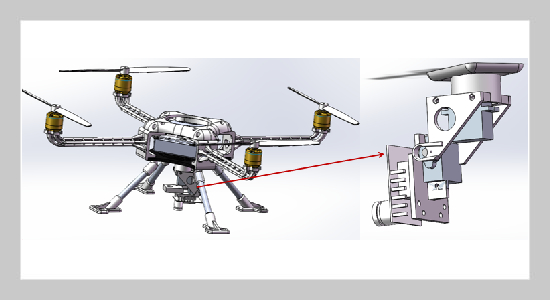
SolidWorks 3D model of the multi-rotor UAV and two-axis direct-drive gimbal.
Copyright The Author(s). This is an open access article distributed under the terms of the Creative Commons Attribution License (CC BY 4.0), which permits unrestricted use, distribution, and reproduction in any medium, provided the original author and source are cited.
Download Citation: BibTeX | http://dx.doi.org/10.6180/jase.202611_34.032
Aiming at the critical engineering pain points of visual tracking systems for small multi-rotor UAVs, including onboard payload redundancy, high control loop latency, and the inherent trade-off between response speed and steady-state accuracy in fixed-gain PID controllers, this paper presents a lightweight end-to-end edge vision two-axis gimbal automatic tracking system. To address the link hysteresis problem of traditional relay architectures, a middleware-free direct-connection architecture between OpenMV edge nodes and the Pixhawk flight controller is implemented, significantly reducing system hardware payload and communication latency. To mitigate integral windup and steady-state chattering caused by the mechanical backlash of micro servos, an incremental PID controller with visual front-end signal compensation is designed, which suppresses invalid oscillations through axis-differentiated dead-zone compensation. To overcome the poor adaptability of fixed proportional gains, nonlinear exponential adaptive logic is introduced to resolve the contradiction between rapid target convergence and overshoot suppression. To break through the limitation of flight controller low-level filtering on servo bandwidth, a software-hardware cross-mapping decoupling strategy is adopted to enhance the dynamic response performance of the system. Experimental results demonstrate that in high-frequency transverse reciprocating sinusoidal motion tests, the system can rapidly overcome instantaneous large deviations caused by target mutations; the step response settling time is reduced by 64% compared with the traditional relay architecture; and target reacquisition is completed within 300 ms after 600 ms of target occlusion. While strictly satisfying the onboard payload constraints of small UAVs, the system effectively improves the real-time performance and robustness of visual tracking systems.
Keywords: Small Multi-Rotor Unmanned Aerial Vehicle (SUAV); Visual Servoing; Incremental PID; MAV Link Communication; End-to-End Control
- [1] D. Palossi, A. Loquercio, F. Conti, E. Flamand, D. Scaramuzza, and L. Benini, (2019) “A 64-mW DNN-Based Visual Navigation Engine for Autonomous Nano-Drones” IEEE Internet of Things Journal 6(5): 8357–8371. DOI: 10.1109/JIOT.2019.2917066.
- [2] P. Corke. “Mobile Robot Vehicles”. In: Robotics, Vision and Control: Fundamental Algorithms in MATLAB. Springer, 2017, 99–124. DOI: 10.1007/978-3-319-54413-7_4.
- [3] S. Tarbouriech and M. Turner, (2009) “Anti-Windup Design: An Overview of Some Recent Advances and Open Problems” IET Control Theory & Applications 3(1): 1–19. DOI: 10.1049/iet-cta:20070435.
- [4] M. Al Radi, M. N. AlMallahi, and A. S. Al-Sumaiti, (2024) “Progress in Artificial Intelligence-Based Visual Servoing of Autonomous Unmanned Aerial Vehicles (UAVs)” International Journal of Thermofluids: DOI: 10.1016/j.ijft.2024.100590.
- [5] P. Warden and D. Situnayake. TinyML: Machine Learning with TensorFlow Lite on Arduino and Ultra-Low-Power Microcontrollers. O’Reilly Media, 2019.
- [6] S. Peng, Y. Liu, Q. Huang, X. Zhou, and H. Bao. “PVNet: Pixel-Wise Voting Network for 6DoF Pose Estimation”. In: 2019 IEEE/CVF Conference on Computer Vision and Pattern Recognition (CVPR). IEEE, 2019, 4561–4570. DOI: 10.1109/CVPR.2019.00469.
- [7] Z. Ning, H. Hu, X. Wang, L. Guo, S. Guo, G. Wang, and X. Gao, (2024) “Mobile Edge Computing and Machine Learning in the Internet of Unmanned Aerial Vehicles: A Survey” ACM Computing Surveys 56(1): 1–31. DOI: 10.1145/3604933.
- [8] Z. Li, D. Li, J. Yang, and H. Li. “A Real-Time Monocular Vision-Aided Target Detection and Tracking for Micro UAV in GPS Denied Environment”. In: Lecture Notes in Electrical Engineering. Springer, 2022. DOI: 10.1007/978-981-15-8155-7_255.
- [9] S. Macenski, T. Foote, B. Gerkey, C. Lalancette, and W. Woodall, (2022) “Robot Operating System 2: Design, Architecture, and Uses in the Wild” Science Robotics 7(66): DOI: 10.1126/scirobotics.abm6074.
- [10] P. McEnroe, S. Wang, and M. Liyanage, (2022) “A Survey on the Convergence of Edge Computing and AI for UAVs: Opportunities and Challenges” IEEE Internet of Things Journal 9(17): 15435–15459. DOI: 10.1109/JIOT.2022.3176400.
- [11] L. Meier, P. Tanskanen, L. Heng, G. H. Lee, F. Fraundorfer, and M. Pollefeys, (2012) “PIXHAWK: A Micro Aerial Vehicle Design for Autonomous Flight Using On-board Computer Vision” Autonomous Robots 33(1): 21–39. DOI: 10.1007/s10514-012-9281-4.
- [12] A. Koubâa, A. Allouch, M. Alajlan, Y. Javed, A. Belghith, and M. Khalgui, (2019) “Micro Air Vehicle Link (MAVLink) in a Nutshell: A Survey” IEEE Access 7: 87658–87680. DOI: 10.1109/ACCESS.2019.2924410.
- [13] A. M. Nascimento, A. V. Brito, M. Saska, and T. P. Nascimento, (2026) “A Review on Vision-Based Control for Multi-Rotor Aerial Vehicles” Robotics and Autonomous Systems 198: DOI: 10.1016/j.robot.2026.105366.
- [14] R. Szeliski. Computer Vision: Algorithms and Applications. 2nd. Springer, 2022. DOI: 10.1007/978-3-030-34372-9.
- [15] F. Chaumette and S. Hutchinson, (2006) “Visual Servo Control. I. Basic Approaches” IEEE Robotics & Automation Magazine 13(4): 82–90. DOI: 10.1109/MRA.2006.250573.
- [16] B. Ekstrand, (2001) “Equations of Motion for a Two-Axes Gimbal System” IEEE Transactions on Aerospace and Electronic Systems 37(3): 1083–1091. DOI: 10.1109/7.953259.
- [17] N. V. Phuong, N. T. Tuyen, N. D. Khanh, and N. N. Hung. “Designing a Robust Control System Based on Sliding Mode Control for Two-axis Gimbal Systems”. In: 2024 Conference of Young Researchers in Electrical and Electronic Engineering (EICon). IEEE, 2024, 455–458. DOI: 10.1109/EICon61730.2024.10468229.
- [18] J. Kuang and M. Chen, (2024) “Adaptive Sliding Mode Control for Trajectory Tracking of Quadrotor Unmanned Aerial Vehicles Under Input Saturation and Disturbances” Drones 8(11): 614. DOI: 10.3390/drones8110614.
- [19] I. López-Sánchez and J. Moreno-Valenzuela, (2023) “PID Control of Quadrotor UAVs: A Survey” Annual Reviews in Control 56: 100900. DOI: 10.1016/j.arcontrol.2023.100900.
- [20] A. Khalid, Z. Mushtaq, S. Arif, K. Zeb, M. A. Khan, and S. Bakshi, (2023) “Control Schemes for Quadrotor UAV: Taxonomy and Survey” ACM Computing Surveys: DOI: 10.1145/3617652.
- [21] M.-Y. Ma, S.-E. Shen, and Y.-C. Huang, (2023) “Enhancing UAV Visual Landing Recognition with YOLO’s Object Detection by Onboard Edge Computing” Sensors 23(21): 8999. DOI: 10.3390/s23218999.
- [22] C. Wang, D. Xu, Y. Zhu, R. Martín-Martín, C. Lu, L. Fei-Fei, and S. Savarese. “DenseFusion: 6D Object Pose Estimation by Iterative Dense Fusion”. In: 2019 IEEE/CVF Conference on Computer Vision and Pattern Recognition (CVPR). IEEE, 2019, 3343–3352. DOI: 10.1109/CVPR.2019.00346.
- [23] Z. Yu, Y. Zhang, B. Jiang, and C.-Y. Su. Fault-Tolerant Cooperative Control of Unmanned Aerial Vehicles. Springer Nature Singapore, 2023. DOI: 10.1007/978-981-99-7661-4.
- [24] A. K. Kamath, Z. Zheng, and M. Feroskhan, (2025) “Depth-Independent Augmented Dynamics Visual Servoing of Multirotors” IEEE Transactions on Aerospace and Electronic Systems 61(2): 5444–5453. DOI: 10.1109/TAES.2024.3496418.