




1School of History and Law, Yulin Normal University, Yulin, Guangxi 537000, China
2Student Affairs Office, Yulin Normal University, Yulin, Guangxi 537000, China
Received: May 09, 2026
Accepted: June 26, 2026
Publication Date: August 09, 2026
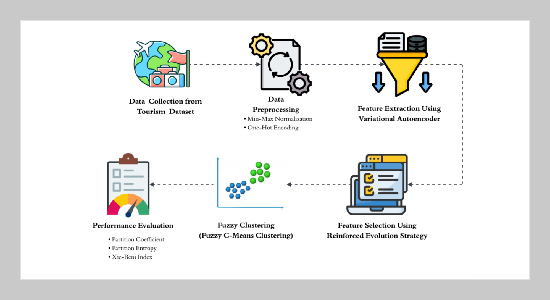
Proposed Intelligent Fuzzy Clustering Framework for Tourism Data Analysis.
Copyright The Author(s). This is an open access article distributed under the terms of the Creative Commons Attribution License (CC BY 4.0), which permits unrestricted use, distribution, and reproduction in any medium, provided the original author and source are cited.
Download Citation: BibTeX | http://dx.doi.org/10.6180/jase.202611_34.031
Tourism analytics is essential for understanding traveler behavior and supporting effective destination management. This study proposes a hybrid framework that combines deep learning, evolutionary optimization, and fuzzy clustering to improve tourism data segmentation. A realworld tourism dataset is preprocessed using Min-Max normalization and one-hot encoding. A Variational Autoencoder (VAE) is employed to extract compact latent features from high dimensional data, while Reinforced Evolution Strategy (RES) selects the most informative features by optimizing information gain and reconstruction quality. Fuzzy C-Means (FCM) clustering is then applied to categorize tourism records while handling uncertainty through soft cluster mem berships. The clustering performance is assessed using Partition Coefficient (PC), Partition Entropy (PE), and Xie-Beni Index (XB). Results demonstrate effective cluster formation, achieving a PC of 0.65, PE of 0.68, and clear cluster separation. The proposed framework also demonstrated strong destination retrieval and ranking capability, achieving Precision@10 of 0.89 , Recall@10 of 0.86 , F1-Score of 0.88 , MAP of 0.91 , and NDCG of 0.93. Compared to previous works, the model showed improved compactness and reduced ambiguity in cluster membership.
Keywords: Tourism Recommendation, Variational Autoencoder, Reinforced Evolution Strategy, Fuzzy C-Means Clustering, Clustering Evaluation.
- [1] C. Moulin and P. Boniface, (2001) “Routeing heritage for tourism: Making heritage and cultural tourism networks for socio-economic development” International Journal of Heritage Studies 7(3): 237–248. DOI: 10.1080/13527250120079411.
- [2] J. Borràs, A. Moreno, and A. Valls, (2014) “Intelligent tourism recommender systems: A survey” Expert Systems with Applications 41(16): 7370–7389. DOI: 10.1016/j.eswa.2014.06.007.
- [3] D. Gavalas, C. Konstantopoulos, K. Mastakas, and G. Pantziou, (2014) “Mobile recommender systems in tourism” Journal of Network and Computer Applications 39: 319–333. DOI: 10.1016/j.jnca.2013.04.006.
- [4] B. D. Mittelstadt, P. Allo, M. Taddeo, S. Wachter, and L. Floridi, (2016) “The ethics of algorithms: Mapping the debate” Big Data & Society 3(2): 2053951716679679. DOI: 10.1177/2053951716679679.
- [5] R. R. Yager, (2003) “Fuzzy logic methods in recommender systems” Fuzzy Sets and Systems 136(2): 133–149. DOI: 10.1016/S0165-0114(02)00223-3.
- [6] X. Yang, L. Zhang, and Z. Feng, (2024) “Personalized tourism recommendations and the e-tourism user experience” Journal of Travel Research 63(5): 1183–1200. DOI: 10.1177/00472875231187332.
- [7] V. M. Charitopoulos, M. Rangoussi, and D. E. Koulouriotis, (2020) “On the use of soft computing methods in educational data mining and learning analytics research: A review of years 2010–2018” International Journal of Artificial Intelligence in Education 30(3): 371–430. DOI: 10.1007/s40593-020-00200-8.
- [8] L. F. Chen and C. T. Tsai, (2016) “Data mining framework based on rough set theory to improve location selection decisions: A case study of a restaurant chain” Tourism Management 53: 197–206. DOI: 10.1016/j.tourman.2015.10.001.
- [9] S. Rokhsaritalemi, A. Sadeghi-Niaraki, and S. M. Choi, (2023) “Exploring emotion analysis using artificial intelligence, GIS, and extended reality for urban services” IEEE Access 11: 92478–92495. DOI: 10.1109/ACCESS.2023.3307639.
- [10] N. Stylos, J. Zwiegelaar, and D. Buhalis, (2021) “Big data empowered agility for dynamic service industries: The tourism sector” International Journal of Contemporary Hospitality Management 33(3): 1015–1036. DOI: 10.1108/IJCHM-07-2020-0644.
- [11] J. Cui, J. Cui, and Z. Liu, (2025) “An Algorithm for Travel Route Recommendation Integrating Fuzzy Clustering and Attribute-Based Features” International Journal of High-Speed Electronics and Systems 35(3): 2540413. DOI: 10.1142/S0129156425404139.
- [12] J. Shen, C. Deng, and X. Gao, (2016) “Attraction recommendation: Towards personalized tourism via collective intelligence” Neurocomputing 173, Part 3: 789–798. DOI: 10.1016/j.neucom.2015.08.030.
- [13] L. Yang, (2022) “Multicriteria recommendation method of tourist routes based on tourist clustering” Mobile Information Systems 2022: 9168899. DOI: 10.1155/2022/9168899.
- [14] L. Huang, S. Chen, D. Shen, et al., (2023) “A hybrid meta-heuristic algorithm with fuzzy clustering method for IoT smart electronic applications” International Journal of Embedded Systems 16(1): 57–66. DOI: 10.1504/IJES.2023.134120.
- [15] S. P. R. Asaithambi, R. Venkatraman, and S. Venkatraman, (2023) “A thematic travel recommendation system using an augmented big data analytical model” Technologies 11(1): 28. DOI: 10.3390/technologies11010028.
- [16] P. D’Urso, L. De Giovanni, M. Disegna, et al., (2021) “A Tourist Segmentation Based on Motivation, Satisfaction and Prior Knowledge with a Socio-Economic Profiling: A Clustering Approach with Mixed Information” Social Indicators Research 154(1): 335–360. DOI: 10.1007/s11205-020-02537-y.
- [17] N. Samani, S. Aliyari, and M. Jelokhani. “Developing a group urban tourism recommendation system based on modified k-means and fuzzy best-worst method”. Research Square, Preprint. 2025. DOI: 10.21203/rs.3.rs-2500314/v1.
- [18] Tourism dataset. 2025. URL: https://www.kaggle.com/code/shroukelnagdy/tourism-dataset/input.