




Anjiang Liu, Youzhuo Zheng, Di Weng, Hengrong Zhang, and Xinhao Li
Electric Power Research Institute, Guizhou Power Grid Co., Ltd, Guiyang, 550002, China
Received: May 04, 2026
Accepted: July 12, 2026
Publication Date: August 09, 2026
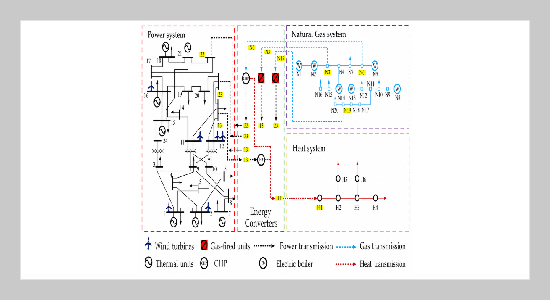
Three scenarios of the recovery process
Copyright The Author(s). This is an open access article distributed under the terms of the Creative Commons Attribution License (CC BY 4.0), which permits unrestricted use, distribution, and reproduction in any medium, provided the original author and source are cited.
Download Citation: BibTeX | http://dx.doi.org/10.6180/jase.202611_34.030
This paper presents an integrated electric-gas energy system fault recovery method based on bidirectional coupled devices. Simulation examples of an IEEE 13-node electric system and a 6-node natural gas system are used to validate the effectiveness of the method. YALMIP is used to model the simulations in the MATLAB environment, while CPLEX is used to solve the optimization issue. Three recovery strategies are compared under the system failure scenarios: independent failure recovery, failure recovery with GFT coupling only, and failure recovery taking into account both GFT and P2G coupling. The power and natural gas systems are bi-directionally coupled through one GFT and one P2G device. The outcomes demonstrate that the recovery strategy that incorporates the consideration of two-way coupled devices can greatly enhance the recovery of natural gas and electricity loads. Scenario 3’ s total recovery is 41,488.12, which is 66.64% and 55.94% of Scenario 1 and Scenario 2’ s respective recoveries. Through a detailed analysis of the changes in network topology and the output of energy conversion equipment during the recovery process, the resilience and effectiveness of the method presented in this study under various fault scenarios are confirmed.
Keywords: integrated electric-gas energy system, fault recovery, two-way coupling, GFT, P2G, supply reliability.
- [1] N. M. Sami and M. Naeini, (2024) “Machine Learning Applications in Cascading Failure Analysis in Power Systems: A Review” Electric Power Systems Research 232: 110415. DOI: 10.1016/j.epsr.2024.110415.
- [2] X. Fu et al., (2023) “Tolerance Analysis of Cyber-Manufacturing Systems to Cascading Failures” ACM Transactions on Internet Technology 23(4): 1–23. DOI: 10.1145/3579847.
- [3] B. Rolf et al., (2023) “A Review on Reinforcement Learning Algorithms and Applications in Supply Chain Management” International Journal of Production Research 61(20): 7151–7179. DOI: 10.1080 / 00207543.2022.2140221.
- [4] L. He et al., (2023) “Research Progress of Microwave Plasma Ignition and Assisted Combustion” Chinese Journal of Aeronautics 36(12): 53–76. DOI: 10.1016/j.cja.2023.04.029.
- [5] J. P. Futalef et al. “An Importance Function to Generate Scenarios for Training a Grey-Box Model for the Computational Risk Assessment of Cyber-Physical Systems”. In: Proceedings of the 33rd European Safety and Reliability Conference (ESREL 2023). 2023, 2130–2137. DOI: 10.3850/978-981-18-8071-1_P684-cd.
- [6] Y. Li et al., (2023) “Dynamic Prediction and Driving Factors of Carbon Emission in Beijing, China, under Carbon Neutrality Targets” Atmosphere 14(5): 798. DOI: 10.3390/atmos14050798.
- [7] S. Ghorbany, S. Yousefi, and E. Noorzai, (2024) “Evaluating and Optimizing Performance of Public–Private Partnership Projects Using Copula Bayesian Network” Engineering, Construction and Architectural Management 31(1): 290–323. DOI: 10.1108 / ECAM-05-2022-0492.
- [8] J. Fang, D. Liu, and K. T. Chi. “Predicting Onset Time of Cascading Failure in Power Systems Using a Neural Network-Based Classifier”. In: Proceedings of the IEEE International Symposium on Circuits and Systems (ISCAS). 2022, 3522–3526. DOI: 10.1109/ISCAS48785.2022.9937800.
- [9] A. Varbella, B. Gjorgiev, and G. Sansavini, (2023) “Geometric Deep Learning for Online Prediction of Cascading Failures in Power Grids” Reliability Engineering & System Safety 237: 109341. DOI: 10.1016/j.ress.2023.109341.
- [10] S. He et al., (2022) “Fast Identification of Vulnerable Set for Cascading Failure Analysis in Power Grid” IEEE Transactions on Industrial Informatics 19(4): 5645–5655. DOI: 10.1109/TII.2022.3202917.
- [11] X. Li, T. Pan, and K. Pan, (2022) “Identification of Key Components after Unintentional Failures for Cascading Failure Protection” IEEE Transactions on Network Science and Engineering 10(2): 1003–1014. DOI: 10.1109/TNSE.2022.3225459.
- [12] R. Feng, (2024) “Multi-Scale Deep Learning-Based University Financial System: Hardware Design and Database Integration” Journal of Combinatorial Mathematics and Combinatorial Computing 120: 337–344. DOI: 10.61091/jcmcc120-30.
- [13] Z. Guo et al., (2023) “A Review on Simulation Models of Cascading Failures in Power Systems” iEnergy 2(4): 284–296. DOI: 10.23919/IEN.2023.0039.
- [14] Y. Liu, T. Wang, and J. Guo, (2022) “Identification of Vulnerable Branches Considering Spatiotemporal Characteristics of Cascading Failure Propagation” Energy Reports 8: 7908–7916. DOI: 10.1016/j.egyr.2022.06.016.
- [15] S. Lonapalawong et al., (2022) “Interpreting the Vulnerability of Power Systems in Cascading Failures Using Multi-Graph Convolutional Networks” Frontiers of Information Technology & Electronic Engineering 23(12): 1848–1861. DOI: 10.1631/FITEE.2200035.