



Wenzhi Zhang1 and Xiangli Lin2
1Lecturer, College of Rehabilitation, Beihai Vocational College of Wellness, Beihai 536000, China
2Associate Professor, Basic Medical Education, Department of Basic Medical Sciences, Beihai Vocational College of Wellness,
Beihai 536000, China
Received: April 22, 2026
Accepted: July 02, 2026
Publication Date: August 09, 2026
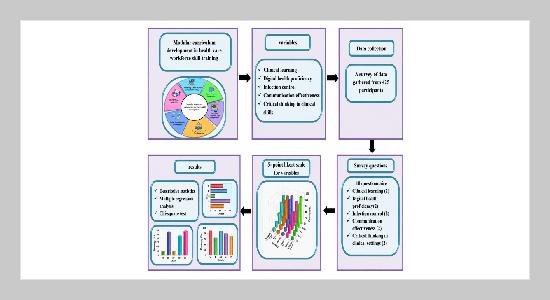
Overall methodology flow of healthcare workforce skill training
Copyright The Author(s). This is an open access article distributed under the terms of the Creative Commons Attribution License (CC BY 4.0), which permits unrestricted use, distribution, and reproduction in any medium, provided the original author and source are cited.
Download Citation: BibTeX | http://dx.doi.org/10.6180/jase.202611_34.028
The increasing complexity of healthcare delivery and rapid technological advancement demand a workforce equipped with adaptable, job-relevant competencies. This study proposes a competency-based mapping model to develop a modular curriculum framework for healthcare education. Core competencies examined include clinical learning, digital health proficiency, infection control, communication effectiveness, and critical thinking. Using a quantitative cross-sectional survey design, data from 425 participants across healthcare institutions and educational providers were analyzed through chi-square tests and regression analysis. Significant gaps (p < 0.01) were identified in digital health, communication, and critical thinking. A modular curriculum with structured competency mapping and visual heatmaps is proposed to enhance workforce alignment and graduate employability.
Keywords: Modular Curriculum, Healthcare Education, Skill Mapping, Industry Requirements, Clinical Skills Training
- [1] J. Longhini, G. Rossettini, and A. Palese, (2024) “Digital health competencies and affecting factors among healthcare professionals: additional findings from a systematic review” Journal of Research in Nursing 29(2): 156–176. DOI: 10.1177/17449871241226899.
- [2] D. H. Rhoney, A. M. Chen, M. D. Churchwell, K. K. Daugherty, J. B. Jarrett, E. L. Kleppinger, and S. M. Meyer, (2024) “The need for competency-based education” American Journal of Pharmaceutical Education 88(6): 100706. DOI: 10.1016/j.ajpe.2024.100706.
- [3] A. Shahiwala, (2025) “Competency-based education in pharmacy-Challenges, opportunities, and the path forward” Currents in Pharmacy Teaching and Learning 17(7): 102358. DOI: 10.1016/j.cptl.2025.102358.
- [4] J. B. Jarrett, A. T. Elmes, E. Keller, C. D. Stowe, and K. K. Daugherty, (2024) “Evaluating the strengths and barriers of competency-based education in the health professions” American Journal of Pharmaceutical Education 88(6): 100709. DOI: 10.1016/j.ajpe.2024.100709.
- [5] L. Coombe, C. A. Severinsen, and P. Robinson, (2022) “Mapping competency frameworks: implications for public health curricula design” Australian and New Zealand Journal of Public Health 46(5): 564–571. DOI: 10.1111/1753-6405.13253.
- [6] J. K. Parmar, T. L’Heureux, S. Anderson, W. Duggleby, C. Pollard, L. Poole, and L. A. R. Sacrey, (2022) “Optimizing the integration of family caregivers in the delivery of person-centered care: evaluation of an educational program for the healthcare workforce” BMC Health Services Research 22(1): 364. DOI: 10.1186/s12913-022-07689-w.
- [7] A. A. Fouad, M. A. Osman, Y. M. M. Abdelmonaem, and N. A. H. A. Karim, (2023) “Awareness, knowledge, attitude, and skills of telemedicine among mental healthcare providers” Middle East Current Psychiatry 30(1): 5. DOI: 10.1186/s43045-022-00272-3.
- [8] E. Jarva, A. Oikarinen, J. Andersson, K. Mikkonen, and M. Kääriäinen, (2024) “Healthcare professionals’ digital health competence profiles and associated factors: A cross-sectional study” Journal of Advanced Nursing 80(8): 3236–3252. DOI: 10.1111/jan.16096.
- [9] M. Al Hemairy, S. Amin, M. Hijji, M. Serhani, and M. Al Ahmad. “Integrated and scalable architecture for providing cost-effective remote health monitoring”. In: Proceedings of the 9th International Conference on Developments in eSystems Engineering (DeSE). IEEE, 2016, 74–77. DOI: 10.1109/DeSE.2016.14.
- [10] S. Ahmed, A. H. Alnaqbi, M. Al Hemairy, and M. Al Ahmad, (2018) “ECG abnormality detection algorithm” International Journal of Advanced Computer Science and Applications 9(8): 215–221. DOI: 10.14569/ijacsa.2018.090827.
- [11] J. Poore, A. Herrington, and L. Hardie, (2022) “Redefining health-care simulation facilitator professional development through online learning” Creative Nursing 28(3): 170–176. DOI: 10.1891/CN-2021-0054.
- [12] J. Majerník, A. Kacmarikova, M. Komenda, A. A. Kononowicz, A. Kocurek, A. Stalmach-Przygoda, and A. Ciureanu, (2022) “Development and implementation of an online platform for curriculum mapping in medical education” Bio-Algorithms and Med-Systems 18(1): 1–11. DOI: 10.1515/bams-2021-0143.
- [13] M. Dwyer, S. J. Prior, P. J. Van Dam, L. O’Brien, and P. Griffin, (2022) “Development and evaluation of a massive open online course on healthcare redesign: a novel method for engaging healthcare workers in quality improvement” Nursing Reports 12(4): 850–860. DOI: 10.3390/nursrep12040082.
- [14] E. J. Conrad and K. C. Hall, (2024) “Leveraging generative AI to elevate curriculum design and pedagogy in public health and health promotion” Pedagogy in Health Promotion 10(3): 178–186. DOI: 10.1177 / 23733799241232641.
- [15] D. Mantaleon, (2023) “The evolving landscape of healthcare: challenges, innovations, and a vision for the future” Health Science Journal 17(8): 1–3. DOI: 10.36648 / 1791809X.17.8.1049.