




Miao Liang1, Wenqi Li1, Jiao Li2, Huijuan Dai2, Yanbin Zhou2, Mengshu Ran1, Guanyun Liu1, and Junsong Zhang1
1College of Tobacco Science and Engineering, Zhengzhou University of Light Industry, Zhengzhou, 450001, P. R. China
2China Tobacco Hebei Industrial Co., Ltd, Shijiazhuang, 050051, P. R. China
Received: May 08, 2026
Accepted: July 13, 2026
Publication Date: August 09, 2026
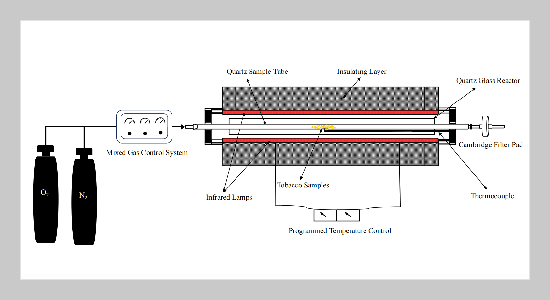
Schematic diagram of programmed heating platform and gas collection system
Copyright The Author(s). This is an open access article distributed under the terms of the Creative Commons Attribution License (CC BY 4.0), which permits unrestricted use, distribution, and reproduction in any medium, provided the original author and source are cited.
Download Citation: BibTeX | http://dx.doi.org/10.6180/jase.202611_34.027
To investigate the differences in thermogravimetric characteristics and heat release behavior of various tobacco leaves, flue-cured, oriental, and Cuibi No. 1 tobaccos were analyzed using thermogravimetric analysis coupled with a programmed heating platform and gas collection system. Partial least squares discriminant analysis (OPLS-DA) was employed to identify key differential substances across heating stages. The thermal weight-loss
process for all samples comprised four stages, with characteristic parameters varying significantly among tobacco types. Oriental tobacco exhibited a higher weight-loss rate at stage II, while Cuibi No. 1 demonstrated a superior comprehensive pyrolysis index of 3.36 × 10⁻⁴ (%/min · ◦C2). Kinetic analysis revealed that the F1.5-order chemical reaction model adequately described the decomposition processes. Activation energy at stage II ranged from 54.30 to 89.20 kJ/mol, with flue-cured tobacco showing significantly higher activation energy at stage III than the other two types. Stage II was identified as the primary phase for aroma product formation, where the total release amount followed the order: flue-cured tobacco (15,278.56 µg/g) > oriental tobacco (14,974.00 µg/g) > Cuibi No. 1 (13,190.34 µg/g), with aroma components accounting for over 84% of the total aroma compounds for each variety. OPLS-DA identified 20, 10, and 5 key differential substances for stages II, III and IV, respectively. These findings provide data support for understanding quality characteristics of tobacco materials and may offer guidance for product formulation design.
Keywords: thermogravimetric characteristics; stepwise heating; tobacco leaf type; heat released products; partial least squares discriminant analysis
- [1] A. Gomez-Siurana, A. Marcilla, M. Beltran, D. Berenguer, I. Martinez-Castellanos, and S. Menargues, (2013) “TGA/FTIR study of tobacco and glycerol-tobacco mixtures” THERMOCHIMICA ACTA 573: 146–157. DOI: 10.1016/j.tca.2013.09.007.
- [2] W. Wu, Y. Mei, L. Zhang, R. Liu, and J. Cai, (2015) “Kinetics and reaction chemistry of pyrolysis and combustion of tobacco waste” FUEL 156: 71–80. DOI: 10.1016/j.fuel.2015.04.016.
- [3] M. Liang, T. Yang, G. Zhang, K. Zhang, L. Wang, R. Li, Y. He, J. Wang, and J. Zhang, (2023) “Effects of hydrochloric acid washing on the structure and pyrolysis characteristics of tobacco stalk” BIOMASS CONVERSION AND BIOREFINERY 13(8): 6817–6830. DOI: 10.1007/s13399-021-01616-5.
- [4] M. Liang, Y. Wang, S. Dai, L. Hong, R. Li, Z. Xu, J. Su, and J. Zhang, (2025) “Effect of glycerol addition and heating rate on the thermal release behavior of cigar tobacco” BIOMASS CONVERSION AND BIOREFINERY 15(4, SI): 6071–6086. DOI: 10.1007/s13399-024-05484-7.
- [5] T. Adam, T. Ferge, S. Mitschke, T. Streibel, R. Baker, and R. Zimmermann, (2005) “Discrimination of three tobacco types (Burley, Virginia and Oriental) by pyrolysis single-photon ionisation-time-of-flight mass spectrometry and advanced statistical methods” ANALYTICAL AND BIOANALYTICAL CHEMISTRY 381(2): 487–499. DOI: 10.1007/s00216-004-2935-0.
- [6] Z. Jiabao, W. Yiqun, L. Miao, Z. Xinchao, W. Dongchuan, and Z. Junsong, (2023) “Low temperature pyrolysis characteristics of heated tobacco raw materials and its correlation with sensory quality” JOURNAL OF LIGHT INDUSTRY 38(3): 94–101. DOI: 10.12187 / 2023.03.012.
- [7] M. Liang, H. Pan, Y. Zhu, H. Zhu, M. Su, Y. Xie, Y. Zheng, X. Jiang, R. Li, and J. Zhang, (2023) “Co-pyrolysis behavior of polylactic acid and biomass from heated tobacco products” BIOMASS CONVERSION AND BIOREFINERY: DOI: 10.1007 / s13399-023-04575-1.
- [8] X. Jiang, J. Wu, L. Zhao, J. Wang, W. Xiao, Z. Chen, J. Jiang, M. Liang, J. Wang, and J. Zhang, (2025) “Study on the Pyrolysis Behaviour of Different Types of Tobacco and Their Pyrolytic Aroma Components Distribution Under Stepwise Heating Conditions” FLAVOUR AND FRAGRANCE JOURNAL 40(3): 512–527. DOI: 10.1002/ffj.3857.
- [9] M. Liang, J. Zhang, B. Li, Q. Fu, Y. Hu, Z. Ren, R. Li, C. Cui, and J. Zhang, (2025) “Comparative Study On The Pyrolysis Characteristics And Gaseous Release Behavior Of Different Reconstituted Tobacco Cut Stem In Processing” JOURNAL OF APPLIED SCIENCE AND ENGINEERING 29(2): 359–368. DOI: 10.6180/jase.202602_29(2).0011.
- [10] K. Aurreethum, V. Sricharoenchaikul, P. R. Kaewpengkrow, and M. Khemkhao, (2026) “Enhancing Pyrolysis Oil From Landfill Waste Plastic With Industrial Waste Catalyst” JOURNAL OF APPLIED SCIENCE AND ENGINEERING 29(4): 1003–1019. DOI: 10.6180/jase.202603_29(4).0023.
- [11] B. Saha, S. Koley, M. Khwairakpam, and A. S. Kalamdhad, (2022) “Comparative study between mono-digestion and co-digestion of terrestrial weed (Parthenium hysterophorus)” CLEANER ENGINEERING AND TECHNOLOGY 11: DOI: 10.1016/j.clet.2022.100560.
- [12] B. Saha, A. S. Kalamdhad, and M. Khwairakpam, (2021) “Efficiency of electrohydrolysis pretreatment on terrestrial weed (Parthenium hysterophorus) to cut down the hydrolysis stage during the anaerobic digestion process and continuous reactor study” ENERGY REPORTS 7: 3547–3555. DOI: 10.1016/j.egyr.2021.06.023.