




Yu Sun, Yadan Liu, Xiaoxia Tao, and Hui Su
Shendong Coal Group Co., Ltd, CHINA ENERGY INVESTMENT, Ordos City Inner Mongolia Autonomous Region, 017209, China
Received: June 07, 2026
Accepted: June 30, 2026
Publication Date: August 09, 2026
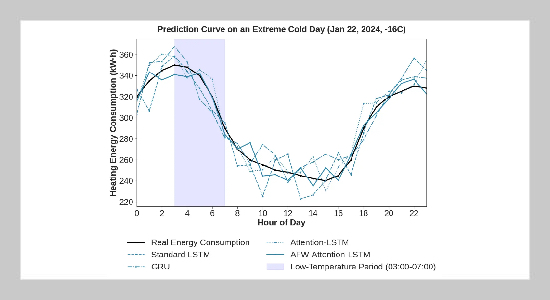
Prediction Curve on an Extreme Cold Day
Copyright The Author(s). This is an open access article distributed under the terms of the Creative Commons Attribution License (CC BY 4.0), which permits unrestricted use, distribution, and reproduction in any medium, provided the original author and source are cited.
Download Citation: BibTeX | http://dx.doi.org/10.6180/jase.202611_34.025
Short-term heating energy consumption prediction is essential for intelligent control and efficient energy allocation in centralized heating systems. To address the limited nonlinear modeling ability of traditional time-series methods, the insufficient long-term dependency learning of conventional machine learning models, and the weak adaptability of existing LSTM-based models to multi-source heterogeneous features, this study proposes an improved AFW-Attention-LSTM model integrating adaptive feature weighting and local attention mechanisms. The model follows a four-stage framework of feature optimization, temporal extraction, key segment enhancement, and prediction output. The adaptive feature weighting module dynamically adjusts the importance of environmental, operational, and building-related features to reduce redundant information interference, while the local attention mechanism emphasizes critical temporal segments such as extreme operating conditions and period transitions. Experiments using 121 days of real operational data from a residential community in a severe cold region show that AFW-Attention-LSTM outperforms standard LSTM, GRU, and Attention-LSTM under both normal and extreme operating conditions. In 1–24 h forecasting tasks, it achieves lower MAE and RMSE, with a maximum prediction accuracy of 96.7% for 1-hour forecasting under normal conditions. The model also demonstrates good training efficiency and prediction stability, providing an effective technical solution for accurate short-term heating energy consumption forecasting and supporting intelligent scheduling and optimized operation of centralized heating systems. However, since the data were collected from a single residential community, further validation across different regions and heating systems is required.
Keywords: Adaptive feature weighting; Local attention mechanism; Multi-source heterogeneous data; Centralized heating system; Energy allocation
- [1] F. Sun, Y. Huo, L. Fu, H. Liu, X. Wang, and Y. Ma, (2023) “Load-forecasting method for IES based on LSTM and dynamic similar days with multi-features” Global Energy Interconnection 6(3): 285–296. DOI: 10.1016/j.gloei.2023.06.003.
- [2] O. Akbarzadeh, S. Hamzehei, H. Attar, A. Amer, N. Fasihihour, M. R. Khosravi, and A. A. Solyman, (2024) “Heating-cooling monitoring and power consumption forecasting using LSTM for energy-efficient smart management of buildings” Tsinghua Science and Technology 29(1): 143–157. DOI: 10.26599 / TST.2023 . 9010008.
- [3] M. Wood, E. Ogliari, A. Nespoli, T. Simpkins, and S. Leva, (2023) “Day ahead electric load forecast: A comprehensive LSTM-EMD methodology and several diverse case studies” Forecasting 5(1): 297–314. DOI: 10.3390/forecast5010016.
- [4] Z. Chen, D. Zhang, H. Jiang, L. Wang, Y. Chen, Y. Xiao, and M. Li, (2021) “Load forecasting based on LSTM neural network and applicable to loads of “replacement of coal with electricity”” Journal of Electrical Engineering & Technology 16(5): 2333–2342. DOI: 10.1007/s42835-021-00768-8.
- [5] R. Batra, S. Arora, M. M. Sharma, S. Rana, K. Raheja, A. Saber, and M. A. Shah, (2024) “Integration of LSTM networks with gradient boosting machines (GBM) for assessing heating and cooling load requirements in building energy efficiency” Energy Exploration & Exploitation 42(6): 2191–2217. DOI: 10.1177/01445987241268075.
- [6] F. A. Ahmad, J. Liu, F. Hashim, and K. Samsudin, (2024) “Short-term load forecasting utilizing a combination model: A brief review” International Journal of Technology 15(1): 121–129. DOI: 10.14716/ijtech.v15i1.5543.
- [7] K. Wu, J. Gu, L. Meng, H. Wen, and J. Ma, (2022) “An explainable framework for load forecasting of a regional integrated energy system based on coupled features and multi-task learning” Protection and Control of Modern Power Systems 7(24): 1–14. DOI: 10.1186/s41601-022-00245-x.
- [8] K. Lan, X. Xin, S. Fang, and P. Cao, (2023) “CNN-LSTM models combined with attention mechanism for short-term building heating load prediction” Journal of Green Building 18(4): 37–56. DOI: 10.3992/jgb.18.4.37.
- [9] O. Rubasinghe, X. Zhang, T. K. Chau, Y. H. Chow, T. Fernando, and H. H. C. Iu, (2023) “A novel sequence to sequence data modelling based CNN-LSTM algorithm for three years ahead monthly peak load forecasting” IEEE Transactions on Power Systems 39(1): 1932–1947. DOI: 10.1109/tpwrs.2023.3271325.
- [10] D. Vasenin, M. Pasetti, D. Astolfi, N. Savvin, A. Vasile, and G. Zizzo, (2025) “LSTM-Based Models for Day-Ahead Electrical Load Forecast: A Novel Feature Selection Method Including Weather Data” Smart Grids and Sustainable Energy 10(2): 1–28. DOI: 10.1007/s40866-025-00281-1.
- [11] C. Wang, Y. Wang, Z. Ding, T. Zheng, J. Hu, and K. Zhang, (2022) “A transformer-based method of multienergy load forecasting in integrated energy system” IEEE Transactions on Smart Grid 13(4): 2703–2714. DOI: 10.1109/TSG.2022.3166600.
- [12] X. Fang, W. Zhang, Y. Guo, J. Wang, M. Wang, and S. Li, (2021) “A novel reinforced deep RNN–LSTM algorithm: Energy management forecasting case study” IEEE Transactions on Industrial Informatics 18(8): 5698–5704. DOI: 10.1109/tii.2021.3136562.
- [13] C. Li, Z. Dong, L. Ding, H. Petersen, Z. Qiu, G. Chen, and D. Prasad, (2022) “Interpretable memristive LSTM network design for probabilistic residential load forecasting” IEEE Transactions on Circuits and Systems I: Regular Papers 69(6): 2297–2310. DOI: 10.1109/tcsi.2022.3155443.
- [14] Z. Xiao, H. Li, H. Jiang, Y. Li, M. Alazab, Y. Zhu, and S. Dustdar, (2023) “Predicting urban region heat via learning arrive-stay-leave behaviors of private cars” IEEE Transactions on Intelligent Transportation Systems 24(10): 10843–10856. DOI: 10.1109/tits.2023.3276704.
- [15] C. Ntakolia, A. Anagnostis, S. Moustakidis, and N. Karcanias, (2022) “Machine learning applied on the district heating and cooling sector: a review” Energy Systems 13(1): 1–30. DOI: 10.1007/s12667-020-00405-9.
- [16] X. Jin, Q. Wu, H. Jia, and N. D. Hatziargyriou, (2021) “Optimal integration of building heating loads in integrated heating/electricity community energy systems: A bi-level MPC approach” IEEE Transactions on Sustainable Energy 12(3): 1741–1754. DOI: 10.1109/tste.2021.3064325.