




Dongsheng Xue, Jiaxing Zhao, Zhengying Yang, Wenwen Wang, Na Wang, and Yingcai Gao
State Grid Shanxi Electric Power Co., Ltd., Yangquan Electric Power Supply Company, Yangquan 045000, Shanxi, China
Received: April 04, 2026
Accepted: May 13, 2026
Publication Date: August 05, 2026
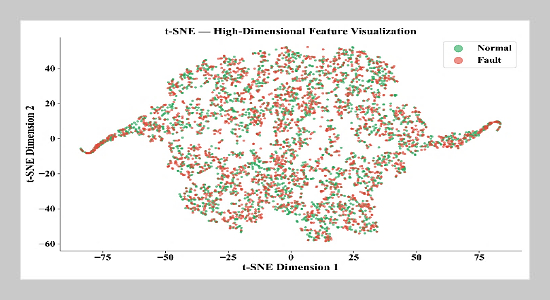
Visualizing Diagnostic Feature Separability
Copyright The Author(s). This is an open access article distributed under the terms of the Creative Commons Attribution License (CC BY 4.0), which permits unrestricted use, distribution, and reproduction in any medium, provided the original author and source are cited.
Download Citation: BibTeX | http://dx.doi.org/10.6180/jase.202611_34.024
The increasing complexity of modern power grids and the integration of advanced monitoring technologies have significantly enhanced real-time system monitoring. Phasor Measurement Units (PMUs) play a vital role by providing accurate measurements of voltage, current, frequency, and rate of change of frequency (ROCOF). However, conventional fault detection methods often struggle to identify diverse transmission line faults due to dynamic grid disturbances and large volumes of time-series data. To address this challenge, this study proposes a deep learning-based framework for accurate fault detection and classification using a PMU dataset derived from the IEEE 39-bus power system. The system considers various fault types, including line-to-ground, line-to-line, double line-to-ground, and three-phase faults. The methodology includes data preprocessing steps such as cleaning, noise filtering, segmentation, and normalization, followed by statistical time-window-based feature extraction. An attention-based Bidirectional Long Short-Term Memory (BiLSTM) model is employed to capture temporal dependencies and identify critical fault patterns. Experimental results demonstrate high performance, achieving accuracy, precision, recall, and F1-score of 98.7%, 97.9%, 98.3%, and 98.1%, respectively.
Keywords: Phasor Measurement Units (PMU); Fault Detection; Deep Learning; BiLSTM; Power System Monitoring
- [1] N. Abdulla, M. Demirci, and S. Ozdemir, (2024) “Smart meter-based energy consumption forecasting for smart cities using adaptive federated learning” Sustainable Energy, Grids and Networks 38: 101342. DOI: 10.1016/j.segan.2024.101342.
- [2] N. Jha, D. Prashar, M. Rashid, et al., (2021) “Electricity load forecasting and feature extraction in smart grid using neural networks” Computers and Electrical Engineering 96: 107479. DOI: 10.1016/j.compeleceng.2021.107479.
- [3] K. M. Lee and C. W. Park, (2024) “High-Precision Analysis Using µPMU Data for Smart Substations” Energies 17(19): 4907. DOI: 10.3390/en17194907.
- [4] A. Adhikari, S. Naetiladdanon, and A. Sangswang, (2022) “Real-time short-term voltage stability assessment using combined temporal convolutional neural network and long short-term memory neural network” Applied Sciences 12(13): 6333. DOI: 10.3390/app12136333.
- [5] N. Bhusal, R. M. Shukla, M. Gautam, et al., (2021) “Deep ensemble learning-based approach to real-time power system state estimation” International Journal of Electrical Power and Energy Systems 129: 106806. DOI: 10.1016/j.ijepes.2021.106806.
- [6] A. A. Almani and X. Han, (2023) “Real-time pricing-enabled demand response using long short-time memory deep learning” Energies 16(5): 2410. DOI: 10.3390/en16052410.
- [7] G. Frigo, Z. Feng, F. G. Toro, et al., (2025) “Hardware-in-the-loop validation of PMU-based metrics for transmission network analysis” International Journal of Electrical Power and Energy Systems 172: 111262. DOI: 10.1016/j.ijepes.2025.111262.
- [8] T. Hou, R. Fang, J. Tang, G. Ge, D. Yang, J. Liu, and W. Zhang, (2021) “A novel short-term residential electric load forecasting method based on adaptive load aggregation and deep learning algorithms” Energies 14(22): 7820. DOI: 10.3390/en14227820.
- [9] N. E. Benti, M. D. Chaka, and A. G. Semie, (2023) “Forecasting renewable energy generation with machine learning and deep learning” Sustainability 15(9): 7087. DOI: 10.3390/su15097087.
- [10] H. Ali, M. H. Alham, and D. K. Ibrahim, (2024) “Big data resolving using Apache Spark for load forecasting and demand response in smart grid” Journal of Big Data 11(1): 59. DOI: 10.1186/s40537-024-00909-6.
- [11] C. Cai, Y. Tao, T. Zhu, and Z. Deng, (2021) “Short-term load forecasting based on deep learning bidirectional LSTM neural network” Applied Sciences 11(17): 8129. DOI: 10.3390/app11178129.
- [12] D. Tomar, P. Tomar, A. Bhardwaj, and G. R. Sinha, (2022) “Deep Learning Neural Network Prediction System Enhanced with Best Window Size in Sliding Window Algorithm for Predicting Domestic Power Consumption in a Residential Building” Computational Intelligence and Neuroscience 2022: 7216959. DOI: 10.1155/2022/7216959.
- [13] Y. Xu, J. Yang, and X. Cai, (2025) “Intelligent analysis algorithm for power engineering data based on improved BiLSTM” Scientific Reports 15(1): 15320. DOI: 10.1038/s41598-025-99409-7.
- [14] Z. Hou, Q. Fu, W. Li, Y. Wang, Z. Dong, X. Ye, and F. Zhang, (2026) “Symmetry-Aware Interpretable Anomaly Alarm Optimization Method for Power Monitoring Systems Based on Hierarchical Attention Deep Reinforcement Learning” Symmetry 18(2): 216. DOI: 10.3390/sym18020216.
- [15] PMU dataset for power line fault detection. 2026.