



Nguyen Thien Tai1,2, Nguyen Thi Mai Phuong1,2, Phan Nhu Nguyet1,2, Nguyen Ai Le1,2, Nguyen Thi Ngoc Nhu1,2, and Ta Huynh Nhi1,2
1Faculty of Environment, University of Science (HCMUS), Ho Chi Minh City, 700000, Vietnam
2Vietnam National University, Ho Chi Minh City (VNU-HCM), Ho Chi Minh City, 700000, Vietnam
Received: February 24, 2026
Accepted: July 22, 2026
Publication Date: August 05, 2026
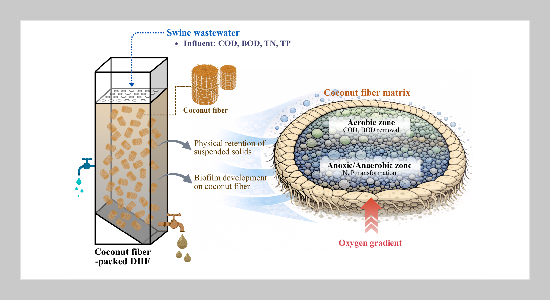
Graphical Abtract
Copyright The Author(s). This is an open access article distributed under the terms of the Creative Commons Attribution License (CC BY 4.0), which permits unrestricted use, distribution, and reproduction in any medium, provided the original author and source are cited.
Download Citation: BibTeX | http://dx.doi.org/10.6180/jase.202611_34.023
Swine farming generates large volumes of wastewater requiring treatment before discharge. In small-scale Vietnamese farms, barn flushing dilutes biogas digester effluents, producing lower-strength wastewater that still exceeds discharge standards. This study evaluated a down-flow hanging filter (DHF) reactor packed with coconut fiber for the treatment of such lower-strength swine wastewater (chemical oxygen demand (COD): 741.90±25.98 mg/L; biochemical oxygen demand (BOD5): 127.93±4.01 mg/L; total nitrogen (TN): 44.67±2.92 mg N/L; total phosphorus (TP): 35.77±2.21 mg P/L). Two parallel reactors were operated: a coconut fiber packed reactor (DHF1) and an unpacked control (DHF0). During stable operation (days 15-44), DHF1 achieved removal efficiencies of 77.05±10.03% for COD, 79.30±7.06% for BOD5, 56.05±8.38% for TN, and 63.82±7.44% for TP, significantly higher than those of DHF0 (54.45±7.11%, 39.83±13.16%, 35.07±7.76%, and 35.53±8.53%, respectively). The improved treatment performance of DHF1 was associated with enhanced biomass retention within the coconut fiber matrix. First-order kinetic analysis further confirmed that coconut fiber packing enhanced apparent first-order rate constants (k) by 1.9-3.1-fold across all parameters compared to the unpacked control, providing concentration-independent evidence of enhanced reactor performance applicable to system design and scale-up. These results indicate that coconut fiber is a sustainable and biodegradable alternative for decentralized post-treatment of lower-strength swine wastewater from small-scale farms with diluted effluents.
Keywords: Down-flow hanging filter; Coconut fiber; Lower-strength wastewater; Small-scale farms; Organic matter removal; Nutrient removal
- [1] R. Rajagopal, P. Rousseau, N. Bernet, and F. Béline, (2011) “Combined anaerobic and activated sludge anoxic/oxic treatment for piggery wastewater” Bioresource Technology 102(3): 2185–2192. DOI: 10.1016/j.biortech.2010.09.112.
- [2] C. Bailey, A. Spielmeyer, G. Hamscher, H. Schüttrumpf, and R. M. Frings, (2016) “The veterinary antibiotic journey: comparing the behaviour of sulfadiazine, sulfamethazine, sulfamethoxazole and tetracycline in cow excrement and two soils” Journal of Soils and Sediments 16(6): 1690–1704. DOI: 10.1007/s11368-016-1370-0.
- [3] L. Huong and L. Duy, (2023) “Environmental Efficiency of Pig Production in Chuong My District, Hanoi” Vietnam Journal of Agricultural Sciences 6(4): 1992–2003. DOI: 10.31817/vjas.2023.6.4.09.
- [4] N. H. Dan, E. R. Rene, and T. Le Luu, (2020) “Removal of Nutrients from Anaerobically Digested Swine Wastewater Using an Intermittent Cycle Extended Aeration System” Frontiers in Microbiology 11: 576438. DOI: 10.3389/fmicb.2020.576438.
- [5] N. Chen, X. Zhang, Q. Du, J. Huo, H. Wang, Z. Wang, W. Guo, and H. H. Ngo, (2023) “Advancements in swine wastewater treatment: Removal mechanisms, influential factors, and optimization strategies” Journal of Water Process Engineering 54: 103986. DOI: 10.1016/j.jwpe.2023.103986.
- [6] T. Okubo, K. Kubota, T. Yamaguchi, S. Uemura, and H. Harada (2016) evaluate a non-aeration sewage treatment technology using third-generation sponge carriers in Water Research, 102, 138–146. DOI: 10.1016/j.watres.2016.06.035.
- [7] M. Hatamoto, T. Okubo, K. Kubota, and T. Yamaguchi (2018) characterize downflow hanging sponge reactors regarding structure, function, and microbial composition in Applied Microbiology and Biotechnology, 102(24), 10345–10352. DOI: 10.1007/s00253-018-9406-6.
- [8] H. V. Dang and L. M. Nguyen (2025) combine hybrid constructed wetlands with an alum-based slow sand filter for swine wastewater treatment in Sustainable Water Resources Management, 11(5), 100. DOI: 10.1007/s40899-025-01270-z.
- [9] N. N. Phan, Y. H. Duong, K. T. Tran, H. M. Bui, and T. T. Ngo (2024) evaluate optimum conditions for an anaerobic down-flow stationary fixed film reactor for swine wastewater treatment in IOP Conference Series: Earth and Environmental Science, 1349, 012017. DOI: 10.1088/1755-1315/1349/1/012017.
- [10] P. Vydehi, G. Shyamala, G. Ravindran, and R. Gokulan (2026) review biocarrier-driven enhancement of microbial reactor performance in wastewater treatment in Bioprocess and Biosystems Engineering, 49, 473–488. DOI: 10.1007/s00449-025-03258-7.
- [11] H. Wu, Y. Huo, F. Qi, Y. Zhang, R. Li, and M. Qiao (2025) discuss biochar-supported microbial systems for persistent organic pollutant remediation in Biochar, 7, 113. DOI: 10.1007/s42773-025-00506-7.
- [12] T. Watari, C. L. Vazquez, M. Hatamoto, T. Yamaguchi, and J. B. van Lier (2021) report on a single-stage mainstream anammox process using a sponge-bed trickling filter in Environmental Technology, 42(19), 3036–3047. DOI: 10.1080/09593330.2020.1720309.
- [13] T. Watari, T. C. Mai, D. Tanikawa, Y. Hirakata, M. Hatamoto, K. Syutsubo, M. Fukuda, N. B. Nguyen, and T. Yamaguchi (2017) cover the DHS reactor as post-treatment for natural rubber processing wastewater in Water Science and Technology, 75(1), 57–68. DOI: 10.2166/wst.2016.487.
- [14] Y. Miyaoka, W. Yoochatchaval, H. Sumino, P. Banjongproo, T. Yamaguchi, T. Onodera, T. Okadera, and K. Syutsubo (2017) evaluate DHS reactor performance for domestic wastewater in Bangkok in Journal of Environmental Science and Health, Part A, 52(10), 956–970. DOI: 10.1080/10934529.2017.1324708.
- [15] P. N. Nguyet, T. Watari, Y. Hirakata, M. Hatamoto, and T. Yamaguchi (2019) investigate methylene blue removal using natural adsorbents in down-flow hanging filter reactors in Environmental Technology, 42(3), 410–418. DOI: 10.1080/09593330.2019.1629636.
- [16] Y. Zharkenov, T. Mkilima, A. Abduova, L. Zhaksylykova, A. Turashev, R. Imambayeva, N. Imambaev, M. Jaxymbetova, A. Smagulova, and E. Beysenbaeva (2024) utilize biofilm-enhanced coconut coir for microplastic removal in Case Studies in Chemical and Environmental Engineering, 9, 100726. DOI: 10.1016/j.cscee.2024.100726.
- [17] Z. Z. Loh, A. Syafiuddin, N. S. Zaidi, E. L. Yong, M. B. Bahrodin, A. Aris, and R. Boopathy (2025) study accelerated start-up using plant-based waste biofilter media for domestic wastewater treatment in ACS ES&T Water, 5(7), 3929–3938. DOI: 10.1021/acsestwater.5c00230.
- [18] APHA, AWWA, and WEF (2012) published Standard Methods for the Examination of Water and Wastewater (22nd ed.), Washington, DC.
- [19] H. Abyar, H. Younesi, N. Bahramifar, A. A. Zinatizadeh, and M. Amini (2017) perform kinetic evaluation and process analysis of COD and nitrogen removal in a UAASB bioreactor in Journal of the Taiwan Institute of Chemical Engineers, 78, 272–281. DOI: 10.1016/j.jtice.2017.06.014.
- [20] M. Ng, S. Dalhatou, J. Wilson, B. P. Kamdem, M. B. Temitope, H. K. Paumo, H. Djelal, A. A. Assadi, P. Nguyen-Tri, and A. Kane (2022) review slaughterhouse wastewater characterization and treatment techniques in Processes, 10(7), 1300. DOI: 10.3390/pr10071300.
- [21] A. Singh, Y. Soga, V. K. Tyagi, R. Singh, K. Chhoden, T. Watari, T. Okubo, C. S. P. Ojha, A. A. Kazmi, and S. K. Chauhan, (2025) “Unlocking the potential of down-flow hanging sponge reactors for integrated nutrient management” Journal of Environmental Chemical Engineering 13(5): 117591. DOI: 10.1016/j.jece.2025.117591.
- [22] M. Z.-U. Zaman, N. Anjum, S. Dey, and H. M. Zakir, (2023) “An Investigation of the Effectiveness of Recycled Coconut Fiber and Rice Husk as Filter Media for Wastewater Treatment” Journal of Global Ecology and Environment 17(3): 30–39. DOI: 10.56557/jogee/2023/v17i38189.
- [23] J. Liao, C. Fang, J. Yu, A. Sathyagal, E. Willman, and W.-T. Liu, (2017) “Direct treatment of high-strength soft drink wastewater using a down-flow hanging sponge reactor: performance and microbial community dynamics” Applied Microbiology and Biotechnology 101(14): 5925–5936. DOI: 10.1007/s00253-017-8326-1.
- [24] T. Watari, Y. Hata, Y. Hirakata, N. N. Phan, T. H. Nguyen, S. Maki, M. Hatamoto, D. Sutani, T. Setia, and T. Yamaguchi, (2021) “Performance evaluation of down-flow hanging sponge reactor for direct treatment of actual textile wastewater; Effect of effluent recirculation to performance and microbial community” Journal of Water Process Engineering 39: 101724. DOI: 10.1016/j.jwpe.2020.101724.
- [25] N. Sato, T. Saito, H. Satoh, N. Tanaka, and K. Kawamoto, (2017) “Coconut-fibre biofilm wastewater treatment system in Sri Lanka: Microcosm experiments for evaluating wastewater treatment efficiencies and oxygen consumption” International Journal of Environmental Science and Development 8(10): 691–695. DOI: 10.18178/ijesd.2017.8.10.1040.
- [26] J. A. De Silva, A. K. Karunaratne, and V. A. Sumanasinghe, (2019) “Wastewater treatment using attached growth microbial biofilms on coconut fiber: A short review” Journal of Agriculture and Value Addition 2(1): 61–70. DOI: 10.4038/java.v2i1.110.
- [27] A. Tawfik, R. A. Wahab, A. Al-Asmer, and F. Matary, (2011) “Effect of hydraulic retention time on the performance of down-flow hanging sponge system treating grey wastewater” Bioprocess and Biosystems Engineering 34(6): 767–776. DOI: 10.1007/s00449-011-0528-9.
- [28] L. Wu, W. Wei, J. Xu, X. Chen, Y. Liu, L. Peng, D. Wang, and B.-J. Ni, (2021) “Denitrifying biofilm processes for wastewater treatment: Developments and perspectives” Environmental Science: Water Research & Technology 7(1): 40–67. DOI: 10.1039/D0EW00576B.
- [29] H. L. Ngo, N. N. Phan, T. T. Ngo, L. D. K. Tran, X.-T. Bui, H.-V. Nguyen, V.-T. Tra, M. Hatamoto, T. Watari, and T. Yamaguchi, (2026) “Enhanced nitrogen removal in sponge membrane bioreactor coupled with iron scraps for municipal wastewater treatment: Performance and microbial community shifts” Case Studies in Chemical and Environmental Engineering 13: 101318. DOI: 10.1016/j.cscee.2025.101318.
- [30] T. Onodera, T. Okubo, S. Uemura, T. Yamaguchi, A. Ohashi, and H. Harada, (2016) “Long-term performance evaluation of down-flow hanging sponge reactor regarding nitrification in a full-scale experiment in India” Bioresource Technology 204: 177–184. DOI: 10.1016/j.biortech.2016.01.005.
- [31] D. Tanikawa, S. Yamashita, T. Kataoka, H. Sonaka, Y. Hirakata, M. Hatamoto, and T. Yamaguchi, (2019) “Non-aerated single-stage nitrogen removal using a down-flow hanging sponge reactor as post-treatment for nitrogen-rich wastewater treatment” Chemosphere 233: 645–651. DOI: 10.1016/j.chemosphere.2019.06.012.
- [32] Y. Jia, M. Zhou, Y. Chen, Y. Hu, and J. Luo, (2020) “Insight into short-cut of simultaneous nitrification and denitrification process in moving bed biofilm reactor: Effects of carbon to nitrogen ratio” Chemical Engineering Journal 400: 125905. DOI: 10.1016/j.cej.2020.125905.
- [33] A. Alvarado, S. West, G. Abbt-Braun, and H. Horn, (2021) “Hydrolysis of particulate organic matter from municipal wastewater under aerobic treatment” Chemosphere 263: 128329. DOI: 10.1016/j.chemosphere.2020.128329.
- [34] L. Shi, X. Li, Q. Zhang, and Y. Peng, (2021) “Effectively stimulating partial denitrification to utilize dissolved slowly-biodegradable organic matter by introducing in-situ biosorption and hydrolytic acidification” Bioresource Technology 333: 125175. DOI: 10.1016/j.biortech.2021.125175.
- [35] X. Xin, S. Liu, J. Qin, Z. Ye, W. Liu, S. Fang, and J. Yang, (2021) “Performances of simultaneous enhanced removal of nitrogen and phosphorus via biological aerated filter with biochar as fillers under low dissolved oxygen for digested swine wastewater treatment” Bioprocess and Biosystems Engineering 44(8): 1741–1753. DOI: 10.1007/s00449-021-02557-z.
- [36] Y. Yang, Y. Zhu, D. Gan, X. Cai, X. Li, X. Liu, and S. Xia, (2024) “Enhancing biofilm formation with powder carriers for efficient nitrogen and phosphorus removal” Science of The Total Environment 951: 175812. DOI: 10.1016/j.scitotenv.2024.175812.
- [37] Z. Bi, Y. Liu, W. C. Rutoh, and Y. Huang, (2024) “Influence of operation sequences on phosphorus recovery by polyphosphate-accumulating organisms biofilm: Performance, kinetics and metabolic response” Journal of Water Process Engineering 61: 105356. DOI: 10.1016/j.jwpe.2024.105356.
- [38] R. Sandeep, J. F. Muscolino, W. V. Macêdo, M. Piculell, M. Christensson, J. S. Poulsen, J. L. Nielsen, and L. Vergeynst, (2023) “Effect of biofilm thickness on the activity and community composition of phosphorus accumulating bacteria in a moving bed biofilm reactor” Water Research 245: 120599. DOI: 10.1016/j.watres.2023.120599.
- [39] X.-Y. Long, W. Dai, R. Tang, H.-W. Zhou, M. Xue, and T. Zhong, (2025) “Influence of solid residence time on the phosphorus adsorption of extracellular polymer substances” Environmental Engineering Research 30(2): 240394. DOI: 10.4491/eer.2024.394.
- [40] H. Zhang, S.-S. Zhang, L. Zhu, Y.-P. Li, and L. Chen, (2022) “Phosphorus recovery in the alternating aerobic/anaerobic biofilm system: Performance and mechanism” Science of The Total Environment 810: 152297. DOI: 10.1016/j.scitotenv.2021.152297.
- [41] H. Zhang, S.-S. Zhang, W. Zhang, W.-C. Ma, Y. Pan, L. Chen, L. Zhu, Y.-P. Li, and J.-R. Li, (2023) “Clarification of the phosphorus release mechanism for recovering phosphorus from biofilm sludge in alternating aerobic/anaerobic biofilm system” Science of The Total Environment 904: 166811. DOI: 10.1016/j.scitotenv.2023.166811.
- [42] H. Zhang, Z. Bi, Y. Pan, Y. Huang, D.-P. Li, and J. Shan, (2020) “Enhanced phosphorus storage in suspended biofilm by increasing dissolved oxygen” Science of The Total Environment 722: 137876. DOI: 10.1016/j.scitotenv.2020.137876.
- [43] A. B. Fanta, A. M. Nair, S. Sægrov, and S. W. Østerhus, (2021) “Phosphorus removal from industrial discharge impacted municipal wastewater using sequencing batch moving bed biofilm reactor” Journal of Water Process Engineering 41: 102034. DOI: 10.1016/j.jwpe.2021.102034.
- [44] C. Chao, Y. Zhao, J. Keskar, M. Ji, Z. Wang, and X. Li, (2020) “Simultaneous removal of COD, nitrogen and phosphorus and the tridimensional microbial response in a sequencing batch biofilm reactor: With varying C/N/P ratios” Biochemical Engineering Journal 154: 107215. DOI: 10.1016/j.bej.2019.04.017.
- [45] A. Tsitouras, N. Al-Ghussain, and R. Delatolla, (2021) “Two moving bed biofilm reactors in series for carbon, nitrogen, and phosphorous removal from high organic wastewaters” Journal of Water Process Engineering 41: 102088. DOI: 10.1016/j.jwpe.2021.102088.
- [46] Y. Wang, T. Tang, J. Wu, S. Yang, X. Zhao, R. Zhu, Z. Zhao, M. He, and X. Huangfu, (2024) “Succession of nitrogen and phosphorus removal functions of sludge and biofilm in low-temperature sewage treatment” Journal of Water Process Engineering 58: 104836. DOI: 10.1016/j.jwpe.2024.104836.
- [47] R. H. Kadlec and S. D. Wallace. Treatment Wetlands. 2nd. CRC Press, 2009. DOI: 10.1201/9781420012514.
- [48] D. Ventura, R. Rapisarda, L. Sciuto, M. Milani, S. Consoli, G. L. Cirelli, and F. Licciardello, (2022) “Application of first-order kinetic removal models on constructed wetlands under Mediterranean climatic conditions” Ecological Engineering 175: 106500. DOI: 10.1016/j.ecoleng.2021.106500.