


College of Economics and Manageme, Ya’an Polytechnic College, No. 659, Xuedao Street, Ya’an Economic and Technological Development Zone, Sichuan, China, Postal Code: 625100
Received: May 08, 2026
Accepted: July 15, 2026
Publication Date: August 05, 2026
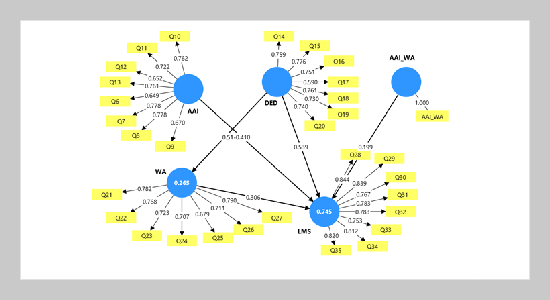
SEM Path Diagram
Copyright The Author(s). This is an open access article distributed under the terms of the Creative Commons Attribution License (CC BY 4.0), which permits unrestricted use, distribution, and reproduction in any medium, provided the original author and source are cited.
Download Citation: BibTeX | http://dx.doi.org/10.6180/jase.202611_34.020
Focused on the fast-evolving Artificial Intelligence (AI)-driven automation and digital economy technologies, the research identifies a literature gap, as it ignores the provincial nature of Sichuan, particularly the issues of job displacement, skills imbalances, and inequality. A region-specific model was developed and tested using data from 500 respondents through Partial Least Squares Structural Equation Modeling (PLS-SEM). The growing role of Artificial Intelligence-driven Predictive technologies, where intelligent maintenance systems enhance operational efficiency while simultaneously influencing Workforce Adaptability and Labour Market Stability within the context of the Digital Economy. Results show that AAI negatively influences LMS (β = −0.41, p < 0.001), while DED positively influences LMS (β = 0.696, p < 0.001). DED also positively affects WA (β = 0.515, p < 0.001), which further contributes to LMS. The model demonstrates strong reliability and validity, with satisfactory Cronbach’s alpha, AVE, HTMT, and SRMR values.
Keywords: Artificial Intelligence Automation Intensity, Digital Economy Development, Labour Market Stability, Workforce Adaptability, Partial Least Squares Structural Equation Modeling.
- [1] Y. Zhao and R. Said, (2023) “The Effect of the Digital Economy on the Employment Structure in China” Economies 11(9): 227. DOI: 10.3390/economies11090227.
- [2] W. Zhang and F. Meng, (2023) “Digital Economy and Intelligent Manufacturing Coupling Coordination: Evidence from China” Systems 11(10): 521. DOI: 10.3390/systems11100521.
- [3] M. Faishal, S. Mathew, K. Neikha, K. Pusa, and T. Zhimomi, (2023) “The Future of Work: AI, Automation, and the Changing Dynamics of Developed Economies” World Journal of Advanced Research and Reviews 18(3): 620–629. DOI: 10.30574/wjarr.2023.18.3.1086.
- [4] C. Qiao and S. Chen, (2025) “The Impact of Digital Transformation on the Employment Structure in Middle-Income Countries” Cogent Economics & Finance 13(1): 2571864. DOI: 10.1080/23322039.2025.2571864.
- [5] Z. Wang, S. Lin, Y. Chen, O. Lyulyov, and T. Pimonenko, (2024) “The Digital Economy and Real Economy: The Dynamic Interaction Effect and the Coupling Coordination Degree” Sustainability 16(13): 5769. DOI: 10.3390/su16135769.
- [6] B. M. Szeszák, I. G. Kerékjártó, L. Soltész, and P. Galambos, (2025) “Industrial Revolutions and Automation: Tracing Economic and Social Transformations of Manufacturing” Societies 15(4): 88. DOI: 10.3390/soc15040088.
- [7] H. Jalonen, (2025) “A Complexity Theory Perspective on Politico-Administrative Systems: Insights from a Systematic Literature Review” International Public Management Journal 28(1): 1–21. DOI: 10.1080/10967494.2024.2333382.
- [8] K. Huang, S. Liu, and D. Xu, (2025) “Can the Return of Rural Labor Effectively Stimulate the Demand for Land? Empirical Evidence from Sichuan Province, China” Agriculture 15(6): 575. DOI: 10.3390/agriculture15060575.
- [9] S. Du and J. Yang, (2025) “The Role of New-Quality Productivity in the Sustainable Development of the Economic–Social–Environmental System: Evidence from 67 Ethnic Counties in Sichuan Province” Sustainability 17(21): 9609. DOI: 10.3390/su17219609.
- [10] K. Wu, Z. Tang, and L. Zhang, (2025) “A Study on the Impact of Industrial Robot Applications on Labor Resource Allocation” Systems 13(7): 569. DOI: 10.3390/systems13070569.
- [11] Z. Ma, Y. Bai, and L. Zhang, (2024) “Sustainable Development of the Rural Labor Market in China from the Perspective of Occupation Structure Transformation” Sustainability 16(7): 2938. DOI: 10.3390/su16072938.
- [12] T. Liu, D. Xue, Y. Fang, and K. Zhang, (2023) “The Impact of Differentiated Development of the Digital Economy on Employment Quality—An Empirical Analysis Based on Provincial Data from China” Sustainability 15(19): 14176. DOI: 10.3390/su151914176.
- [13] J. Du, C. Zhao, Y. Hu, and X. Chen, (2024) “Impact of Industrial Robots on Labor Income Share: Empirical Evidence from Chinese A-Listed Companies” Sustainability 16(16): 6928. DOI: 10.3390/su16166928.
- [14] H. Lu, Q. Zhang, Q. Cui, Y. Luo, P. Pishdad-Bozorgi, and X. Hu, (2021) “How Can Information Technology Use Improve Construction Labor Productivity? An Empirical Analysis from China” Sustainability 13(10): 5401. DOI: 10.3390/su13105401.
- [15] L. Liang, K. Qin, S. Jiang, X. Wang, and Y. Shi, (2021) “Impact of Epidemic-Affected Labor Shortage on Food Safety: A Chinese Scenario Analysis Using the CGE Model” Foods 10(11): 2679. DOI: 10.3390/foods10112679.