




Zhuoxi chen1 and Baitong Zhong2
1Hunan Vocational College of Electronic Technology, School of Humanities and Education , changsha Hunan province, China,
410000
2College of Information Engineering, Hunan Mechanical & Electrical Polytechnic, Hunan Province, China, 410000
Received: April 18, 2026
Accepted: June 16, 2026
Publication Date: August 05, 2026
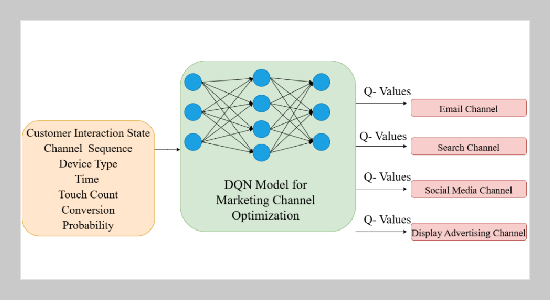
DQN Architecture for Omni-Channel Marketing Decision Making
Copyright The Author(s). This is an open access article distributed under the terms of the Creative Commons Attribution License (CC BY 4.0), which permits unrestricted use, distribution, and reproduction in any medium, provided the original author and source are cited.
Download Citation: BibTeX | http://dx.doi.org/10.6180/jase.202611_34.016
The rapid expansion of digital platforms together with the intricate nature of customer engagement across multiple channels which include email and social media and search engines and display advertising have made it more difficult to optimize omni-channel marketing campaigns. Traditional methods operated with fixed models which could not track ongoing user behavior and their changing choices rendering those methods ineffective. The research presented a new hybrid framework which combined Long Short-Term Memory (LSTM) and Deep Q-Network (DQN) based Reinforcement Learning framework to increase campaign success while delivering better return on investment. The model applied the Marketing Attribution Path Dataset to employ an LSTM in learning customer interaction patterns. The DQN framework used the predictions to train its agent to develop marketing channel selection policies which used conversion rate and click-through rate and revenue as their reward system. Additionally, the proposed framework effectively integrates sequential prediction with adaptive decision optimization, improving performance in dynamic marketing environments. The results showed that the proposed model achieved better results because it achieved an accuracy of 0.9745 and a precision of 0.9697 and a recall of 0.9796 and an F1-score of 0.9746 which exceeded the performance of existing methods. The reinforcement learning agent demonstrated its learning capacity by successfully identifying the channels that produced optimal performance. The study showed that the LSTM-DQN framework which researchers developed as their solution for intelligent omni-channel marketing optimization achieved both scalable and adaptive capabilities while delivering major improvements in customer engagement and campaign efficiency.
Keywords: Omni-channel marketing, LSTM, Deep Q-Network, Reinforcement learning, Campaign optimization, Customer journey modeling.
- [1] M. Kramarz and M. Kmiecik, (2024) “The role of the logistics operator in the network coordination of omni-channels” Applied Sciences 14(12): 5206. DOI: 10.3390/app14125206.
- [2] I. D. Nagy, D.-C. Dabija, R. E. Cramarenco, and M. I. Burcă-Voicu, (2024) “The use of digital channels in omni-channel retail—An empirical study” Journal of Theoretical and Applied Electronic Commerce Research 19(2): 797–817. DOI: 10.3390/jtaer19020042.
- [3] Z. He, L. Chen, and B. Liu, (2024) “Application of integrating reinforcement learning and intelligent scheduling in logistics distribution” Intelligent Decision Technologies 18(1): 57–74. DOI: 10.3233/IDT-230528.
- [4] Y. Wan, Z. Yan, and S. Wang, (2025) “Pricing and return strategies in omni-channel apparel retail considering the impact of fashion level” Mathematics 13(5): 890. DOI: 10.3390/math13050890.
- [5] T. A. Rainy, (2025) “AI-driven marketing analytics for retail strategy: A systematic review of data-backed campaign optimization” International Journal of Scientific Interdisciplinary Research 6(1): 28–59. DOI: 10.63125/0k4k5585.
- [6] J. Pan, C.-J. Lu, W.-J. Chen, K.-S. Wu, and C.-T. Yang, (2024) “A study on the production-inventory problem with omni-channel and advance sales based on the brand owner’s perspective” Mathematics 12(19): 3122. DOI: 10.3390/math12193122.
- [7] S. Mou, (2022) “Integrated order picking and multi-skilled picker scheduling in omni-channel retail stores” Mathematics 10(9): 1484. DOI: 10.3390/math10091484.
- [8] Y. Xie, H.-Q. Ye, and W. Zhu, (2025) “Prediction and optimization for multi-product marketing resource allocation in cross-border e-commerce” Journal of Theoretical and Applied Electronic Commerce Research 20(2): 124. DOI: 10.3390/jtaer20020124.
- [9] C. Ziakis and M. Vlachopoulou, (2023) “Artificial intelligence in digital marketing: Insights from a comprehensive review” Information 14(12): 664. DOI: 10.3390/info14120664.
- [10] J. Jeong, D. Hong, and S. Youm, (2022) “Optimization of the decision-making system for advertising strategies of small enterprises—Focusing on company A” Systems 10(4): 116. DOI: 10.3390/systems10040116.
- [11] Y. Zhang, (2025) “A method to manage the energy consumption of cloud centers for predictability in neuro-fuzzy networks” Journal of Engineering and Applied Science 72(1): 85. DOI: 10.1186/s44147-025-00646-4.
- [12] GoMask.ai. Marketing Attribution Path Dataset (Synthetic Dataset). Retrieved March 31, 2026. 2026.
- [13] S. Roosta, S. J. Sadjadi, and A. Makui, (2025) “Dynamic pricing modeling and inventory management in omnichannel retail using Quantum Decision Theory and reinforcement learning” PLOS ONE 20(10): e0333068. DOI: 10.1371/journal.pone.0333068.
- [14] S. Huang and Y. Yang, (2025) “Reinforcement learning optimization strategies for dynamic pricing and inventory control in e-commerce retail” International Journal of Housing Science and Its Applications 46(4): 29–44. DOI: 10.70517/ijhsa46403.