




Meng Cai1, Yi Ren2, and Feng Liu2
1Pipe China West Pipeline Co., Ltd., Xinjiang, 830000, China
2Pipe China Digital Co., Ltd., Beijing, 102200, China
Received: April 18, 2026
Accepted: June 26, 2026
Publication Date: August 05, 2026
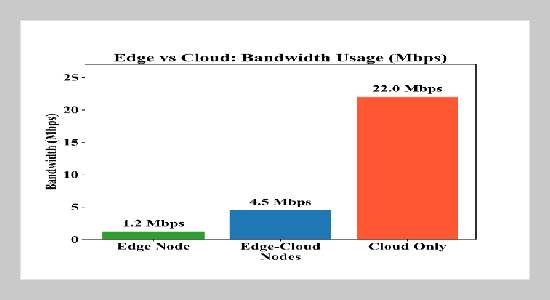
Bandwidth Usage Comparison in Edge-Cloud Pipeline Monitoring
Copyright The Author(s). This is an open access article distributed under the terms of the Creative Commons Attribution License (CC BY 4.0), which permits unrestricted use, distribution, and reproduction in any medium, provided the original author and source are cited.
Download Citation: BibTeX | http://dx.doi.org/10.6180/jase.202611_34.014
Natural gas pipelines generate large volumes of acoustic time-series data, leading to challenges in bandwidth usage, storage requirements, and accurate fault detection. Traditional cloud-based anomaly detection methods are often inefficient due to limited compression capability, making them unsuitable for large-scale distributed monitoring environments. To address these issues, this study proposes an intelligent edge-cloud collaborative framework that integrates efficient data compression with early fault detection mechanisms. The system begins with data acquisition using the Natural Gas Pipeline Safety Monitoring Dataset. The preprocessing stage includes noise filtering, normalization, and statistical-frequency feature extraction to capture signal energy, frequency band characteristics, and correlation peaks. At the edge layer, compressed data is analyzed using a hybrid model combining Robust Random Cut Forest (RRCF) and Isolation Forest for real-time anomaly detection and fault alert generation. The cloud layer employs Long Short Term Memory (LSTM) networks for time-series prediction, missing data reconstruction, and long term fault forecasting. The proposed framework achieved a compression ratio of 5:1, reducing storage and transmission requirements while preserving critical acoustic information. For anomaly detection, the model achieved high accuracy and F1-score, demonstrating reliable fault identification. Prediction performance was evaluated using Mean Absolute Error (MAE) and Root Mean Squared Error (RMSE), which measure forecasting error between predicted and actual pipeline conditions. Experimental results confirm strong performance, scalability, and suitability for industrial IoT applications.
Keywords: Edge-Cloud Collaborative Architecture, Natural Gas Pipeline Monitoring, Time Series Data Compression, Hybrid Anomaly Detection, Long Short-Term Memory, Fault Early Warning Systems
- [1] L.Giglietal., (2024) “Next Generation Edge-Cloud Continuum Architecture for Structural Health Monitoring” IEEE Transactions on Industrial Informatics20(4): 5874–5887.DOI:10.1109/TII.2023.3337391.
- [2] F. Saghir, M. E. Gonzalez Perdomo, and P. Behrenbruch, (2023) “Performance Analysis of Artificial Lift Systems Deployed in Natural Gas Wells: A Time-Series Analytics Approach” Geoenergy Science and Engineering 230: 212238. DOI: 10.1016/j.geoen.2023.212238.
- [3] R. Kumar, P. Kumar, and Y. Kumar. “Time Series Data Prediction Using IoT and Machine Learning Technique”. In: Procedia Computer Science. 167. 2020, 373–381. DOI: 10.1016/j.procs.2020.03.240.
- [4] F. Shi, L. Yan, X. Zhao, and R. X. Gao, (2022) “Machine Learning-Based Time-Series Data Analysis in Edge-Cloud-Assisted Oil Industrial IoT System” Mobile Information Systems 2022(1): 5988164. DOI: 10.1155/2022/5988164.
- [5] S. Zhang et al., (2025) “Bridging Edge and Cloud: A Knowledge-Enhanced Framework for Efficient Time Series Anomaly Detection” IEEE Transactions on Services Computing 18(6): 3538–3551. DOI: 10.1109/TSC.2025.3610402.
- [6] F. Zhao, S. Zhang, H. Zhao, L. Yu, Q. Feng, and J. He, (2022) “An Intelligent Optical Fiber-Based Prewarning System for Oil and Gas Pipelines” Optical Fiber Technology 71: 102953. DOI: 10.1016/j.yofte.2022.102953.
- [7] S. Dong et al., (2026) “Progress in Modern Pipeline Safety and Intelligent Technology” Sustainability 18(4): 1728. DOI: 10.3390/su18041728.
- [8] H. Jing, L. Huang, H. Liu, W. Jiang, Q. Deng, and R. Niu, (2025) “A Proposal for Rapid Assessment of Long-Distance Oil and Gas Pipelines After Earthquakes” Applied Sciences 15(7): 3595. DOI: 10.3390/app15073595.
- [9] C. Mei, S. Lu, Z. Song, H. Li, Z. Feng, and J. Liu, (2025) “A Time Series-Based Data Modelling Approach for Natural Gas Pipeline Intelligent Management System” International Journal of Computers Communications & Control 20(4): DOI: 10.15837/ijccc.2025.4.6813.
- [10] S. R. Fahim, Y. Sarker, S. K. Sarker, M. R. I. Sheikh, and S. K. Das, (2020) “Self Attention Convolutional Neural Network with Time Series Imaging Based Feature Extraction for Transmission Line Fault Detection and Classification” Electric Power Systems Research 187: 106437. DOI: 10.1016/j.epsr.2020.106437.
- [11] X. Lin, G. Li, Y. Wang, K. Zeng, W. Yang, and F. Wang, (2024) “Advances in Intelligent Identification of Fiber-Optic Vibration Signals in Oil and Gas Pipelines” Journal of Pipeline Science and Engineering 4(4): 100184. DOI: 10.1016/j.jpse.2024.100184.
- [12] C. Gao, P. Yang, Y. Chen, Z. Wang, and Y. Wang, (2021) “An Edge-Cloud Collaboration Architecture for Pattern Anomaly Detection of Time Series in Wireless Sensor Networks” Complex & Intelligent Systems 7(5): 2453–2468. DOI: 10.1007/s40747-021-00442-6.
- [13] S. Liu, (2025) “From Forecasting to Prevention: Operationalizing Spatiotemporal Risk Decoupling in Gas Pipelines via Integrated Time-Series and Pattern Mining” Processes 13(11): 3589. DOI: 10.3390/pr13113589.
- [14] Y. Yang, H. Zhang, and Y. Li, (2021) “Long-Distance Pipeline Safety Early Warning: A Distributed Optical Fiber Sensing Semi-Supervised Learning Method” IEEE Sensors Journal 21(17): 19453–19461. DOI: 10.1109/JSEN.2021.3087537.
- [15] Z. Zuo, L. Ma, S. Liang, J. Liang, H. Zhang, and T. Liu, (2022) “A Semi-Supervised Leakage Detection Method Driven by Multivariate Time Series for Natural Gas Gathering Pipeline” Process Safety and Environmental Protection 164: 468–478. DOI: 10.1016/j.psep.2022.06.036.