



Shuang Lin1, Jiawei Chen1, Yan Yang1, Jian Qian1, Wenxu Yao1, and Yuxuan Hu2
1Electric Power Research Institute, State Grid Fujian Electric Power Co., Ltd., Fuzhou, China
2School of Informatics, Xiamen University, Xiamen, China
Received: November 10, 2025
Accepted: April 29, 2026
Publication Date: August 02, 2026
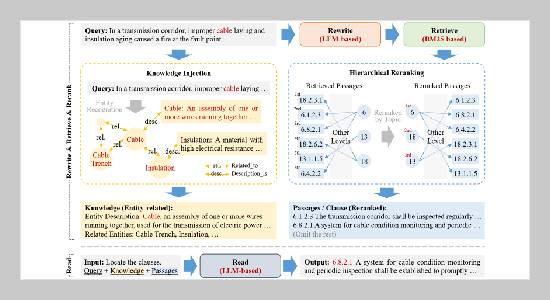
The overall architecture of the PoweR4 framework
Copyright The Author(s). This is an open access article distributed under the terms of the Creative Commons Attribution License (CC BY 4.0), which permits unrestricted use, distribution, and reproduction in any medium, provided the original author and source are cited.
Download Citation: BibTeX | http://dx.doi.org/10.6180/jase.202611_34.012
In the context of power equipment supervision, users often describe fault scenarios in natural language and expect accurate clause-level localization within regulatory manuals. While Large Language Models (LLMs) demonstrate strong generalization capabilities, they face challenges of hallucination and factual inconsistency in domain-specific tasks such as clause localization for power supervision. Although Retrieval-Augmented Generation (RAG) frameworks can alleviate this problem through external documents, existing approaches often focus on isolated enhancements—such as query rewriting or reranking—without addressing the interplay across multiple stages. Thus, we propose PoweR4, a four-stage domain knowledge-enhanced RAG framework tailored for clause localization in the power domain. It consists of: (1) query rewriting using hypothetical document generation, (2) clause retrieval via BM25-based indexing, (3) hierarchical reranking guided by document tree structures, and (4) response generation enriched by knowledge graph–based context construction. We conduct extensive experiments on three real-world datasets, demonstrating that PoweR4 consistently outperforms strong baselines in generation quality. Furthermore, we analyze the impact of query rewriting strategies, document structure depth in reranking, and the degree of knowledge injection, offering a novel paradigm for designing RAG systems in complex industrial domains.
Keywords: Retrieval-Augmented Generation; Power Equipment Supervision; Clause Localization; Knowledge Graph.
- [1] A. J. Thirunavukarasu, D. S. J. Ting, K. Elangovan, L. Gutierrez, T. F. Tan, and D. S. W. Ting, (2023) “Large language models in medicine” Nature medicine 29(8): 1930–1940. DOI: 10.1038/s41591-023-02448-8.
- [2] Y. Li, S. Wang, H. Ding, and H. Chen. “Large language models in finance: A survey”. In: Proceedings of the fourth ACM international conference on AI in finance. 2023, 374–382. DOI: 10.1145/3604237.3626869.
- [3] J. Lai, W. Gan, J. Wu, Z. Qi, and P. S. Yu, (2024) “Large language models in law: A survey” AI Open: DOI: 10.1016/j.aiopen.2024.09.002.
- [4] L. Huang, W. Yu, W. Ma, W. Zhong, Z. Feng, H. Wang, Q. Chen, W. Peng, X. Feng, B. Qin, et al., (2025) “A survey on hallucination in large language models: Principles, taxonomy, challenges, and open questions” ACM Transactions on Information Systems 43(2): 1–55. DOI: 10.1145/3703155.
- [5] C. Wang, X. Liu, Y. Yue, X. Tang, T. Zhang, C. Jiyayang, Y. Yao, W. Gao, X. Hu, Z. Qi, et al., (2023) “Survey on factuality in large language models: Knowledge, retrieval and domain-specificity” arXiv preprint arXiv:2310.07521: DOI: 10.48550/arXiv.2310.07521.
- [6] Y. Gao, Y. Xiong, X. Gao, K. Jia, J. Pan, Y. Bi, Y. Dai, J. Sun, H. Wang, and H. Wang, (2023) “Retrieval-augmented generation for large language models: A survey” arXiv preprint arXiv:2312.10997 2(1): DOI: 10.48550/arXiv.2312.10997.
- [7] X. Ma, Y. Gong, P. He, H. Zhao, and N. Duan. “Query Rewriting in Retrieval-Augmented Large Language Models”. In: Proceedings of the 2023 Conference on Empirical Methods in Natural Language Processing. Ed. by H. Bouamor, J. Pino, and K. Bali. Singapore: Association for Computational Linguistics, 2023, 5303–5315. DOI: 10.18653/v1/2023.emnlp-main.322.
- [8] H. Trivedi, N. Balasubramanian, T. Khot, and A. Sabharwal, (2022) “Interleaving retrieval with chain-of-thought reasoning for knowledge-intensive multi-step questions” arXiv preprint arXiv:2212.10509: DOI: 10.48550/arXiv.2212.10509.
- [9] N. Kandpal, H. Deng, A. Roberts, E. Wallace, and C. Raffel. “Large language models struggle to learn long-tail knowledge”. In: International Conference on Machine Learning. PMLR. 2023, 15696–15707. DOI: 10.48550/arXiv.2211.08411.
- [10] L. Gao, X. Ma, J. Lin, and J. Callan. “Precise zero-shot dense retrieval without relevance labels”. In: Proceedings of the 61st Annual Meeting of the Association for Computational Linguistics (Volume 1: Long Papers). 2023, 1762–1777. DOI: 10.18653/v1/2023.acl-long.99.
- [11] R. Zhao, F. Zhao, L. Wang, X. Wang, and G. Xu. “Kg-cot: Chain-of-thought prompting of large language models over knowledge graphs for knowledge-aware question answering”. In: Proceedings of the Thirty-Third International Joint Conference on Artificial Intelligence (IJCAI-24). International Joint Conferences on Artificial Intelligence. 2024, 6642–6650. DOI: 10.24963/ijcai.2024/734.
- [12] D. Edge, H. Trinh, N. Cheng, J. Bradley, A. Chao, A. Mody, S. Truitt, D. Metropolitansky, R. O. Ness, and J. Larson, (2024) “From local to global: A graph rag approach to query-focused summarization” arXiv preprint arXiv:2404.16130: DOI: 10.48550/arXiv.2404.16130.
- [13] F. Liao, J. Huang, Q. Liu, X. Peng, B. Liu, X. Wu, and J. Qian. “TCEKG: A Temporal and Causal Event Knowledge Graph for Power Distribution Network Fault Diagnosis”. In: International Conference on Intelligent Computing. Springer. 2024, 505–517. DOI: 10.1007/978-981-97-5615-5_41.
- [14] J. Zhao, Z. Ma, H. Zhao, X. Zhang, Q. Liu, and C. Zhang. “Self-consistency, Extract and Rectify: Knowledge Graph Enhance Large Language Model for Electric Power Question Answering”. In: International Conference on Intelligent Computing. Springer. 2024, 493–504. DOI: 10.1007/978-981-97-5615-5_40.
- [15] S. Gururangan, A. Marasović, S. Swayamdipta, K. Lo, I. Beltagy, D. Downey, and N. A. Smith, (2020) “Don’t stop pretraining: Adapt language models to domains and tasks” arXiv preprint arXiv:2004.10964: DOI: 10.18653/v1/2020.acl-main.740.
- [16] P. Christou, M. Z. Islam, Y. Lin, and J. Xiong, (2025) “LLM4DistReconfig: A Fine-tuned Large Language Model for Power Distribution Network Reconfiguration” arXiv preprint arXiv:2501.14960: DOI: 10.18653/v1/2025.naacl-long.208.
- [17] Y. Yang, C. Li, B. Zhu, W. Zheng, F. Zhang, and Z. Li, (2024) “Enhancing domain-specific text generation for power grid maintenance with P2FT” Scientific Reports 14(1): 26771. DOI: 10.1038/s41598-024-78078-y.
- [18] H. Touvron, L. Martin, K. Stone, P. Albert, A. Almahairi, Y. Babaei, N. Bashlykov, S. Batra, P. Bhargava, S. Bhosale, et al., (2023) “Llama 2: Open foundation and fine-tuned chat models” arXiv preprint arXiv:2307.09288: DOI: 10.48550/arXiv.2307.09288.
- [19] Q. Team, (2024) “Qwen2 technical report” arXiv preprint arXiv:2412.15115: DOI: 10.48550/arXiv.2412.15115.