

Yi Zhexue1, Lin Ze2, and Chen Feng2
1Continuing Education College, Zhejiang College of Security Technology; Wenzhou, Zhejiang Province 325000, China
2College of AI, Zhejiang College of Security Technology; Wenzhou, Zhejiang Province 325000, China
Received: April 13, 2026
Accepted: June 12, 2026
Publication Date: August 05, 2026
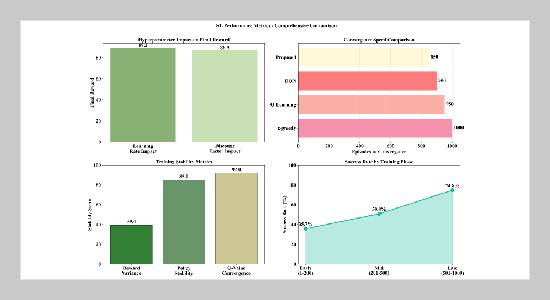
Comprehensive Reinforcement Learning Performance Metrics
Copyright The Author(s). This is an open access article distributed under the terms of the Creative Commons Attribution License (CC BY 4.0), which permits unrestricted use, distribution, and reproduction in any medium, provided the original author and source are cited.
Download Citation: BibTeX | http://dx.doi.org/10.6180/jase.202611_34.010
Intelligent personalized learning systems must continuously adapt instructional strategies based on students’ progress and engagement levels. However, designing adaptive curricula remains challenging, as traditional supervised learning and standard reinforcement learning approaches often fail to effectively integrate mastery assessment with long-term policy optimization. This study proposes a computational framework for personalized training path optimization that integrates mastery modelling with deep reinforcement learning to improve algorithmic efficiency, adaptive policy convergence, and long-term educational decision-making under dynamic learner-state transitions. The optimization problem is formulated as a Markov Decision Process and optimized using a Deep Q-Network (DQN) with experience replay and target-network stabilization to enhance computational efficiency, policy stability, and convergence performance across varying experimental learning conditions. (α = 0.01, γ = 0.95, batch size = 64, replay buffer = 50,000,ε decayed from 1.0 to 0.01 over 1000 episodes). Experimental results demonstrate that the proposed framework achieves an accuracy of 91.38% and a success rate of 89.56%, outperforming Q-Learning (78.42%) and Policy Gradient (84.67%) methods. The model exhibits stable convergence, with episode rewards increasing from 43.97 to 89.54 and Q-loss decreasing from 15.1682 to 0.2533. These results confirm that integrating probabilistic learner-state modelling with deep reinforcement learning provides a computationally efficient and analytically robust solution for scalable personalized education optimization.
Keywords: Personalized Learning, Deep Reinforcement Learning, Bayesian Knowledge Tracing, Deep Q-Network, Adaptive Education
- [1] L.-Y. Zhou and Y.-Y. Wang, (2025) “Simulation of Personalized English Learning Path Recommendation System Based on Knowledge Graph and Deep Reinforcement Learning” Scientific Reports 15(1): 34554. DOI: 10.1038/s41598-025-17918-x.
- [2] S. Amin, M. I. Uddin, A. A. Alarood, W. K. Mashwani, A. Alzahrani, and A. O. Alzahrani, (2023) “Smart E-Learning Framework for Personalized Adaptive Learning and Sequential Path Recommendations Using Reinforcement Learning” IEEE Access 11: 89769–89790. DOI: 10.1109/ACCESS.2023.3305584.
- [3] Y. Ma, L. Wang, J. Zhang, F. Liu, and Q. Jiang, (2023) “A Personalized Learning Path Recommendation Method Incorporating Multi-Algorithm” Applied Sciences 13(10): 5946. DOI: 10.3390/app13105946.
- [4] B. Jiang et al., (2022) “Data-Driven Personalized Learning Path Planning Based on Cognitive Diagnostic Assessments in MOOCs” Applied Sciences 12(8): 3982. DOI: 10.3390/app12083982.
- [5] Q. Yang and C. Liang, (2025) “A Second-Classroom Personalized Learning Path Recommendation System Based on Large Language Model Technology” Applied Sciences 15(14): 7655. DOI: 10.3390/app15147655.
- [6] O. Bulut, J. Shin, S. N. Yildirim-Erbasli, G. Gorgun, and Z. A. Pardos, (2023) “An Introduction to Bayesian Knowledge Tracing with pyBKT” Psych 5(3): 770–786. DOI: 10.3390/psych5030050.
- [7] S.-Y. Jeong and Y.-K. Kim, (2023) “Deep Learning-Based Context-Aware Recommender System Considering Change in Preference” Electronics 12(10): 2337. DOI: 10.3390/electronics12102337.
- [8] M. Barone, M. Naeem, M. Ciaschi, G. Tretola, and A. Coronato, (2025) “AI-Based Intelligent System for Personalized Examination Scheduling” Technologies 13(11): 518. DOI: 10.3390/technologies13110518.
- [9] J. P. López-Goyez, A. González-Briones, and Y. Demazeau, (2026) “An Adaptive Multi-Agent Architecture with Reinforcement Learning and Generative AI for Intelligent Tutoring Systems: A Moodle-Based Case Study” Applied Sciences 16(3): 1323. DOI: 10.3390/app16031323.
- [10] A. Darvish and M. Sepehri, (2025) “Artificial Intelligence-Driven Project Portfolio Optimization Under Deep Uncertainty Using Adaptive Reinforcement Learning” Applied Sciences 15(23): 12713. DOI: 10.3390/app152312713.
- [11] S. Saleem, M. U. Aziz, M. J. Iqbal, and S. Abbas, (2025) “AI in Education: Personalized Learning Systems and Their Impact on Student Performance and Engagement” Critical Review of Social Science Studies 3(1): 2445–2459. DOI: 10.59075/c35qa453.
- [12] C. Y. Zaharuddin and G. Yao, (2024) “Enhancing Student Engagement with AI-Driven Personalized Learning Systems” International Transactions on Education Technology 3(1): 1–8. DOI: 10.33050/itee.v3i1.662.
- [13] C. F. Mahmoud and J. T. Sørensen, (2024) “Artificial Intelligence in Personalized Learning with a Focus on Current Developments and Future Prospects” Research Advances in Education 3(8): 25–31. DOI: 10.56397/RAE.2024.08.04.
- [14] C. C. Y. Yang and H. Ogata, (2023) “Personalized Learning Analytics Intervention Approach for Enhancing Student Learning Achievement and Behavioral Engagement in Blended Learning” Education and Information Technologies 28(3): 2509–2528. DOI: 10.1007/s10639-022-11291-2.
- [15] S. K. Sahu, A. Mokhade, and N. D. Bokde, (2023) “An Overview of Machine Learning, Deep Learning, and Reinforcement Learning-Based Techniques in Quantitative Finance: Recent Progress and Challenges” Applied Sciences 13(3): 1956. DOI: 10.3390/app13031956.