





Xuan-Thuc Nguyen1, Ngoc-Quynh Nguyen1, Le-Minh Nguyen1, Thi-Tuyet-Nhung Le2, Dai-Cuong Pham2, and Dinh-Quy Vu2
1Viettel High Technology Industries Corporation– Viettel Group, Hanoi, Vietnam
2School of Mechanical Engineering, Hanoi University of Science and Technology, Hanoi, Vietnam
Received: March 07, 2026
Accepted: July 11, 2026
Publication Date: August 05, 2026
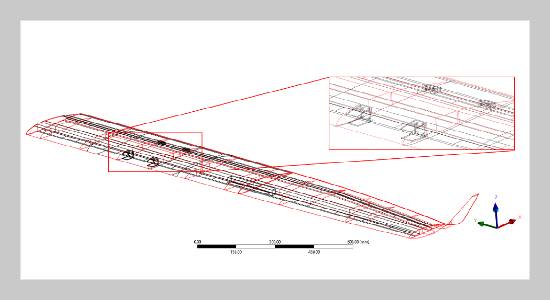
Composite wing model.
Copyright The Author(s). This is an open access article distributed under the terms of the Creative Commons Attribution License (CC BY 4.0), which permits unrestricted use, distribution, and reproduction in any medium, provided the original author and source are cited.
Download Citation: BibTeX | http://dx.doi.org/10.6180/jase.202611_34.009
Fluid–Structure Interaction (FSI) is a multidisciplinary research field that has drawn significant attention across various domains, including aerospace, biomedical engineering, agriculture, industry, and renewable energy. The finite element method (FEM) has become a leading computational tool for investigating these coupled phenomena, enabling more accurate prediction of the interactions between fluids and solids. Although numerical FSI simulations are more economical than physical experiments, they require substantial computational resources. This study focuses on the influence of time step size on the accuracy and convergence of coupled FSI simulations. A cantilever beam model is adopted as the benchmark case and analyzed using the ANSYS software suite. The time step of the fluid solver and the sub-step size of the structural solver are systematically varied to determine the optimal configuration that ensures accuracy while minimizing computation time. The amplitude and frequency responses obtained from the coupled solver are validated against reference results from published literature. The optimized time step and sub-step selection strategy is then applied to more
complex FSI simulations, including a cropped delta wing and a lightweight composite UAV wing, to evaluate flutter behavior within their operating envelopes.
Keywords: Computational Fluid Dynamics (CFD); Fluid–Structure Interaction (FSI); Time Step, Sub-Step; Convergence
- [1] B. Wang, L. Feng, L. Xu, H. Gao, X. Luo, and N. Qi, (2025) “Three-dimensional fluid–structure interaction modelling of the venous valve using immersed boundary/finite element method” Computers in Biology and Medicine 185: 109450. DOI: 10.1016/j.compbiomed.2024.109450.
- [2] F. Marcinnò, C. Vergara, L. Giovannacci, A. Quarteroni, and G. Prouse, (2024) “Computational fluid-structure interaction analysis of the end-to-side radiocephalic arteriovenous fistula” Computer Methods and Programs in Biomedicine 249: 108146. DOI: 10.1016/j.cmpb.2024.108146.
- [3] A. M. Tango, A. Monteleone, A. Ducci, and G. Burriesci, (2025) “Analysis of the haemodynamic changes caused by surgical and transcatheter aortic valve replacements by means fluid–structure interaction simulations” Computers in Biology and Medicine 186: 109673. DOI: 10.1016/j.compbiomed.2025.109673.
- [4] L. Feng, H. Gao, and X. Luo, (2024) “Whole–heart modelling with valves in a fluid–structure interaction framework” Computer Methods in Applied Mechanics and Engineering 420: 116724. DOI: 10.1016/j.cma.2023.116724.
- [5] S. Qashqaie Abdi and K. Hassani, (2023) “The study of the relationship between unicuspid aortic valve insufficiency and heart disease by fluid–structure interaction modeling” Biomedical Engineering Advances 5: 100079. DOI: 10.1016/j.bea.2023.100079.
- [6] L. Cai, T. Zhao, Y. Wang, X. Luo, and H. Gao, (2023) “Fluid–structure interaction simulation of pathological mitral valve dynamics in a coupled mitral valve-left ventricle model” Intelligent Medicine 3(2): 104–114. DOI: 10.1016/j.imed.2022.06.005.
- [7] A. Souche and K. Valen-Sendstad, (2022) “High-fidelity fluid structure interaction simulations of turbulent-like aneurysm flows reveals high-frequency narrowband wall vibrations: A stimulus of mechanobiological relevance?” Journal of Biomechanics 145: 111369. DOI: 10.1016/j.jbiomech.2022.111369.
- [8] Y. Mai, S. Wen, J. Zhang, Y. Lan, and G. Huang, (2025) “Analysis of the two-way fluid–structure interaction between the rice canopy and the downwash airflow of a quadcopter UAV” Biosystems Engineering 250: 343–364. DOI: 10.1016/j.biosystemseng.2025.01.005.
- [9] H. Cui, C. Wang, X. Liu, X. Liu, J. Yuan, and Y. Liu, (2023) “Prediction of the distribution of airflow within the cotton canopy using fluid–structure interaction simulation and machine-learning methods” Biosystems Engineering 232: 51–66. DOI: 10.1016/j.biosystemseng.2023.06.011.
- [10] X. Liao, C. G. Koh, and Y. K. Chow, (2025) “A hybrid strategy for numerical simulations of fluid–structure interaction problems in ocean engineering” Applied Ocean Research 155: 104433. DOI: 10.1016/j.apor.2025.104433.
- [11] I. Prüter, F. Spröer, K. Keimer, O. Lojek, C. Windt, D. Schürenkamp, H. Bihs, I. Nistor, and N. Goseberg, (2025) “A comprehensive numerical study on the current-induced fluid–structure interaction of flexible submerged vegetation” Journal of Fluids and Structures 133: 104232. DOI: 10.1016/j.jfluidstructs.2024.104232.
- [12] H. K. Sakran, M. S. A. Aziz, and C. Y. Khor, (2024) “Blade Wrap Angle Impact on Centrifugal Pump Performance: Entropy Generation and Fluid-Structure Interaction Analysis” Computer Modeling in Engineering & Sciences 140(1): 109–137. DOI: 10.32604/cmes.2024.047245.
- [13] N. B. Darbamulla and R. K. Jaiman, (2024) “A finite element framework for fluid–structure interaction of turbulent cavitating flows with flexible structures” Computers & Fluids 277: 106283. DOI: 10.1016/j.compfluid.2024.106283.
- [14] M. R. Firdaus, M. R. Mahalik, A. Jusuf, S. Wicaksono, L. Gunawan, and T. Dirgantara, (2024) “Modelling Strategies to Simulate the Fluid-Structure Interaction of Amphibious Aircraft Float Structure” Procedia Structural Integrity 52: 309–322. DOI: 10.1016/j.prostr.2023.12.031.
- [15] P. Shakya, M. Thomas, A. C. Seibi, M. Shekaramiz, and M. A. S. Masoum, (2024) “Fluid-structure interaction and life prediction of small-scale damaged horizontal axis wind turbine blades” Results in Engineering 23: 102388. DOI: 10.1016/j.rineng.2024.102388.
- [16] L. Yuan, Z. Liu, L. Li, and M. Lin, (2023) “Analysis of the Influence of the Blade Deformation on Wind Turbine Output Power in the Framework of a Bidirectional Fluid-Structure Interaction Model” Fluid Dynamics & Materials Processing 19(5): 1129–1141. DOI: 10.32604/fdmp.2023.023538.
- [17] Y. Cui, L. Wang, J. Ru, and J. Wu, (2023) “Analysis and Optimization of Flow-Guided Structure Based on Fluid-Structure Interaction” Fluid Dynamics & Materials Processing 19(6): 1573–1584. DOI: 10.32604/fdmp.2023.024873.
- [18] M. Mihaila-Andres, C. Rotaru, and P. G. Matei, (2015) “Staggered Approach for Fluid-Structure Interaction Phenomena of an AGARD 445.6 Wing Using Commercial CFD/CSM Software” Journal of Aerospace Engineering 28(4): DOI: 10.1061/(asce)as.1943-5525.0000427.
- [19] N. Di Domenico, C. Groth, A. Wade, T. Berg, and M. E. Biancolini, (2018) “Fluid structure interaction analysis: vortex shedding induced vibrations” Procedia Structural Integrity 8: 422–432. DOI: 10.1016/j.prostr.2017.12.042.
- [20] A. J. Torregrosa, A. Gil, P. Quintero, and A. Cremades, (2022) “On the effects of orthotropic materials in flutter protection of wind turbine flexible blades” Journal of Wind Engineering and Industrial Aerodynamics 227: 105055. DOI: 10.1016/j.jweia.2022.105055.
- [21] F. Salmon and L. Chatellier, (2022) “3D fluid–structure interaction simulation of an hydrofoil at low Reynolds number” Journal of Fluids and Structures 111: 103573. DOI: 10.1016/j.jfluidstructs.2022.103573.
- [22] W. Guo, Y. Shui, L. Nie, and G. Chen, (2024) “Fluid-structure interaction simulation for multi-body flexible morphing structures” Chinese Journal of Aeronautics 37(2): 137–147. DOI: 10.1016/j.cja.2023.09.009.
- [23] J. Pflüger and C. Breitsamter, (2024) “Gust response of an elasto-flexible morphing wing using fluid–structure interaction simulations” Chinese Journal of Aeronautics 37(2): 45–57. DOI: 10.1016/j.cja.2023.12.017.
- [24] Y. Guo, W. Yang, Y. Dong, and D. Xue, (2024) “Resonance mechanism of flapping wing based on fluid structure interaction simulation” Chinese Journal of Aeronautics 37(5): 243–262. DOI: 10.1016/j.cja.2024.01.011.
- [25] Y. Dai, Y. Hu, Y. Wu, C. Song, and C. Yang, (2025) “Effect of leading-edge and trailing-edge camber morphing on gust load for an elastic wing” Chinese Journal of Aeronautics 38(4): 103245. DOI: 10.1016/j.cja.2024.09.021.
- [26] T. Schwentner and T.-P. Fries, (2024) “Fully Coupled, Higher-Order, Block-Structured Mesh Generation in Fluid–Structure Interaction” International Journal for Numerical Methods in Fluids 97(3): 359–377. DOI: 10.1002/fld.5355.
- [27] M. R. Rajanna, E. L. Johnson, N. Liu, A. Korobenko, Y. Bazilevs, and M.-C. Hsu, (2022) “Fluid–structure interaction modeling with nonmatching interface discretizations for compressible flow problems: Computational framework and validation study” Mathematical Models and Methods in Applied Sciences 32(12): 2497–2528. DOI: 10.1142/s0218202522500592.
- [28] B. Li, W. Sun, Y. Xie, and W. Yu, (2024) “Optimal L2 Error Analysis of a Loosely Coupled Finite Element Scheme for Thin-Structure Interactions” SIAM Journal on Numerical Analysis 62(4): 1782–1813. DOI: 10.1137/23m1578401.
- [29] M. Bukač, G. Fu, A. Seboldt, and C. Trenchea, (2023) “Time-adaptive partitioned method for fluid-structure interaction problems with thick structures” Journal of Computational Physics 473: 111708. DOI: 10.1016/j.jcp.2022.111708.
- [30] J. Čečrdle. Whirl Flutter of Turboprop Aircraft Structures. Elsevier, 2015. DOI: 10.1016/C2014-0-01800-X.
- [31] A. K. Slone, K. Pericleous, C. Bailey, and M. Cross, (2002) “Dynamic fluid–structure interaction using finite volume unstructured mesh procedures” Computers & Structures 80(5–6): 371–390. DOI: 10.1016/s0045-7949(01)00177-8.
- [32] C. Peng and J. Han, (2011) “Numerical investigation of the effects of structural geometric and material nonlinearities on limit-cycle oscillation of a cropped delta wing” Journal of Fluids and Structures 27(4): 611–622. DOI: 10.1016/j.jfluidstructs.2011.03.015.
- [33] A. A. Kumar, N. Manoj, A. K. Onkar, and M. Manjuprasad, (2016) “Fluid-Structure Interaction Analysis of a Cropped Delta Wing” Procedia Engineering 144: 1205–1212. DOI: 10.1016/j.proeng.2016.05.102.
- [34] W. Wang, Y. Dai, C. Zhang, X. Gao, and M. Zhao, (2016) “Micromechanical Modeling of Fiber-Reinforced Composites with Statistically Equivalent Random Fiber Distribution” Materials 9(8): 624. DOI: 10.3390/ma9080624.
- [35] MakeItFrom.com. 7075-T6 Aluminum Material Properties Database.
- [36] Corecell™ M-foam structural core data sheet. Gurit. 2021.
- [37] Federal Aviation Administration. Airworthiness Standard FAR Part 23, Part 25. 2024.