




Sugoro Bhakti Sutono1,2, Cucuk Nur Rosyidi1, Pringgo Widyo Laksono1, and Eko Pujiyanto1
1Department of Industrial Engineering, Universitas Sebelas Maret, Surakarta, Central Java 57126, Indonesia
2Department of Industrial Engineering, Universitas Muria Kudus, Kudus, Central Java 57126, Indonesia
Received: December 27, 2025
Accepted: July 02, 2026
Publication Date: August 05, 2026
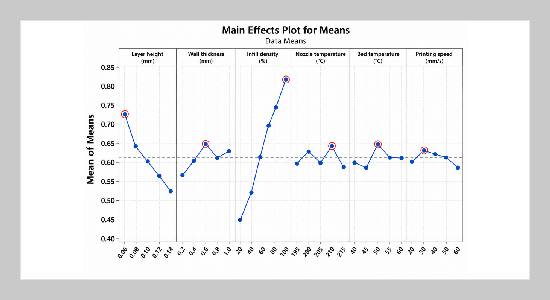
Graphical representation of the mean PCA-weighted GRG for each process parameter level
Copyright The Author(s). This is an open access article distributed under the terms of the Creative Commons Attribution License (CC BY 4.0), which permits unrestricted use, distribution, and reproduction in any medium, provided the original author and source are cited.
Download Citation: BibTeX | http://dx.doi.org/10.6180/jase.202611_34.007
Biodegradable, patient-specific bone screw-like prototypes produced by fused deposition modeling (FDM) require careful selection of process parameters to balance mechanical integrity and manufacturing efficiency. This study optimized FDM parameters for improved PLA+ bone screw-like specimens using an integrated Taguchi-grey relational analysis (GRA) framework with principal component analysis (PCA)-derived weighting. Six parameters were investigated using an L25 orthogonal array with triplicate experiments, and the compressive strength (CS), printing time (PT), and part weight (PW) were aggregated into a weighted grey relational grade (GRG). The factor-level optimum (0.06 mm layer height, 0.6 mm wall thickness, 100% infill density, 210 ◦C nozzle temperature, 50 ◦C bed temperature, and 30 mm/s printing speed) increased the composite GRG by 3.11% relative to the best experimental trial, achieving CS ≈ 44.4 MPa with moderate PT (≈ 64.5 min) and PW (≈0.554 g). The optimized condition improved CS by 23.6% while reducing PT by 2.27% and PW by 3.99% relative to the baseline condition. Analysis of variance identified infill density as the dominant contributor
to the multi-response performance, followed by layer height and wall thickness. The results demonstrate the effectiveness of the PCA-weighted GRA for transparent multi-objective optimization in FDM. Compressive strength was used as a screening metric; further torsional, pull-out, insertion/removal torque, and fatigue tests are required for fixation-relevant qualification. The optimized parameter set is therefore presented as a local manufacturing optimum for the tested printer-filament-nozzle configuration, not as a generalized implant-design rule.
Keywords: fused deposition modeling, bone screw, multi-response optimization, Taguchi method, grey relational analysis, principal component analysis
- [1] M. Bardot and M. D. Schulz, (2020) “Biodegradable poly(lactic acid) nanocomposites for fused deposition modeling 3D printing” Nanomaterials 10: 2567. DOI: 10.3390/nano10122567.
- [2] S. Sharma, D. Mudgal, and V. Gupta, (2024) “Integrating extrusion process and additive manufacturing for biomedical breakthroughs” International Journal on Interactive Design and Manufacturing (IJIDeM) 18: 3547–3570. DOI: 10.1007/s12008-023-01632-x.
- [3] R. Agarwal, V. Gupta, and J. Singh, (2022) “Additive manufacturing-based design approaches and challenges for orthopaedic bone screws: a state-of-the-art review” Journal of the Brazilian Society of Mechanical Sciences and Engineering 44: 37. DOI: 10.1007/s40430-021-03331-8.
- [4] A. Grivet-Brancot, M. Boffito, and G. Ciardelli, (2022) “Use of Polyesters in Fused Deposition Modeling for Biomedical Applications” Macromolecular Bioscience 22: 2200039. DOI: 10.1002/mabi.202200039.
- [5] R. Agarwal, V. Gupta, and J. Singh, (2022) “Mechanical and biological behaviour of additive manufactured biomimetic biodegradable orthopaedic cortical screws” Rapid Prototyping Journal 28: 1690–1705. DOI: 10.1108/RPJ-01-2022-0006.
- [6] R. Dhandapani, P. D. Krishnan, A. Zennifer, V. Kannan, A. Manigandan, M. R. Arul, D. Jaiswal, A. Subramanian, S. G. Kumbar, and S. Sethuraman, (2020) “Additive manufacturing of biodegradable porous orthopaedic screw” Bioactive Materials 5: 458–467. DOI: 10.1016/j.bioactmat.2020.03.009.
- [7] A. Joseph and V. Uthirapathy, (2024) “A Systematic Review of the Contribution of Additive Manufacturing toward Orthopedic Applications” ACS Omega 9: 44042–44075. DOI: 10.1021/acsomega.4c04870.
- [8] Y. Karayer, Ş. Altınsoy, G. Koç, D. Can, and Y. E. Toğar, (2025) “Effects of Steam Sterilization and Recycling on the Mechanical and Surface Properties of 3D-Printed Biodegradable PLA and Re-PLA Materials” Polymers 17: 2590. DOI: 10.3390/polym17192590.
- [9] E. Kargar and A. Ghasemi-Ghalebahman, (2023) “Experimental investigation on fatigue life and tensile strength of carbon fiber-reinforced PLA composites based on fused deposition modeling” Scientific Reports 13: 18194. DOI: 10.1038/s41598-023-45046-x.
- [10] V. C. Agbakoba, P. Hlangothi, J. Andrew, and M. J. John, (2022) “Mechanical and Shape Memory Properties of 3D-Printed Cellulose Nanocrystal (CNC)-Reinforced Polylactic Acid Bionanocomposites for Potential 4D Applications” Sustainability 14: 12759. DOI: 10.3390/su141912759.
- [11] E. Hozdić and R. Hasanagić, (2024) “Analysis of the Impact of Cooling Lubricants on the Tensile Properties of FDM 3D Printed PLA and PLA+CF Materials” Polymers 16: 2228. DOI: 10.3390/polym16152228.
- [12] V. DeStefano, S. Khan, and A. Tabada, (2020) “Applications of PLA in modern medicine” Engineered Regeneration 1: 76–87. DOI: 10.1016/j.engreg.2020.08.002.
- [13] J.-W. Li, C.-F. Du, C.-X. Yuchi, and C.-Q. Zhang, (2019) “Application of Biodegradable Materials in Orthopedics” Journal of Medical and Biological Engineering 39: 633–645. DOI: 10.1007/s40846-019-00469-8.
- [14] H. Zhou, Z. Song, and S. Cai, (2020) “Toughening of poly(lactide acid) with low crystallinity through biaxial poststretching” Journal of Polymer Science 58: 3488–3495. DOI: 10.1002/pol.20200526.
- [15] L. Sandanamsamy, W. S. W. Harun, I. Ishak, F. R. M. Romlay, K. Kadirgama, D. Ramasamy, S. R. A. Idris, and F. Tsumori, (2023) “A comprehensive review on fused deposition modelling of polylactic acid” Progress in Additive Manufacturing 8: 775–799. DOI: 10.1007/s40964-022-00356-w.
- [16] T. M. Joseph, A. Kallingal, A. M. Suresh, D. K. Mahapatra, M. S. Hasanin, J. Haponiuk, and S. Thomas, (2023) “3D printing of polylactic acid: recent advances and opportunities” The International Journal of Advanced Manufacturing Technology 125(3): 1015–1035. DOI: https://doi.org/10.1007/s00170-022-10795-y.
- [17] R. Agarwal, J. Singh, and V. Gupta, (2025) “A data-driven ensemble machine learning approach for predicting the mechanical strength of 3D printed orthopaedic bone screws” Proceedings of the Institution of Mechanical Engineers, Part E: Journal of Process Mechanical Engineering 239: 1650–1662. DOI: 10.1177/09544089231211235.
- [18] M. M. Rahman, J. Sultana, S. B. Rayhan, and A. Ahmed, (2023) “Optimization of FDM manufacturing parameters for the compressive behavior of cubic lattice cores: an experimental approach by Taguchi method” The International Journal of Advanced Manufacturing Technology 129: 1329–1343. DOI: 10.1007/s00170-023-12342-9.
- [19] U. K. uz Zaman, E. Boesch, A. Siadat, M. Rivette, and A. A. Baqai, (2019) “Impact of fused deposition modeling (FDM) process parameters on strength of built parts using Taguchi’s design of experiments” The International Journal of Advanced Manufacturing Technology 101: 1215–1226. DOI: 10.1007/s00170-018-3014-6.
- [20] A. Elkaseer, S. Schneider, and S. G. Scholz, (2020) “Experiment-Based Process Modeling and Optimization for High-Quality and Resource-Efficient FFF 3D Printing” Applied Sciences 10: 2899. DOI: 10.3390/app10082899.
- [21] E. U. Enemuoh, S. Duginski, C. Feyen, and V. G. Menta, (2021) “Effect of Process Parameters on Energy Consumption, Physical, and Mechanical Properties of Fused Deposition Modeling” Polymers 13: 2406. DOI: 10.3390/polym13152406.
- [22] B. A. Ahmed, U. Nadeem, A. S. Hakeem, A. Ul-Hamid, M. Y. Khan, M. Younas, and H. A. Saeed, (2023) “Printing Parameter Optimization of Additive Manufactured PLA Using Taguchi Design of Experiment” Polymers 15: 4370. DOI: 10.3390/polym15224370.
- [23] A. Hasan, M. Fahad, and M. A. Khan, (2024) “Effect of print parameters on the tensile strength and built time of FDM-printed PLA parts” The International Journal of Advanced Manufacturing Technology 132: 3047–3065. DOI: 10.1007/s00170-024-13506-x.
- [24] J. D. Kechagias, (2024) “3D printing parametric optimization using the power of Taguchi design: an expository paradigm” Materials and Manufacturing Processes 39: 797–803. DOI: 10.1080/10426914.2023.2290258.
- [25] C. Camposeco-Negrete, J. Varela-Soriano, and J. J. Rojas-Carreón, (2021) “The effects of printing parameters on quality, strength, mass, and processing time of polylactic acid specimens produced by additive manufacturing” Progress in Additive Manufacturing 6: 821–840. DOI: 10.1007/s40964-021-00198-y.
- [26] S. Pachauri, N. K. Gupta, and A. Gupta, (2025) “Influence of 3D printing process parameters on the mechanical properties of polylactic acid (PLA) printed with fused filament fabrication: experimental and statistical analysis” International Journal on Interactive Design and Manufacturing (IJIDeM) 19: 1159–1177. DOI: 10.1007/s12008-023-01424-3.
- [27] A. Alafaghani and A. Qattawi, (2018) “Investigating the effect of fused deposition modeling processing parameters using Taguchi design of experiment method” Journal of Manufacturing Processes 36: 164–174. DOI: 10.1016/j.jmapro.2018.09.025.
- [28] J. Sultana, M. M. Rahman, Y. Wang, A. Ahmed, and C. Xiaohu, (2024) “Influences of 3D printing parameters on the mechanical properties of wood PLA filament: an experimental analysis by Taguchi method” Progress in Additive Manufacturing 9: 1239–1251. DOI: 10.1007/s40964-023-00516-6.
- [29] G. Nyiranzeyimana, J. Mutua, B. Mose, and T. Mbuya, (2022) “A grey-based Taguchi method to optimize fused deposition modelling process parameters for manufacture of a hip joint implant” Materialwissenschaft und Werkstofftechnik 53: 89–108. DOI: 10.1002/mawe.202100129.
- [30] A. H. Kadhum, S. Al-Zubaidi, and S. S. A. AlKareem, (2023) “Optimization of Mechanical Properties and Surface Characteristics of PLA+ 3D Printing Materials” International Journal of Chemical Engineering 2023: 1–15. DOI: 10.1155/2023/8887905.
- [31] R. Ranjan and A. Saha, (2024) “A novel hybrid multi-criteria optimization of 3D printing process using grey relational analysis (GRA) coupled with principal component analysis (PCA)” Engineering Research Express 6: 015080. DOI: 10.1088/2631-8695/ad2320.
- [32] R. Agarwal, H. K. Mehtani, J. Singh, and V. Gupta, (2022) “Post-yielding fracture mechanics of 3D printed polymer-based orthopedic cortical screws” Polymer Composites 43: 6829–6837. DOI: 10.1002/pc.26620.
- [33] Y. Kuo, T. Yang, and G.-W. Huang, (2008) “The use of grey relational analysis in solving multiple attribute decision-making problems” Computers & Industrial Engineering 55: 80–93. DOI: 10.1016/j.cie.2007.12.002.
- [34] ASTM. ASTM F543-23: Specification and Test Methods for Metallic Medical Bone Screws. 2023. DOI: 10.1520/F0543-23.
- [35] J. Singh, K. K. Goyal, R. Kumar, and V. Gupta, (2022) “Influence of process parameters on mechanical strength, build time, and material consumption of 3D printed poly-lactic acid parts” Polymer Composites 43: 5908–5928. DOI: 10.1002/pc.26849.
- [36] M. Fahad, M. Mujeeb, and M. A. Khan, (2023) “Effect of Process Parameters on the Compressive and Impact Strength of 3D Printed Parts” Iranian Journal of Science and Technology, Transactions of Mechanical Engineering 47: 257–265. DOI: 10.1007/s40997-022-00514-z.
- [37] J. D. Kechagias, N. Vidakis, M. Petousis, and N. Mountakis, (2023) “A multi-parametric process evaluation of the mechanical response of PLA in FFF 3D printing” Materials and Manufacturing Processes 38: 941–953. DOI: 10.1080/10426914.2022.2089895.
- [38] L. Auffray, P.-A. Gouge, and L. Hattali, (2022) “Design of experiment analysis on tensile properties of PLA samples produced by fused filament fabrication” The International Journal of Advanced Manufacturing Technology 118: 4123–4137. DOI: 10.1007/s00170-021-08216-7.
- [39] V. Darji, S. Singh, and H. S. Mali, (2023) “Mechanical characterization of additively manufactured polymer composites: A state-of-the-art review and future scope” Polymer Composites 44: 4370–4419. DOI: 10.1002/pc.27431.
- [40] S. Chakraborty, H. N. Datta, and S. Chakraborty, (2023) “Grey Relational Analysis-Based Optimization of Machining Processes: a Comprehensive Review” Process Integration and Optimization for Sustainability 7: 609–639. DOI: 10.1007/s41660-023-00311-4.
- [41] Y. Kuo, T. Yang, and G.-W. Huang, (2008) “The use of a grey-based Taguchi method for optimizing multi-response simulation problems” Engineering Optimization 40: 517–528. DOI: 10.1080/03052150701857645.
- [42] O. Tunçel, K. Tüfekci, and Ç. Kahya, (2024) “Multi-objective optimization of 3D printing process parameters using gray-based Taguchi for composite PLA parts” Polymer Composites 45: 12870–12884. DOI: 10.1002/pc.28674.
- [43] A. Bademlioglu, A. Canbolat, and O. Kaynakli, (2020) “Multi-objective optimization of parameters affecting Organic Rankine Cycle performance characteristics with Taguchi-Grey Relational Analysis” Renewable and Sustainable Energy Reviews 117: 109483. DOI: 10.1016/j.rser.2019.109483.
- [44] C.-F. J. Kuo, T.-L. Su, P.-R. Jhang, C.-Y. Huang, and C.-H. Chiu, (2011) “Using the Taguchi method and grey relational analysis to optimize the flat-plate collector process with multiple quality characteristics in solar energy collector manufacturing” Energy 36: 3554–3562. DOI: 10.1016/j.energy.2011.03.065.
- [45] S. B. Sutono, S. H. A. Rashid, Z. Taha, N. Subagyo, and H. Aoyama, (2017) “Integration of grey-based Taguchi method and principal component analysis for multi-response decision-making in Kansei engineering” European Journal of Industrial Engineering 11: 205–227. DOI: 10.1504/EJIE.2017.083254.
- [46] Z. A. Khan, S. Kamaruddin, and A. N. Siddiquee, (2010) “Feasibility study of use of recycled High Density Polyethylene and multi response optimization of injection moulding parameters using combined grey relational and principal component analyses” Materials & Design 31: 2925–2931. DOI: 10.1016/j.matdes.2009.12.028.
- [47] I. T. Jolliffe. Principal Component Analysis. New York: Springer-Verlag, 2002. DOI: 10.1007/b98835.
- [48] G. Gao, F. Xu, J. Xu, G. Tang, and Z. Liu, (2022) “A Survey of the Influence of Process Parameters on Mechanical Properties of Fused Deposition Modeling Parts” Micromachines 13: 553. DOI: 10.3390/mi13040553.
- [49] M. A. Mazlan, M. A. Anas, N. A. N. Izmin, and A. H. Abdullah, (2023) “Effects of Infill Density, Wall Perimeter and Layer Height in Fabricating 3D Printing Products” Materials 16: 695. DOI: 10.3390/ma16020695.
- [50] J. K. Abifarin, (2021) “Taguchi grey relational analysis on the mechanical properties of natural hydroxyapatite: effect of sintering parameters” The International Journal of Advanced Manufacturing Technology 117: 49–57. DOI: 10.1007/s00170-021-07288-9.
- [51] J. K. Abifarin, M. U. Suleiman, E. A. Abifarin, F. B. Fidelis, O. K. Oyelakin, D. I. Jacob, and M. Y. Abdulrahim, (2022) “Fabrication of mechanically enhanced hydroxyapatite scaffold with the assistance of numerical analysis” The International Journal of Advanced Manufacturing Technology 118: 3331–3344. DOI: 10.1007/s00170-021-08184-y.
- [52] O. A. Osuchukwu, A. Salihi, I. Abdullahi, and D. O. Obada, (2022) “Taguchi grey relational optimization of sol–gel derived hydroxyapatite from a novel mix of two natural biowastes for biomedical applications” Scientific Reports 12: 17968. DOI: 10.1038/s41598-022-22888-5.