





Jasman Yusuf1 and Achmad Zultan Mansur2
1Civil Engineering Department of Muhammadiyah Parepare University, Parepare, 91131, Indonesia.
2Civil Engineering Department of Borneo Tarakan University, Tarakan, 77123, Indonesia.
Received: March 29, 2026
Accepted: July 11, 2026
Publication Date: August 05, 2026
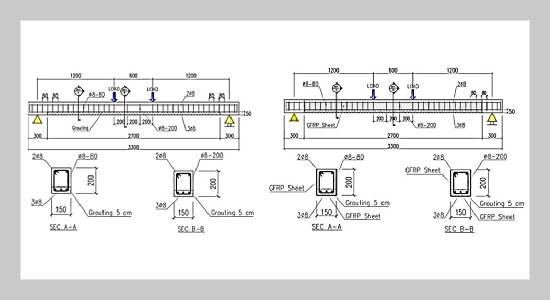
Specimen Detail.
Copyright The Author(s). This is an open access article distributed under the terms of the Creative Commons Attribution License (CC BY 4.0), which permits unrestricted use, distribution, and reproduction in any medium, provided the original author and source are cited.
Download Citation: BibTeX | http://dx.doi.org/10.6180/jase.202611_34.006
Corrosion-induced deterioration in reinforced concrete structures poses a critical threat to structural integrity and service life. This study investigates the effectiveness of an integrated rehabilitation strategy that combines geometric restoration using high strength, non-shrink grout (Sikagrout 215) with flexural strengthening via externally bonded glass fiber-reinforced polymer (GFRP) composites on beams damaged by simulated corrosion
induced section loss and spalling. An experimental program was conducted on two groups: unstrengthened control beams (NB) and rehabilitated specimens (GFB). Key performance indicators, including ultimate load capacity, loaddeflection response, concrete and steel strain development, and GFRP strain evolution, were systematically analyzed. Results demonstrate that GFRP-strengthened beams achieved a 10.87% higher average
ultimate load (34.64 kN) than sound control beams (31.24 kN). Although the GFRP layer resulted in a slightly lower ultimate concrete strain in GFB (2391 µε) compared to NB (2821 µε), the rehabilitated beams exhibited enhanced structural resilience, evidenced by a 28.82% increase in yield load and a 25.08% reduction in mid-span deflection at ultimate failure. Furthermore, the failure mode shifted from conventional ductile flexural failure in
control beams to a highly predictable GFRP rupture, without premature shear failure. GFRP strain measurements confirmed full material utilization, with recorded rupture strains of 15,672 and 18,532 µε aligning within an 8% margin of theoretical predictions. These findings validate that the proposed dual-phase rehabilitation approach recovers lost strength while quantitatively enhancing structural resilience and failure predictability, offering a practical, evidence-based solution for extending the service life of aging infrastructure affected by corrosion.
Keywords: Integrated Rehabilitation, GFRP, Corrosion, RC Beams, Flexural Capacity, Ductility
- [1] Y. Zhou, Y. Zheng, J. Pan, L. Sui, F. Xing, H. Sun, and P. Li, (2019) “Experimental investigations on corrosion resistance of innovative steel-FRP composite bars using X-ray microcomputed tomography” Composites Part B: Engineering 161: 272–284. DOI: 10.1016/j.compositesb.2018.10.069.
- [2] G. G. Triantafyllou, T. C. Rousakis, and A. I. Karabinis, (2017) “Analytical assessment of the bearing capacity of RC beams with corroded steel bars beyond concrete cover cracking” Composites Part B: Engineering 119: 132–140. DOI: 10.1016/j.compositesb.2017.03.036.
- [3] L. Dai, P. Chen, X. Luo, L. Wang, and J. Zhang, (2024) “Prediction of corrosion-induced retraction slip of prestressing strand in pre-tensioned concrete beams” Structure and Infrastructure Engineering 20(11): 1778–1789. DOI: 10.1080/15732479.2023.2165117.
- [4] D. M. Frangopol and M. Liu, (2007) “Maintenance and management of civil infrastructure based on condition, safety, optimization, and life-cycle cost” Structure and Infrastructure Engineering 3(1): 29–41. DOI: 10.1080/15732470500253164.
- [5] Y. Mugahed Amran, R. Alyousef, R. S. Rashid, H. Alabduljabbar, and C.-C. Hung, (2018) “Properties and applications of FRP in strengthening RC structures: A review” Structures 16: 208–238. DOI: 10.1016/j.istruc.2018.09.008.
- [6] J. Tatar and S. Milev, (2021) “Durability of externally bonded fiber-reinforced polymer composites in concrete structures: a critical review” Polymers 13(5): 765. DOI: 10.3390/polym13050765.
- [7] A. Diniță, R. G. Ripeanu, C. N. Ilincă, D. Cursaru, D. Matei, R. I. Naim, M. Tănase, and A. I. Portoacă, (2023) “Advancements in fiber-reinforced polymer composites: a comprehensive analysis” Polymers 16(1): 2. DOI: 10.3390/polym16010002.
- [8] M. Elkafrawy, P. Gowrishankar, N. G. Aswad, A. Alashkar, A. Khalil, M. AlHamaydeh, and R. Hawileh, (2024) “GFRP-reinforced concrete columns: state-of-the-art, behavior, and research needs” Buildings 14(10): 3131. DOI: 10.3390/buildings14103131.
- [9] M. Alhusban, M. Alhusban, and A. A. Alkhawaldeh, (2023) “The Efficiency of Using Machine Learning Techniques in Fiber-Reinforced-Polymer Applications in Structural Engineering” Sustainability 16(1): 11. DOI: 10.3390/su16010011.
- [10] R. E. Melchers, C. Q. Li, and W. Lawanwisut, (2006) “Modelling deterioration of structural behaviour of reinforced concrete beams under saline environment corrosion” Magazine of Concrete Research 58(9): 575–587. DOI: 10.1680/macr.2006.58.9.575.
- [11] D. Coronelli and P. Gambarova, (2004) “Structural assessment of corroded reinforced concrete beams: modeling guidelines” Journal of Structural Engineering 130(8): 1214–1224. DOI: 10.1061/(ASCE)0733-9445(2004)130:8(1214).
- [12] S. Barbhuiya, B. B. Das, and F. Kanavaris, (2024) “A review of fracture propagation in concrete: fundamentals, experimental techniques, modelling and applications” Magazine of Concrete Research 76(10): 482–514. DOI: 10.1680/jmacr.23.00143.
- [13] H. Lee, H. Jang, and W. Chung, (2019) “Effect of recycled concrete on the flexural behavior of concrete-filled FRP tubes” International Journal of Concrete Structures and Materials 13(1): 12. DOI: 10.1186/s40069-018-0318-8.
- [14] A. Cohades, C. Branfoot, S. Rae, I. Bond, and V. Michaud, (2018) “Progress in self-healing fiber-reinforced polymer composites” Advanced Materials Interfaces 5(17): 1800177. DOI: 10.1002/admi.201800177.
- [15] P. W. R. Beaumont, (2020) “The structural integrity of composite materials and long-life implementation of composite structures” Applied Composite Materials 27(5): 449–478. DOI: 10.1007/s10443-020-09822-6.
- [16] C. Miàs, L. Torres, M. Guadagnini, and A. Turon, (2015) “Short and long-term cracking behaviour of GFRP reinforced concrete beams” Composites Part B: Engineering 77: 223–231. DOI: 10.1016/j.compositesb.2015.03.024.
- [17] A. Karimipour and M. Edalati, (2021) “Retrofitting of the corroded reinforced concrete columns with CFRP and GFRP fabrics under different corrosion levels” Engineering Structures 228: 111523. DOI: 10.1016/j.engstruct.2020.111523.
- [18] S. A. Khan, (2024) “Enhancing the mechanical properties of fibre-reinforced concrete through sustainable mix design: effects of fibre type and dose” Discover Civil Engineering 1(1): 88. DOI: 10.1007/s44290-024-00087-7.
- [19] J. Johnson and S. Eswari, (2025) “Flexural and ductile characteristics of glass fibre reinforced polymer bar-reinforced concrete incorporating basalt fibres of varied lengths” Innovative Infrastructure Solutions 10(9): 399. DOI: 10.1007/s41062-025-02204-6.
- [20] B. O. Rageh, M. A. El-Mandouh, A. H. Elmasry, and M. M. Attia, (2022) “Flexural behavior of RC beams strengthened with GFRP laminate and retrofitting with novelty of adhesive material” Buildings 12(9): 1444. DOI: 10.3390/buildings12091444.
- [21] C. Mensah, Z. Wang, A. O. Bonsu, and W. Liang, (2020) “Effect of different bond parameters on the mechanical properties of FRP and concrete interface” Polymers 12(11): 2466. DOI: 10.3390/polym12112466.
- [22] H. Fergani, M. Di Benedetti, C. Miàs Oller, C. Lynsdale, and M. Guadagnini, (2018) “Durability and degradation mechanisms of GFRP reinforcement subjected to severe environments and sustained stress” Construction and Building Materials 170: 637–648. DOI: 10.1016/j.conbuildmat.2018.03.092.
- [23] Z. Dang, P. Feng, J.-Q. Yang, and Q. Zhang, (2020) “Axial compressive behavior of engineered cementitious composite confined by fiber-reinforced polymer” Composite Structures 243: 112191. DOI: 10.1016/j.compstruct.2020.112191.
- [24] A. S. Karzad, M. Leblouba, S. A. Toubat, and M. Maalej, (2019) “Repair and strengthening of shear-deficient reinforced concrete beams using Carbon Fiber Reinforced Polymer” Composite Structures 223: 110963. DOI: 10.1016/j.compstruct.2019.110963.
- [25] G. Maranan, A. Manalo, B. Benmokrane, W. Karunasena, and P. Mendis, (2015) “Evaluation of the flexural strength and serviceability of geopolymer concrete beams reinforced with glass-fibre-reinforced polymer (Gfrp) bars” Engineering Structures 101: 529–541. DOI: 10.1016/j.engstruct.2015.08.003.
- [26] M. Goldston, A. Remennikov, and M. N. Sheikh, (2017) “Flexural behaviour of GFRP reinforced high strength and ultra high strength concrete beams” Construction and Building Materials 131: 606–617. DOI: 10.1016/j.conbuildmat.2016.11.094.
- [27] M. K. Askar, A. F. Hassan, and Y. S. Al-Kamaki, (2022) “Flexural and shear strengthening of reinforced concrete beams using FRP composites: A state of the art” Case Studies in Construction Materials 17: e01189. DOI: 10.1016/j.cscm.2022.e01189.
- [28] J. D. Ortiz, S. S. Khedmatgozar Dolati, P. Malla, A. Nanni, and A. Mehrabi, (2023) “Frp-reinforced/strengthened concrete: state-of-the-art review on durability and mechanical effects” Materials 16(5): 1990. DOI: 10.3390/ma16051990.