


Ahmad Septiawan1, Sigit Pranowo Hadiwardoyo1, R. Jachrizal Sumabrata1, and Riana Herlina Lumingkewas2
1Department of Civil Engineering, Universitas Indonesia, Kampus UI Depok 16424, Indonesia
2Civil Engineering Study Program, Institut Teknologi Indonesia, Tangerang Selatan, Indonesia
Received: April 04, 2026
Accepted: July 19, 2026
Publication Date: August 05, 2026
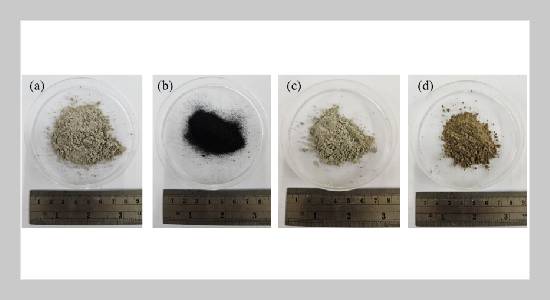
Powder material (a) Si; (b) Cr; (c) Ce and (d) FA
Copyright The Author(s). This is an open access article distributed under the terms of the Creative Commons Attribution License (CC BY 4.0), which permits unrestricted use, distribution, and reproduction in any medium, provided the original author and source are cited.
Download Citation: BibTeX | http://dx.doi.org/10.6180/jase.202611_34.005
Although numerous studies have evaluated asphalt modifiers, systematic comparisons of multiple micro scale additives under an identical experimental framework remain limited. To address this gap, this study analyzed the rheological performance and microstructural characteristics of asphalt binders modified with four micro-material additives: fly ash (FA), cement (Ce), crumb rubber (Cr), and silica (Si). Particle size reduction was carried out by milling, producing micro-scale particles, which were then blended with pure asphalt pen 60/70 (PG-64) at dosages of 1–3%. Performance was evaluated using conventional physical tests, rotational viscosity, Scanning Electron Microscope (SEM), and Dynamic Shear Rheometer (DSR) tests, including temperature sweeps under three aging conditions: original, RTFO and PAV. Results showed that the micro material modifiers significantly affected the physical and rheological characteristics of asphalt binders, reducing penetration values, raising softening points and enhancing viscoelastic performance across aging conditions. Temperature strongly influences binder viscosity, with higher temperatures producing lower viscosity and
varying levels of temperature sensitivity among binders. The modified binders, including Cement (VCe), Fly Ash (VFA), Crumb Rubber (VCr) and Silica (VSi) exhibited increased complex modulus (G∗) and reduced phase angle (δ), indicating improved stiffness, structural stability, and elastic behavior. Rheological evaluation further revealed that increasing temperature reduced rutting and fatigue performance, while modified binders generally exhibited lower fatigue parameter (G∗ sinδ) values than the virgin binder, indicating enhanced fatigue cracking resistance. The VCr mixture, particularly VCr-3, demonstrated the most effective improvement in long-term fatigue resistance and elastic performance.
Keywords: micro-material, modified asphalt binder, rheology, temperature sweep
- [1] M. Lagos-Varas, A. C. Raposeiras, D. Movilla-Quesada, J. P. Arenas, D. Castro-Fresno, O. Muñoz-Cáceres, and V. C. Andres-Valeri, (2020) “Study of the permanent deformation of binders and asphalt mixtures using rheological models of fractional viscoelasticity” Construction and Building Materials 260: 120438. DOI: 10.1016/j.conbuildmat.2020.120438.
- [2] A. B. Roy-Chowdhury, M. F. Saleh, and M. Moyers-Gonzalez, (2021) “Characterisation of Permanent Deformation Behaviour of Asphalt Mix Based on a Combined Elastic Plastic (CEP) Parameter” Infrastructures 6(12): 183. DOI: 10.3390/infrastructures6120183.
- [3] S. P. Hadiwardoyo, R. J. Sumabrata, A. C. Nissa, F. A. Muhammad, M. Hia, D. Iskandar, and R. H. Lumingkewas, (2023) “Improvement of Buton Rock Asphalt Performance by Adding Nano-Crumb Rubber and Waste Engine Oil” International Journal of Pavement Research and Technology 16(5): 1181–1195. DOI: 10.1007/s42947-022-00189-4.
- [4] X. Zhang, C. Han, J. Yang, X. Xu, and F. Zhang, (2021) “Evaluating the Rheological Properties of High-Modulus Asphalt Binders Modified with Rubber Polymer Composite Modifier” Materials 14(24): 7727. DOI: 10.3390/ma14247727.
- [5] A. Behnood and M. Modiri Gharehveran, (2019) “Morphology, rheology, and physical properties of polymer-modified asphalt binders” European Polymer Journal 112: 766–791. DOI: 10.1016/j.eurpolymj.2018.10.049.
- [6] R. Joumblat, Z. Al Basiouni Al Masri, and A. Elkordi, (2023) “Dynamic Modulus and Phase Angle of Asphalt Concrete Mixtures Containing Municipal Solid Waste Incinerated Fly Ash as Mineral Filler Substitution” International Journal of Pavement Research and Technology 16(5): 1196–1216. DOI: 10.1007/s42947-022-00190-x.
- [7] I. S. Bessa, K. L. Vasconcelos, V. T. F. Castelo Branco, and L. L. B. Bernucci, (2019) “Fatigue resistance of asphalt binders and the correlation with asphalt mixture behaviour” Road Materials and Pavement Design 20(sup2): S695–S709. DOI: 10.1080/14680629.2019.1633741.
- [8] M. A. Notani, P. Hajikarimi, F. M. Nejad, and A. Khodaii, (2020) “Rutting resistance of toner-modified asphalt binder and mixture” International Journal of Pavement Research and Technology 13(1): 1–9. DOI: 10.1007/s42947-019-0131-z.
- [9] S. Sreedhar and E. Coleri, (2018) “Effects of Binder Content, Density, Gradation, and Polymer Modification on Cracking and Rutting Resistance of Asphalt Mixtures Used in Oregon” Journal of Materials in Civil Engineering 30(11): 04018298. DOI: 10.1061/(ASCE)MT.1943-5533.0002506.
- [10] V. F. d. S. Neto, L. C. d. F. L. Lucena, A. G. de Barros, A. E. d. F. L. Lucena, and P. G. T. M. Filho, (2022) “Rheological evaluation of asphalt binder modified with zinc oxide nanoparticles” Case Studies in Construction Materials 17: e01224. DOI: 10.1016/j.cscm.2022.e01224.
- [11] M. L. C. Aidara, M. Ba, and A. Carter, (2020) “Impact of Intrinsic Properties of Aggregate and Volumetric Properties of Hot Mixture Asphalt (HMA) in the Influence of the Resistance to Rutting” Open Journal of Civil Engineering 10(3): 187–194. DOI: 10.4236/OJCE.2020.103016.
- [12] L. M. de Barros, L. A. H. do Nascimento, and F. T. S. Aragão, (2022) “Effects of binder and aggregate properties on the permanent deformation of asphalt mixtures by means of uniaxial and triaxial tests” Construction and Building Materials 332: 127346. DOI: 10.1016/J.CONBUILDMAT.2022.127346.
- [13] Y. Yan, H. Zhang, M. Bekoe, C. Allen, J. Zhou, and R. Roque, (2023) “Effects of asphalt binder type, aggregate type, and gradation characteristics on fracture properties and performance of asphalt mixtures at intermediate temperatures” Construction and Building Materials 409: 133801. DOI: 10.1016/J.CONBUILDMAT.2023.133801.
- [14] G. Tian, C. Chen, T. Zhang, Y. Gao, S. Wang, Y. Jia, Z. Chen, Y. Li, Z. Zhou, and Z. Wei, (2023) “Effect of high-elasticity anti-rutting additive on viscoelastic behavior of asphalt binder and its modification mechanism” Case Studies in Construction Materials 19: e02504. DOI: 10.1016/J.CSCM.2023.E02504.
- [15] A. Behnood and M. Modiri Gharehveran, (2019) “Morphology, rheology, and physical properties of polymer-modified asphalt binders” European Polymer Journal 112: 766–791. DOI: 10.1016/J.EURPOLYMJ.2018.10.049.
- [16] L. Porot, E. Chailleux, P. Apostolidis, J. Zhu, A. Margaritis, and L. Tsantilis, (2022) “Complex Bituminous Binders, Are Current Test Methods Suitable for?” RILEM Bookseries 27: 37–43. DOI: 10.1007/978-3-030-46455-4_5/SAVE-RESEARCH.
- [17] Q. Liu, J. Wu, X. Qu, C. Wang, and M. Oeser, (2020) “Investigation of bitumen rheological properties measured at different rheometer gap sizes” Construction and Building Materials 265: 120287. DOI: 10.1016/J.CONBUILDMAT.2020.120287.
- [18] F. S. Bhat and M. S. Mir, (2020) “Rheological investigation of asphalt binder modified with nanosilica” International Journal of Pavement Research and Technology 14(3): 276–287. DOI: 10.1007/S42947-020-0327-2.
- [19] W. Haroon and N. Ahmad, (2024) “Effect of nano silica on the performance of modified crumb rubber bitumen and asphalt mixtures” Innovative Infrastructure Solutions 9(7): 280–. DOI: 10.1007/S41062-024-01590-7.
- [20] G. Shafabakhsh, M. Motamedi, M. Firouznia, and M. Isazadeh, (2019) “Experimental investigation of the effect of asphalt binder modified with nanosilica on the rutting, fatigue and performance grade” Petroleum Science and Technology 37(13): 1495–1500. DOI: 10.1080/10916466.2018.1476534.
- [21] H. H. Zghair, H. Jony, and M. Hassan. “Rheological Characteristics of Nano Silica Modified Asphalt Binder Material”. In: Proceedings of the 5th International Engineering Conference, IEC 2019. Institute of Electrical and Electronics Engineers Inc., 2019, 79–84. DOI: 10.1109/IEC47844.2019.8950636.
- [22] M. Saltan, S. Terzi, and S. Karahancer, (2018) “Performance analysis of nano modified bitumen and hot mix asphalt” Construction and Building Materials 173: 228–237. DOI: 10.1016/j.conbuildmat.2018.04.014.
- [23] A. M. Al-Sabaeei, M. B. Napiah, M. H. Sutanto, W. S. Alaloul, S. E. Zoorob, and A. Usman, (2022) “Influence of nanosilica particles on the high-temperature performance of waste denim fibre-modified bitumen” International Journal of Pavement Engineering 23(2): 207–220. DOI: 10.1080/10298436.2020.1737060.
- [24] B. Shi and S. Zhou, (2024) “Application of fume silica nanoparticles to improve high-temperature rheological performance of terminal blend rubberized asphalt” Case Studies in Construction Materials 20: e03276. DOI: 10.1016/j.cscm.2024.e03276.
- [25] E. I. Szerb, I. Nicotera, B. Teltayev, R. Vaiana, and C. O. Rossi, (2018) “Highly stable surfactant-crumb rubber-modified bitumen: NMR and rheological investigation” Road Materials and Pavement Design 19(5): 1192–1202. DOI: 10.1080/14680629.2017.1289975.
- [26] Rosnawati Buhari, S. S. Razi Zainal, N. H. Mohd Kamaruddin, and K. N. Yunos, (2024) “Effect of Amine Additive on Rutting Resistance of Rubberized Asphalt Binder” Journal of Advanced Research in Applied Mechanics 123(1): 135–146. DOI: 10.37934/aram.123.1.135146.
- [27] R. M. Badri, Z. A. Alkaissi, and M. Sutanto, (2021) “Physical, rheological and morphological characterization of modified asphalt binder with differing crumb rubber contents” Materials Today: Proceedings 42: 3028–3034. DOI: 10.1016/J.MATPR.2020.12.819.
- [28] S. J. Lee, C. K. Akisetty, and S. N. Amirkhanian, (2008) “The effect of crumb rubber modifier (CRM) on the performance properties of rubberized binders in HMA pavements” Construction and Building Materials 22(7): 1368–1376. DOI: 10.1016/j.conbuildmat.2007.04.010.
- [29] M. Khalili, K. Jadidi, M. Karakouzian, and S. Amirkhanian, (2019) “Rheological properties of modified crumb rubber asphalt binder and selecting the best modified binder using AHP method” Case Studies in Construction Materials 11: e00276. DOI: 10.1016/J.CSCM.2019.E00276.
- [30] N. K. Resentia, B. S. Subagio, E. S. Hariyadi, and R. G. Pradoto, (2023) “Rheological Characteristic of Petroleum Asphalt Binder Modified by Natural Nano Silica and Nano Fly ash” International Journal of Pavement Research and Technology 2023 18:3 18(3): 577–585. DOI: 10.1007/S42947-023-00365-0.
- [31] G. G. Al-Khateeb, A. Sukkari, H. Ezzat, E. Nasr, and W. Zeiada, (2024) “Rheology of Crumb Rubber-Modified Warm Mix Asphalt (WMA)” Polymers 16(7): 906. DOI: 10.3390/POLYM16070906.
- [32] H. H. Zghair, H. H. Joni, and M. S. Hassan, (2019) “Evaluation of the Effect of Mixing Conditions of Micro-Silica Modified Asphalt Binder” IOP Conference Series: Materials Science and Engineering 518(2): 022048. DOI: 10.1088/1757-899X/518/2/022048.
- [33] M. Saudy, M. Guirguis, S. ELBadawy, M. AbouZeid, and T. Madkour, (2026) “A comparative evaluation of sustainable asphalt binder modifiers for enhanced performance” Scientific Reports 16(1): 12213–. DOI: 10.1038/s41598-026-46495-w.
- [34] A. A. Setiawan, F. J. Philip, E. Permanasari, and Resdiansyah, (2019) “Skid Resistance and Micro-structure of Concrete Containing Waste Plastic Fiber for Rigid Pavement” Journal of Applied Science and Engineering 22(4): 597–606. DOI: 10.6180/JASE.201912_22(4).0001.
- [35] AASHTO T316. Standard Method of Test for Viscosity Determination of Asphalt Binder Using Rotational Viscometer This document is only for acquaintance This document is only for acquaintance. Tech. rep. 2019, 1–5. URL: https://matest.ru/uploads/standards/AASHTO_T316-13.pdf.
- [36] AASHTO M320, (2015) “Standard Specification for Performance-Graded Asphalt Binder This document is only for acquaintance This document is only for acquaintance” AASHTO Book of Standards 10: 1–12. URL: https://matest.ru/uploads/standards/AASHTO_M320-15.pdf.
- [37] R. L. Cosme, J. E. S. L. Teixeira, and J. L. Calmon, (2016) “Use of frequency sweep and MSCR tests to characterize asphalt mastics containing ornamental stone residues and LD steel slag” Construction and Building Materials 122: 556–566. DOI: 10.1016/J.CONBUILDMAT.2016.06.126.
- [38] H. Nazari, K. Naderi, and F. Moghadas Nejad, (2018) “Improving aging resistance and fatigue performance of asphalt binders using inorganic nanoparticles” Construction and Building Materials 170: 591–602. DOI: 10.1016/J.CONBUILDMAT.2018.03.107.