



Su Chen1, Dahai Li2, and Jing Wang1
1Department of Mechanical and Electrical Engineering, Henan Vocational College of Water Conservancy and Environment,
Zhengzhou, 450002 China
2School of Electronics and Electrical Engineering, Zhengzhou University of Science and Technology, Zhengzhou, 450064 China
Received: May 31, 2026
Accepted: July 15, 2026
Publication Date: August 05, 2026
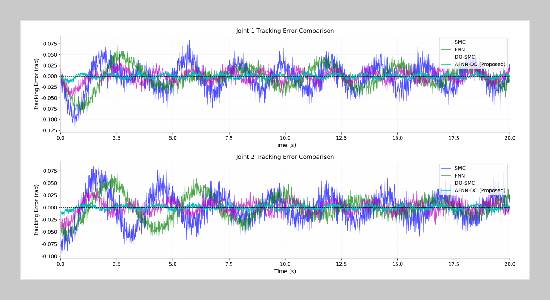
Comparison of Tracking Errors for Four Control Methods.
Copyright The Author(s). This is an open access article distributed under the terms of the Creative Commons Attribution License (CC BY 4.0), which permits unrestricted use, distribution, and reproduction in any medium, provided the original author and source are cited.
Download Citation: BibTeX | http://dx.doi.org/10.6180/jase.202611_34.004
Aiming at the nonlinear dynamic characteristics, parameter uncertainties, external complex disturbances, and inherent friction interference of multi-joint manipulator robots, in this work, a nonlinear disturbance observer (DO) is combined with an adaptive fuzzy neural network (AFNN) to form a new control strategy for manipulators. The dynamic model of the manipulator is formulated by considering various composite disturbances, including parametric uncertainties, unmodeled dynamics and external load interference. The developed nonlinear observer can achieve real-time observation and compensation for low-frequency lumped disturbances, thereby alleviating the operating pressure of the main control unit. The residual observation error and high-frequency unknown disturbances of the disturbance observer online are then approximated via an improved RBF fuzzy neural network (RBF-FNN). And adaptive learning laws of network weights are derived based on the Lyapunov stability criterion to realize self-adjustment of control parameters. In addition, the composite control strategy combining disturbance feed-forward compensation and fuzzy neural network adaptive feedback control effectively suppresses the chattering phenomenon existing in traditional sliding mode control and improves the trajectory tracking accuracy of the manipulator. Lyapunov stability criterion is adopted to rigorously demonstrate the stability of the overall closed-loop system. It is verified that both tracking errors and observation errors satisfy the uniform ultimate boundedness condition. Subsequently, comparative simulations are implemented on a two-link manipulator test platform. The results reveal that the presented AFNN-DO strategy outperforms conventional sliding mode control (SMC), standalone fuzzy neural network control and DO-based sliding mode control (DO-SMC) in response rapidity, tracking precision and disturbance rejection performance. The maximum position tracking error of each joint is reduced by 46.8% and 52.3% respectively, which verifies the feasibility and superiority of the proposed control method
Keywords: Manipulator robot; Disturbance observer; Adaptive fuzzy neural network; Trajectory tracking; Lyapunov stability; Lumped disturbance
- [1] R. Y. Zhong, X. Xu, E. Klotz, and S. T. Newman, (2017) “Intelligent manufacturing in the context of industry 4.0: a review” Engineering 3(5): 616–630. DOI: 10.1016/J.ENG.2017.05.015.
- [2] T. Yang, X. Yi, S. Lu, K. H. Johansson, and T. Chai, (2021) “Intelligent manufacturing for the process industry driven by industrial artificial intelligence” Engineering 7(9): 1224–1230. DOI: 10.1016/j.eng.2021.04.023.
- [3] L. Zhang, L. Zhou, L. Ren, and Y. Laili, (2019) “Modeling and simulation in intelligent manufacturing” Computers in Industry 112: 103123. DOI: 10.1016/j.compind.2019.08.004.
- [4] L. Tianhua and Y. Shoulin, (2015) “An improved neural network adaptive sliding mode control used in robot trajectory tracking control” 11(05): 1655. DOI: 10.24507/ijicic.11.05.1655.
- [5] V. T. Dang, T. D. T. Tran, D. B. H. Nguyen, and T. L. Nguyen, (2026) “Observer-based nonlinear cascade control approach of rewinding systems with uncertainties and disturbances compensation” International Journal of Automation and Control 20(3): 273–294. DOI: 10.1504/IJAAC.2026.153727.
- [6] J. Wang, M. Jung, S. Yin, and H. Li, (2025) “Adaptive Multi-Scale Gated Convolution and Context-Aware Attention Network for Accurate Small Object Detection ([J]” International Journal of Computational Methods and Experimental Measurements 13(3): 576–587. DOI: 10.56578/ijcmem130308.
- [7] S. Yin, L. Wang, T. Chen, H. Huang, J. Gao, J. Zhang, M. Liu, P. Li, and C. Xu, (2026) “LKAFormer: A lightweight kolmogorov-arnold transformer model for image semantic segmentation” ACM Transactions on Intelligent Systems and Technology 17(3): 1–24. DOI: 10.1145/3759254.
- [8] S. Chen, J. Liu, P. Wang, C. Xu, S. Cai, and J. Chu, (2024) “Accelerated optimization in deep learning with a proportional-integral-derivative controller” Nature Communications 15(1): 10263. DOI: 10.1038/s41467-024-54451-3.
- [9] M. A. Z. Tajrishi and A. A. Kalat, (2024) “Fast finite time fractional-order robust-adaptive sliding mode control of nonlinear systems with unknown dynamics” Journal of Computational and Applied Mathematics 438: 115554. DOI: 10.1016/j.cam.2023.115554.
- [10] M. K. Senapati, O. Al Zaabi, K. Al Hosani, K. Al Jaafari, C. Pradhan, and U. R. Muduli, (2024) “Advancing electric vehicle charging ecosystems with intelligent control of DC microgrid stability” IEEE Transactions on Industry Applications 60(5): 7264–7278. DOI: 10.1109/TIA.2024.3413052.
- [11] C.-L. Hwang and Y.-H. Chen, (2019) “Fuzzy fixed-time learning control with saturated input, nonlinear switching surface, and switching gain to achieve null tracking error” IEEE Transactions on Fuzzy Systems 28(7): 1464–1476. DOI: 10.1109/TFUZZ.2019.2917121.
- [12] T. Zeng, X. Ren, and Y. Zhang, (2019) “Fixed-time sliding mode control and high-gain nonlinearity compensation for dual-motor driving system” IEEE Transactions on Industrial Informatics 16(6): 4090–4098. DOI: 10.1109/TII.2019.2950806.
- [13] H.-G. Han, X.-L. Wu, Z. Liu, and J.-F. Qiao, (2017) “Design of self-organizing intelligent controller using fuzzy neural network” IEEE Transactions on Fuzzy systems 26(5): 3097–3111. DOI: 10.1109/TFUZZ.2017.2785812.
- [14] H. Jiang, G. Duan, and M. Hou, (2024) “State and disturbance observer-based controller design for fully actuated systems” IEEE Transactions on Circuits and Systems I: Regular Papers 71(11): 5261–5270. DOI: 10.1109/TCSI.2024.3399555.
- [15] D. Zhang, J. Hu, J. Cheng, Z.-G. Wu, and H. Yan, (2024) “A novel disturbance observer based fixed-time sliding mode control for robotic manipulators with global fast convergence” IEEE/CAA Journal of Automatica Sinica 11(3): 661–672. DOI: 10.1109/JAS.2023.123948.
- [16] Q. Wen, X. Yang, C. Huang, J. Zeng, Z. Yuan, and P. X. Liu, (2023) “Disturbance observer-based neural network integral sliding mode control for a constrained flexible joint robotic manipulator” International Journal of Control, Automation and Systems 21(4): 1243–1257. DOI: 10.1007/s12555-021-0972-5.
- [17] K. Guo, H. Zhang, C. Wei, H. Jiang, and J. Wang, (2024) “Novel sliding mode control of the manipulator based on a nonlinear disturbance observer” Scientific Reports 14(1): 30656. DOI: 10.1038/s41598-024-77125-y.
- [18] S. Wu, Z. Li, W. Chen, and F. Sun, (2024) “Dynamic modeling of robotic manipulator via an augmented deep Lagrangian network” Tsinghua Science and Technology 29(5): 1604–1614. DOI: 10.26599 / TST.2024.9010011.
- [19] Z. Zhou and C. Gosselin, (2024) “Simplified inverse dynamic models of parallel robots based on a Lagrangian approach” Meccanica 59(4): 657–680. DOI: 10.1007/s11012-024-01782-6.
- [20] B. Li, X. Li, H. Gao, and F.-Y. Wang, (2024) “Advances in flexible robotic manipulator systems—Part I: Overview and dynamics modeling methods” IEEE/ASME Transactions on Mechatronics 29(2): 1100–1110. DOI: 10.1109/TMECH.2024.3359067.