



School of Foreign Languages, Zhengzhou University of Science and Technology, Zhengzhou 450064 China
Received: January 02, 2026
Accepted: July 10, 2026
Publication Date: August 05, 2026
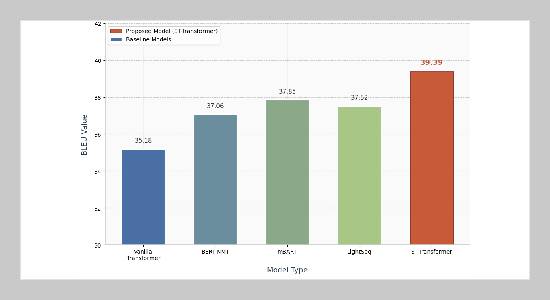
BLEU value comparison of different models on self-built academic corpus
Copyright The Author(s). This is an open access article distributed under the terms of the Creative Commons Attribution License (CC BY 4.0), which permits unrestricted use, distribution, and reproduction in any medium, provided the original author and source are cited.
Download Citation: BibTeX | http://dx.doi.org/10.6180/jase.202611_34.003
Academic text translation differs from general text translation due to its rigorous logical structure, specialized domain terminology, fixed syntactic patterns, and high requirements for semantic fidelity. Traditional neural machine translation (NMT) models based on vanilla Transformer suffer from two core defects in English-Chinese academic translation: insufficient capture of domain-specific term semantic features and weak long-distance
logical dependency modeling, which easily cause terminology mistranslation, logical dislocation, and low readability of translated texts. To solve the above problems, this paper proposes a novel deep learning aided English-Chinese academic text translation model (ST-Transformer) based on semantic term enhancement and hierarchical gated attention mechanism. Firstly, a domain academic term embedding module is constructed to fuse term dictionary features and contextual semantic information to realize differentiated encoding of common words and professional terms. Secondly, a hierarchical gated attention unit is designed to optimize the multi-head attention structure of the encoder, suppress invalid redundant information in long academic sentences, and strengthen the correlation between core semantic components. Finally, a length penalty adaptive loss function is introduced to balance the translation quality of long and short academic sentences and avoid incomplete translation of complex clauses. Based on self-constructed multi-domain academic parallel corpus and public IWSLT2019 academic translation dataset, comparative experiments are conducted with mainstream baseline models including vanilla Transformer, BERT-NMT, mBART and LightSeq. The experimental results show that the proposed ST-Transformer model achieves 4.21 BLEU points and 3.86 COMET points higher than the vanilla Transformer on English-Chinese academic translation tasks. Meanwhile, the terminology translation accuracy reaches 96.35%, which effectively improves the overall translation quality and semantic consistency of academic texts. Ablation experiments verify the independent effectiveness of each improved module. This study provides an efficient technical solution for intelligent and high-quality translation of cross-language academic papers, monographs and research reports.
Keywords: Neural Machine Translation; Academic Text; English-Chinese Translation; Transformer; Gated Attention; Term Embedding
- [1] A. Chidlow, E. Plakoyiannaki, and C. Welch, (2014) “Translation in cross-language international business research: Beyond equivalence” Journal of international business studies 45(5): 562–582. DOI: 10.1057/jibs.2013.67.
- [2] M. Todorova, (2018) “Civil society in translation: innovations to political discourse in Southeast Europe” The Translator 24(4): 353–366. DOI: 10.1080/13556509.2019.1586071.
- [3] B. Heinisch, (2021) “The role of translation in citizen science to foster social innovation” Frontiers in sociology 6: 629720. DOI: 10.3389/fsoc.2021.629720.
- [4] J. Yu, L. Zhao, S. Yin, and M. Ivanović, (2024) “News recommendation model based on encoder graph neural network and bat optimization in online social multimedia art education” Computer Science and Information Systems 21(3): 989–1012. DOI: 10.2298/CSIS231225025Y.
- [5] Y. Jiang and S. Yin, (2023) “Heterogenous-view occluded expression data recognition based on cycle-consistent adversarial network and K-SVD dictionary learning under intelligent cooperative robot environment” Computer Science and Information Systems 20(4): 1869–1883. DOI: 10.2298/CSIS221228034J.
- [6] D. O’Neil, (2025) “Standardization, power, and purity: Ideological tensions in language and scientific discourse” Education Sciences 15(4): 489. DOI: 10.3390/educsci15040489.
- [7] V. Stepanova, (2015) “Legal drafting and editing in academic studies” Procedia-Social and Behavioral Sciences 214: 1116–1124. DOI: 10.1016/j.sbspro.2015.11.715.
- [8] S. C. Siu. “Revolutionising translation with AI: Unravelling neural machine translation and generative pre-trained large language models”. In: New advances in translation technology: Applications and pedagogy. Springer, 2024, 29–54. DOI: 10.1007/978-981-97-2958-6_3.
- [9] S. Bo, Y. Zhang, J. Huang, S. Liu, Z. Chen, and Z. Li. “Attention mechanism and context modeling system for text mining machine translation”. In: 2024 6th International Conference on Data-driven Optimization of Complex Systems (DOCS). IEEE. 2024, 857–863. DOI: 10.1109/DOCS63458.2024.10704434.
- [10] T. G. Fantaye and G. Abera. “Developing Bidirectional English-Anuak Machine Translation Using a Deep Learning Approach”. In: Pan African Conference on Artificial Intelligence. Springer. 2024, 293–308. DOI: 10.1007/978-3-032-05063-2_13.
- [11] V. Ashish, S. Noam, P. Niki, U. Jakob, J. Llion, N. Aidan, K. Łukasz, and P. Illia. “Attention is all you need: Advances in neural information processing systems”. In: NeurIPS Proceedings. 2017. DOI: 10.65215/r5bs2d54.
- [12] K. Hu, A. A. Laghari, Y. Liu, J. Li, and H. Li, (2026) “Application of Adaptive Step Size Runge-Kutta Method in Solving Ordinary Differential Equations” IFS/ACM Transactions on Machine Learning 3(1): 1–8. DOI: 10.70891/TML.2026.040001.
- [13] M. I. Ragab, E. H. Mohamed, and W. Medhat. “Multilingual propaganda detection: Exploring transformer-based models mBERT, XLM-RoBERTa, and mT5”. In: Proceedings of the first International Workshop on Nakba Narratives as Language Resources. 2025, 75–82.
- [14] R. Tairas and J. Cabot, (2015) “Corpus-based analysis of domain-specific languages” Software & Systems Modeling 14(2): 889–904. DOI: 10.1007/s10270-013-0352-6.
- [15] M. M. Prajapati and H. A. Patil. “Speech-to-Tree: Cultivating Dependency Structures from Spoken English”. In: 2025 International Conference on Asian Language Processing (IALP). IEEE. 2025, 79–84. DOI: 10.1109/IALP68296.2024.11156314.
- [16] P. Li, Q. Zhu, and W. Zhang. “A dependency tree based approach for sentence-level sentiment classification”. In: 2011 12th ACIS International Conference on Software Engineering, Artificial Intelligence, Networking and Parallel/Distributed Computing. IEEE. 2011, 166–171. DOI: 10.1109/SNPD.2011.20.
- [17] D. H. Whetstone, L. E. Ridenour, and H. Moulaison-Sandy, (2022) “Questionable authorship practices across the disciplines: Building a multidisciplinary thesaurus using evolutionary concept analysis” Library & Information Science Research 44(4): 101201. DOI: 10.1016/j.lisr.2022.101201.
- [18] H. Liu, Z. Dong, R. Jiang, J. Deng, J. Deng, Q. Chen, and X. Song. “Spatio-temporal adaptive embedding makes vanilla transformer sota for traffic forecasting”. In: Proceedings of the 32nd ACM international conference on information and knowledge management. 2023, 4125–4129. DOI: 10.1145/3583780.3615160.
- [19] S. Yin, L. Wang, A. A. Laghari, L. Teng, G. Srivastava, A. Almadhor, and T. R. Gadekallu, (2026) “FGM-MLSD: A Fuzzy Region Competition and Gaussian Mixture Segment Model Via Modified Line Segment Detector Model for Airport Object Saliency Detection in Remote Sensing Images” IEEE Transactions on Fuzzy Systems 34(4): 1175–1186. DOI: 10.1109/TFUZZ.2026.3650858.
- [20] G. Polat, Ü. M. Çağlar, and A. Temizel, (2025) “Class distance weighted cross entropy loss for classification of disease severity” Expert Systems with Applications 269: 126372. DOI: 10.1016/j.eswa.2024.126372.
- [21] S. Xiong, Z. Pang, and Y. Cheng. “Low-Resource Machine Translation Model Based on Hybrid Retrieval Enhancement and Dual Feedback Memory Mechanism”. In: 2025 5th International Conference on Computer Science, Electronic Information Engineering and Intelligent Control Technology (CEI). IEEE. 2025, 1–4. DOI: 10.1109/CEI66465.2025.11398435.
- [22] H. Huang, H. Zhang, Y. Wang, H. Liu, X. Chen, Y. Chen, and Y. Liang, (2025) “Integrated Robust Optimization for Lightweight Transformer Models in Low-Resource Scenarios” Symmetry 17(7): 1162. DOI: 10.3390/sym17071162.