




Cheng-Wei Hung1 and Pen-Chou Chen2
1Department of Civil Engineering and Environmental Informatics, Minghsin University of Science and Technology, Hsinchu 30401, Taiwan
2Department of Civil Engineering, National Chung Hsing University, Taichung 40227, Taiwan
Received: May 06, 2025
Accepted: June 19, 2026
Publication Date: August 05, 2026
SHAP summary plot for the best-performing model.
Copyright The Author(s). This is an open access article distributed under the terms of the Creative Commons Attribution License (CC BY 4.0), which permits unrestricted use, distribution, and reproduction in any medium, provided the original author and source are cited.
Download Citation: BibTeX | http://dx.doi.org/10.6180/jase.202611_34.002
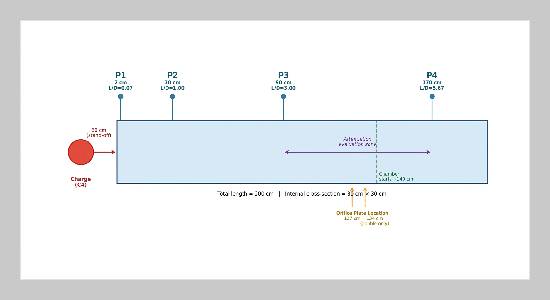
External explosions near tunnel entrances can transmit severe shock waves into rectangular underground passages. This study experimentally compares three compact internal blast-pressure reduction configurations: an expansion chamber, a single-orifice plate, and a double-orifice plate. Scaled C4 explosive tests were conducted using 100-350g charges located 60 cm from the tunnel entrance and aligned with the tunnel centreline. A
rectangular steel tunnel model with a 30 cm × 30 cm internal cross-section and a total length of 200 cm was instrumented at L/D = 0.07, 1.00, 3.00, and 5.67. The main attenuation index was the downstream-to-upstream peak-pressure ratio between L/D = 3.00 and L/D = 5.67. Across the five charge masses, the expansion chamber, single-orifice plate, and double-orifice plate produced mean experimental pressure reductions of 29.9 ±9.9%,51.2 ±6.1%, and 81.9±3.8%, respectively. The double-orifice configuration provided the strongest attenuation because it introduced two sequential restriction and diffraction stages. For the expansion chamber, the downstream pressure represents an intra-chamber measurement and should not be interpreted as a post chamber transmission coefficient. The numerical observations are retained only as supplementary qualitative interpretation; the experimental results form the quantitative basis of the conclusions. The findings provide a bounded experimental ranking of compact geometric attenuation devices for rectangular tunnel blast mitigation, rather than a general design standard.
Keywords: confined blast; pressure reduction; scaled explosive testing; geometric restriction; shock-wave diffraction; protective design
- [1] Department of the Army. TM 5-1300: Structures to Resist the Effects of Accidental Explosions. U.S. Department of the Army. Washington, DC, 1990.
- [2] Department of the Army. TM 5-855-1: Fundamentals of Protective Design for Conventional Weapons. U.S. Department of the Army. Washington, DC, 1998.
- [3] P. D. Smith, P. Vismeg, L. C. Teo, and L. Tingey, (1998) “Blast wave transmission along rough-walled tunnels” International Journal of Impact Engineering 21(6): 419–432. DOI: 10.1016/S0734-743X(98)00003-7.
- [4] A. Britan, O. Igra, G. Ben-Dor, and H. Shapiro, (2006) “Shock wave attenuation by grids and orifice plates” Shock Waves 16: 1–15. DOI: 10.1007/s00193-006-0019-0.
- [5] G. W. McMahon, J. R. Britt, and B. C. Patterson. “Airblast Propagation within Tunnels from Portal Detonations”. In: Proceedings of the 18th Military Aspects of Blast and Shock. Bad Reichenhall, Germany, 2004.
- [6] G. W. McMahon and S. R. Taylor. In-Tunnel Airblast from Near-Portal Detonations. Tech. rep. Vicksburg, MS, USA: Engineer Research and Development Center, 2005.
- [7] S. Berger, G. Ben-Dor, and O. Sadot, (2015) “Experimental and numerical investigations of shock-wave attenuation by geometrical means: A single barrier configuration” European Journal of Mechanics – B/Fluids 50: 60–70. DOI: 10.1016/j.euromechflu.2014.11.006.
- [8] S. Berger, G. Ben-Dor, and O. Sadot, (2015) “Numerical investigation of shock-wave attenuation by geometrical means: Double barrier configuration” Journal of Fluids Engineering 137(4): 041203. DOI: 10.1115/1.4028875.
- [9] M. Eslami, P. K. MirzaMohammadi, S. H. Khalilpour, H. Parsa, and V. Kodur, (2023) “Experimental and numerical investigation of blast wave attenuation by using barriers in different configurations and shapes” Journal of Structural Engineering 149(1): 04022200. DOI: 10.1061/JSENDH.STENG-11408.
- [10] P. K. MirzaMohammadi, S. H. Khalilpour, H. Parsa, and P. Sareh, (2023) “Symmetric multipath branching as a layout design strategy for blast-resilient tunnel structures” Structures 58: 105616. DOI: 10.1016/j.istruc.2023.105616.
- [11] O. S. Isaac, O. G. Alshammari, E. G. Pickering, S. D. Clarke, and S. E. Rigby, (2023) “Blast wave interaction with structures – an overview” International Journal of Protective Structures 14(4): 584–630. DOI: 10.1177/20414196221118595.
- [12] C. W. Hung and C. C. Tai, (2021) “Numerical study of pressure attenuation effect on tunnel explosion” Applied Sciences 11(12): 5646. DOI: 10.3390/app11125646.
- [13] Z. Wu, D. Jin, B. Yu, S. Chen, S. Deng, X. Song, W. Yu, Y. Sui, H. Wu, W. Shi, and M. Wang, (2025) “Experimental and numerical investigation on shock wave attenuation in a chamber” Scientific Reports 15: 11493. DOI: 10.1038/s41598-025-93836-2.
- [14] V. Vinod, G. P. Majji, S. V. Anil, R. O. Ram, and L. D. Chandrala, (2025) “Attenuation of blast waves using rigid porous plate arrays: Insights from experiments and simulations” Physics of Fluids 37(7): 076135. DOI: 10.1063/5.0273908.
- [15] V. M. Deshpande and T. Chakraborty, (2024) “Numerical analysis of a tunnel subjected to blast loads in a transversely isotropic rock mass” International Journal of Geomechanics 24(10): 04024214. DOI: 10.1061/IJGNAI.GMENG-9274.
- [16] J. Li, Y. Wang, J. Huang, B. Du, Z. Zong, and M. Li, (2026) “Blast wave propagation and overpressure prediction in a tunnel with one closed end” Tunnelling and Underground Space Technology 170: 107370. DOI: 10.1016/j.tust.2025.107370.
- [17] J. O. Hallquist. LS-DYNA Theory Manual. Livermore Software Technology Corporation. Livermore, CA, 2006.
- [18] Livermore Software Technology Corporation. LS-DYNA Keyword User’s Manual, Version 971. Livermore Software Technology Corporation. Livermore, CA, 2012.
- [19] Y. H. Bi. “Numerical Simulation and Validation of Shock Wave Propagation within a Tunnel”. (mathesis). Taoyuan, Taiwan: National Defense University, 2013.
- [20] PCB Piezotronics. Model 113A23 ICP Pressure Sensor Specification Sheet. PCB Piezotronics. Depew, NY, 2012.