





Department of Engineering Management, Henan Technical College of Construction, Zhengzhou 450064, Henan, China
Received: November 10, 2025
Accepted: April 29, 2026
Publication Date: August 02, 2026
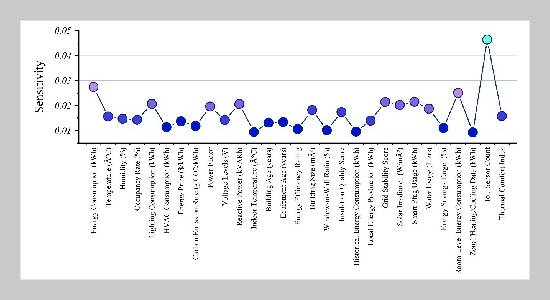
SHAP summary plot for the best-performing model.
Copyright The Author(s). This is an open access article distributed under the terms of the Creative Commons Attribution License (CC BY 4.0), which permits unrestricted use, distribution, and reproduction in any medium, provided the original author and source are cited.
Download Citation: BibTeX | http://dx.doi.org/10.6180/jase.202611_34.001
Energy conservation emerged as a global priority due to rising energy demand, environmental concerns, and the share of industrial and urban sectors in consumption. Energy-saving potential requires exact prediction because this information enables the creation of efficient retrofit methods and sustainable energy policy frameworks. This study develops and evaluates predictive models for estimating energy-saving potential using a dataset of 2,191 aggregated daily samples derived from 52,584 raw measurements. The dataset includes 29 input variables, with feature selection performed through the Variance Inflation Factor (VIF) analysis to address multicollinearity. Three Machine Learning (ML) models, Extra Trees Regression (ETR), Quantile Regression (QR), and Stochastic Gradient Boosting (SGB), are implemented and optimized using two metaheuristic algorithms, the Kepler Optimization Algorithm (KOA) and the Gazelle Optimization Algorithm (GOA). Model performance is assessed via 5-fold cross-validation and evaluated using R², RMSE, COV, PI, MAE, and MARD metrics, along with runtime analysis. Statistical robustness is ensured through the Wilcoxon test, while SHAP analysis was performed on the best-performing model to identify the most influential features driving energy-saving potential. The best-performing model was SGKA (KOA-optimized SGB), which achieved the highest accuracy (R² = 0.975) and the lowest RMSE (0.162), along with the smallest MAE and MARD values in the test phase. Optimized ensemble learning methods produce both precise and dependable, and easily understood prediction results, according to the research findings. The research field will progress through the development of hybrid physics–data systems and deep learning methods, and real-time prediction systems. These will include occupant behavior analysis.
Keywords: Energy-saving potential; Machine learning; Extra trees regression; Quantile regression; Wilcoxon test
- [1] A. Shahsavari and M. Akbari, (2018) “Potential of solar energy in developing countries for reducing energy-related emissions” Renewable and sustainable energy reviews 90: 275–291. DOI: 10.1016/j.rser.2018.03.065.
- [2] M. M. Bah and M. Y. Saari, (2020) “Quantifying the impacts of energy price reform on living expenses in Saudi Arabia” Energy Policy 139: 111352. DOI: 10.1016/j.enpol.2020.111352.
- [3] A. Allouhi, Y. E. Fouih, T. Kousksou, A. Jamil, Y. Zeraouli, and Y. Mourad, (2015) “Energy consumption and efficiency in buildings: current status and future trends” Journal of Cleaner production 109: 118–130. DOI: 10.1016/j.jclepro.2015.05.139.
- [4] A. Martos, R. Pacheco-Torres, J. Ordóñez, and E. Jadraque-Gago, (2016) “Towards successful environmental performance of sustainable cities: Intervening sectors. A review” Renewable and Sustainable Energy Reviews 57: 479–495. DOI: 10.1016/j.rser.2015.12.095.
- [5] B. Lin and J. Zhu, (2019) “Impact of energy saving and emission reduction policy on urban sustainable development: Empirical evidence from China” Applied Energy 239: 12–22. DOI: 10.1016/j.apenergy.2019.01.166.
- [6] S. A. H. Zaidi, M. Hussain, and Q. U. Zaman, (2021) “Dynamic linkages between financial inclusion and carbon emissions: evidence from selected OECD countries” Resources, Environment and Sustainability 4: 100022. DOI: 10.1016/j.resenv.2021.100022.
- [7] K. S. Moon, (2008) “Sustainable structural engineering strategies for tall buildings” The Structural Design of Tall and Special Buildings 17: 895–914. DOI: 10.1002/tal.475.
- [8] J.-K. Choi, J. Eom, and E. McClory, (2018) “Economic and environmental impacts of local utility-delivered industrial energy-efficiency rebate programs” Energy Policy 123: 289–298. DOI: 10.1016/j.enpol.2018.08.066.
- [9] V. Jadhav, R. Jadhav, P. Magar, S. Kharat, and S. U. Bagwan. “Energy conservation through energy audit”. In: 2017 International Conference on Trends in Electronics and Informatics (ICEI). IEEE, 2017, 481–485. DOI: 10.1109/ICOEI.2017.8300974.
- [10] I. Johansson, S. Johnsson, and P. Thollander, (2022) “Impact evaluation of an energy efficiency network policy programme for industrial SMEs in Sweden” Resources, Environment and Sustainability 9: 100065. DOI: 10.1016/j.resenv.2022.100065.
- [11] F. J. Montáns, F. Chinesta, R. Gómez-Bombarelli, and J. N. Kutz, (2019) “Data-driven modeling and learning in science and engineering” Comptes Rendus Mécanique 347: 845–855. DOI: 10.1016/j.crme.2019.11.009.
- [12] X. Yang, S. Liu, Y. Zou, W. Ji, Q. Zhang, A. Ahmed, X. Han, Y. Shen, and S. Zhang, (2022) “Energy-saving potential prediction models for large-scale building: A state-of-the-art review” Renewable and Sustainable Energy Reviews 156: 111992. DOI: 10.1016/j.rser.2021.111992.
- [13] P. Shen, Z. Wang, and Y. Ji, (2021) “Exploring potential for residential energy saving in New York using developed lightweight prototypical building models based on survey data in the past decades” Sustainable Cities and Society 66: 102659. DOI: 10.1016/j.scs.2020.102659.
- [14] J. Ko, J. Park, and J.-W. Jeong, (2021) “Energy saving potential of a model-predicted frost prevention method for energy recovery ventilators” Applied Thermal Engineering 185: 116450. DOI: 10.1016/j.applthermaleng.2020.116450.
- [15] Y. Xu, J. Winter, and W.-C. Lee. “Prediction-based strategies for energy saving in object tracking sensor networks”. In: IEEE International Conference on Mobile Data Management, 2004. Proceedings. 2004. IEEE, 2004, 346–357. DOI: 10.1109/MDM.2004.1263084.
- [16] T. M. Chung and J. Burnett, (2001) “On the prediction of lighting energy savings achieved by occupancy sensors” Energy engineering 98: 6–23. DOI: 10.1080/01998590109509317.
- [17] W. Kleiminger, S. Santini, and F. Mattern. Simulating the energy savings potential in domestic heating scenarios in Switzerland. 2014. DOI: 10.3929/ethz-a-010193004.
- [18] H.-I. Cho, D. Cabrera, and M. K. Patel, (2020) “Estimation of energy savings potential through hydraulic balancing of heating systems in buildings” Journal of Building Engineering 28: 101030. DOI: 10.1016/j.jobe.2019.101030.
- [19] K. B. Wittchen, J. Kragh, and O. M. Jensen, (2011) “Energy saving potentials–A case study on the Danish building stock” SBi, Aalborg University:
- [20] M. Y. M. Yusop. Energy saving for pneumatic actuation using dynamic model prediction. Cardiff University (United Kingdom), 2006.
- [21] E. Widayati, (2021) “Estimating Energy Saving Potential by Taking Into Account Interdependence Effect Case Study: High Rise Office Building in Jakarta” Jurnal Inovasi Pendidikan dan Sains 2: 26–32. DOI: 10.51673/jips.v2i1.476.
- [22] C. Zhang, F. Zhao, and Y. Liu, (2012) “Diagrid tube structures composed of straight diagonals with gradually varying angles” The Structural Design of Tall and Special Buildings 21: 283–295. DOI: 10.1002/tal.596.
- [23] D. Engineer. Southern California Energy Consumption Dataset. Kaggle, 2024.
- [24] R. M. O’brien, (2007) “A caution regarding rules of thumb for variance inflation factors” Quality & quantity 41: 673–690. DOI: 10.1007/s11135-006-9018-6.
- [25] P. Geurts, D. Ernst, and L. Wehenkel, (2006) “Extremely randomized trees” Machine learning 63: 3–42. DOI: 10.1007/s10994-006-6226-1.
- [26] R. Koenker and G. B. Jr, (1978) “Regression quantiles” Econometrica: journal of the Econometric Society: 33–50. DOI: 10.2307/1913643.
- [27] J. H. Friedman, (2002) “Stochastic gradient boosting” Computational statistics & data analysis 38: 367–378. DOI: 10.1016/S0167-9473(01)00065-2.
- [28] S. H. Hakmi, A. M. Shaheen, H. Alnami, G. Moustafa, and A. Ginidi, (2023) “Kepler algorithm for large-scale systems of economic dispatch with heat optimization” Biomimetics 8: 608. DOI: 10.3390/biomimetics8080608.
- [29] J. O. Agushaka, A. E. Ezugwu, and L. Abualigah, (2023) “Gazelle optimization algorithm: a novel nature-inspired metaheuristic optimizer” Neural Computing and Applications 35: 4099–4131. DOI: 10.1007/s00521-022-07854-6.
- [30] R. Kohavi. “A study of cross-validation and bootstrap for accuracy estimation and model selection”. In: Ijcai. 14. Montreal, Canada, 1995, 1137–1145.
- [31] J. Bergstra and Y. Bengio, (2012) “Random search for hyper-parameter optimization.” Journal of machine learning research 13:
- [32] L. Bottou, F. E. Curtis, and J. Nocedal, (2018) “Optimization methods for large-scale machine learning” SIAM review 60: 223–311. DOI: 10.1137/16M1080173.