


Foreign Linguistics and Applied Linguistics, Xi’an Fanyi University, Xi’an 710105, China
Received: March 3, 2026
Accepted: May 06, 2026
Publication Date: August 02, 2026
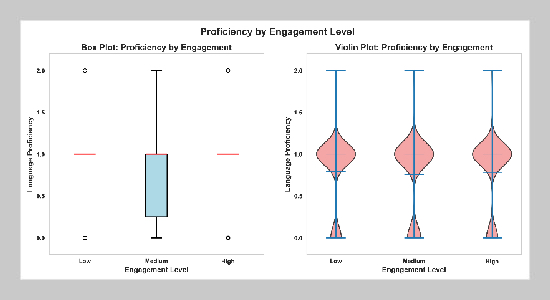
Proficiency by Engagement Level.
Copyright The Author(s). This is an open access article distributed under the terms of the Creative Commons Attribution License (CC BY 4.0), which permits unrestricted use, distribution, and reproduction in any medium, provided the original author and source are cited.
Download Citation: BibTeX | http://dx.doi.org/10.6180/jase.202610_33.062
This study examines adaptive learning in English language teaching with a sample of 1,000 students. It is evident that adaptive learning greatly increases student engagement as evident from participation patterns (p < 0.001, Cohen’s d = 6.937). Yet engagement does not have a significant effect on language proficiency (r =-0.008, p = 0.805). Rather, skill is heavily predicted by linguistic features such as mean sentence length, lexical density, grammaticality, and overall quality (R2 = 0.554), suggesting that skill-based language learning is more important than just participation. This proposed framework facilitates a deeper comprehension of the correlation between student engagement and language development, while also giving educators relevant insights to create personalized learning strategies. In conclusion, this study makes it clear that adaptive learning technologies have a significant positive effect on engagement, while at the same time emphasizing the importance of linguistic skills development for English proficiency advancement.
Keywords: Adaptive learning; student engagement; English language proficiency; linguistic analysis; personalized education
- [1] H. A. El-Sabagh, (2021) “Adaptive e-learning environment based on learning styles and its impact on development students’ engagement” International Journal of Educational Technology in Higher Education 18(1): 53. DOI: 10.1186/s41239-021-00289-4.
- [2] M. Mejeh and M. Rehm, (2024) “Taking adaptive learning in educational settings to the next level: leveraging natural language processing for improved personalization” Educational Technology Research and Development 72(3): 1597–1621. DOI: 10.1007/s11423-024-10345-1.
- [3] L. Lim, S. H. Lim, and W. Y. R. Lim, (2023) “Efficacy of an adaptive learning system on course scores” Systems 11(1): 31. DOI: 10.3390/systems11010031.
- [4] J. Yiling, M. Omar, and F. M. Kamaruzaman, (2025) “Exploring the AI-Enhanced Project-Based Learning for English Language Acquisition: A Systematic Review of the Key Elements and Emerging Technology Trends” International Journal of Learning, Teaching and Educational Research 24(2): 636–652. DOI: 10.26803/ijlter.24.2.31.
- [5] T.-T. Wu, H.-Y. Lee, W.-S. Wang, C.-J. Lin, and Y.-M. Huang, (2023) “Leveraging computer vision for adaptive learning in STEM education: effect of engagement and self-efficacy” International Journal of Educational Technology in Higher Education 20(1): 53. DOI: 10.1186/s41239-023-00422-5.
- [6] R. Sajja, Y. Sermet, M. Cikmaz, D. Cwiertny, and I. Demir, (2024) “Artificial Intelligence-Enabled Intelligent Assistant for Personalized and Adaptive Learning in Higher Education” Information 15(10): 596. DOI: 10.3390/info15100596.
- [7] H.-C. Yeh, (2025) “The synergy of generative AI and inquiry-based learning: transforming the landscape of English teaching and learning” Interactive Learning Environments 33(1): 88–102. DOI: 10.1080/10494820.2024.2335491.
- [8] Y. Xia, S.-Y. Shin, and J.-C. Kim, (2024) “Cross-Cultural Intelligent Language Learning System (CILS): Leveraging AI to Facilitate Language Learning Strategies in Cross-Cultural Communication” Applied Sciences 14(13): 5651. DOI: 10.3390/app14135651.
- [9] R. Tiwari, (2023) “The integration of AI and machine learning in education and its potential to personalize and improve student learning experiences” International Journal of Scientific Research in Engineering and Management 7(2): DOI: 10.55041/IJSREM17645.
- [10] R. Fitas, (2025) “Inclusive education with AI: supporting special needs and tackling language barriers” AI and Ethics 5(6): 5729–5757. DOI: 10.1007/s43681-025-00824-3.
- [11] W. Liu and Y. Wang, (2024) “The Effects of Using AI Tools on Critical Thinking in English Literature Classes Among EFL Learners: An Intervention Study” European Journal of Education 59(4): e12804. DOI: 10.1111/ejed.12804.
- [12] C. A. Eden, O. N. Chisom, and I. S. Adeniyi, (2024) “Harnessing technology integration in education: Strategies for enhancing learning outcomes and equity” World Journal of Advanced Engineering Technology and Sciences 11(2): 001–008. DOI: 10.30574/wjaets.2024.11.2.0071.
- [13] L. Zhang and W. Zhang, (2025) “Integrating large language models into project-based learning based on self-determination theory” Interactive Learning Environments 33(5): 3580–3592. DOI: 10.1080/10494820.2024.2446535.
- [14] D. Ramya and O. T. Poongodi, (2021) “A study on the usage of information communication technology tools in the teaching–learning process of engineering education” Journal of Applied Science and Engineering 25(2): 321–326. DOI: 10.6180/jase.202204_25(2).0017.
- [15] E. G. e. a. Rincon-Flores, (2024) “Improving the learning-teaching process through adaptive learning strategy” Smart Learning Environments 11(1): 27. DOI: 10.1186/s40561-024-00314-9.
- [16] J.-C. Liang, G.-J. Hwang, M.-R. A. Chen, and D. Darmawansah, (2023) “Roles and research foci of artificial intelligence in language education: an integrated bibliographic analysis and systematic review approach” Interactive Learning Environments 31(7): 4270–4296. DOI: 10.1080/10494820.2021.1958348.
- [17] O. O. Adeleye, C. A. Eden, and I. S. Adeniyi, (2024) “Innovative teaching methodologies in the era of artificial intelligence: A review of inclusive educational practices” World Journal of Advanced Engineering Technology and Sciences 11(2): 069–079. DOI: 10.30574/wjaets.2024.11.2.0091.
- [18] J. Belda-Medina and V. Kokošková, (2023) “Integrating chatbots in education: insights from the Chatbot-Human Interaction Satisfaction Model (CHISM)” International Journal of Educational Technology in Higher Education 20(1): 62. DOI: 10.1186/s41239-023-00432-3.
- [19] H. e. a. Yaseen, (2025) “The Impact of Adaptive Learning Technologies, Personalized Feedback, and Interactive AI Tools on Student Engagement: The Moderating Role of Digital Literacy” Sustainability 17(3): 1133. DOI: 10.3390/su17031133.
- [20] R. Rebolledo Font De La Vall and F. González Araya, (2023) “Exploring the Benefits and Challenges of AI-Language Learning Tools” International Journal of Social Science and Humanity Invention 10(1): 7569–7576. DOI: 10.18535/ijsshi/v10i01.02.
- [21] M. Alenezi, S. Wardat, and M. Akour, (2023) “The Need of Integrating Digital Education in Higher Education: Challenges and Opportunities” Sustainability 15(6): 4782. DOI: 10.3390/su15064782.
- [22] R. Daher, (2025) “Integrating AI literacy into teacher education: a critical perspective paper” Discover Artificial Intelligence 5(1): 217. DOI: 10.1007/s44163-025-00475-7.
- [23] E. Smyrnova-Trybulska, N. Morze, and L. Varchenko-Trotsenko, (2022) “Adaptive learning in university students’ opinions: Cross-border research” Education and Information Technologies 27(5): 6787–6818. DOI: 10.1007/s10639-021-10830-7.
- [24] S. M. Chandrakant, (2023) “Gamified learning and NLP: Enhancing student engagement through AI-driven interactive education models” International Journal of Science Research Archive 9(1): 813–824. DOI: 10.30574/ijsra.2023.9.1.0496.
- [25] W. e. a. Strielkowski, (2025) “AI-driven adaptive learning for sustainable educational transformation” Sustainable Development 33(2): 1921–1947. DOI: 10.1002/sd.3221.
- [26] Kaggle. Reflective English Learning Dataset. https://www.kaggle.com/datasets/ziya07/reflective-english-learning-dataset. 2026