




Lei Ye, Xuechao Zhang, Yang Liu, Chenyun Ji, and Guangchun Yin
Chizhou Power Supply Company, State Grid Anhui Electric Power Co., Ltd, 247100, China
Received: June 10, 2026
Accepted: July 2, 2026
Publication Date: July 25, 2026
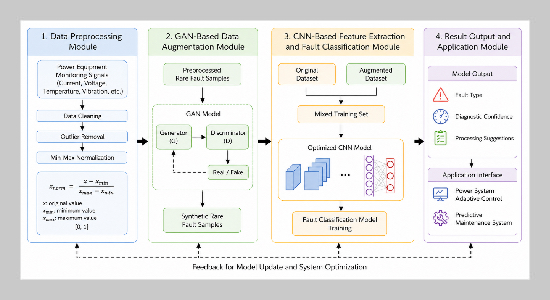
Overall workflow of the proposed GAN-CNN power equipment fault diagnosis method
Copyright The Author(s). This is an open access article distributed under the terms of the Creative Commons Attribution License (CC BY 4.0), which permits unrestricted use, distribution, and reproduction in any medium, provided the original author and source are cited.
Download Citation: BibTeX | http://dx.doi.org/10.6180/jase.202610_33.055
This study proposes a small-sample fault diagnosis method integrating an optimized generative adversarial network (GAN) and lightweight convolutional neural network (CNN). The core innovations include: (1) A weighted adversarial loss function is designed to balance the training of real and synthetic fault samples, solving the data imbalance problem of rare faults; (2) A GAN-CNN hierarchical feature fusion framework is constructed, which uses GAN for highfidelity fault sample augmentation and CNN for adaptive spatial feature extraction of monitoring signals, overcoming the limitation of high-dimensional feature extraction in traditional GAN models. Three groups of simulation experiments and public benchmark dataset (CWRU, MFPT) validation are designed to verify the performance of the proposed method. Experimental results show that: for rare fault scenarios, the proposed method achieves 93.5% diagnostic accuracy, which is 8.5 percentage points higher than traditional methods; on the CWRU bearing fault benchmark dataset, the method achieves 99.12% overall accuracy under 10% small sample ratio, outperforming 5 state-of-the-art (SOTA) fault diagnosis methods; meanwhile, the method reduces the diagnostic inference latency to 180 ms , with significant improvements in anti-interference, precision, recall and F1-score. This method can be coupled with adaptive control and fault-tolerant control loops of power systems, providing technical support for condition-aware operation control and predictive maintenance of power equipment.
Keywords: Generative adversarial network (GAN), Power equipment fault diagnosis, Small sample learning, Data augmentation, Fault-tolerant control
- [1] G. Serin, B. Sener, A. M. Ozbayoglu, and H. O. Unver, (2020) “Review of Tool Condition Monitoring in Machining and Opportunities for Deep Learning” The International Journal of Advanced Manufacturing Technology 109(3): 953–974. DOI: 10.1007/s00170-020-05449-w.
- [2] S. Lu, H. Chai, A. Sahoo, and B. T. Phung, (2020) “Condition Monitoring Based on Partial Discharge Diagnostics Using Machine Learning Methods: A Comprehensive State-of-the-Art Review” IEEE Transactions on Dielectrics and Electrical Insulation 27(6): 1861–1888. DOI: 10.1109/TDEI.2020.009070.
- [3] X. Li, W. Zhang, Q. Ding, and J. Q. Sun, (2020) “Intelligent Rotating Machinery Fault Diagnosis Based on Deep Learning Using Data Augmentation” Journal of Intelligent Manufacturing 31(2): 433–452. DOI: 10.1007/s10845-018-1456-1.
- [4] H. Shao, M. Xia, G. Han, Y. Zhang, and J. Wan, (2020) “Intelligent Fault Diagnosis of Rotor-Bearing System Under Varying Working Conditions With Modified Transfer Convolutional Neural Network and Thermal Images” IEEE Transactions on Industrial Informatics 17(5): 3488–3496. DOI: 10.1109/TII.2020.3005965.
- [5] J. Luo, J. Huang, and H. Li, (2021) “A Case Study of Conditional Deep Convolutional Generative Adversarial Networks in Machine Fault Diagnosis” Journal of Intelligent Manufacturing 32(2): 407–425. DOI: 10.1007/s10845-020-01579-w.
- [6] X. Li and W. Zhang, (2020) “Deep Learning-Based Partial Domain Adaptation Method on Intelligent Machinery Fault Diagnostics” IEEE Transactions on Industrial Electronics 68(5): 4351–4361. DOI: 10.1109/TIE.2020.2984968.
- [7] K. Huang, S. Wu, F. Li, C. Yang, and W. Gui, (2021) “Fault Diagnosis of Hydraulic Systems Based on Deep Learning Model With Multirate Data Samples” IEEE Transactions on Neural Networks and Learning Systems 33(11): 6789–6801. DOI: 10.1109/TNNLS.2021.3083401.
- [8] A. Abid, M. T. Khan, and J. Iqbal, (2021) “A Review on Fault Detection and Diagnosis Techniques: Basics and Beyond” Artificial Intelligence Review 54(5): 3639–3664. DOI: 10.1007/s10462-020-09934-2.
- [9] M. Zhao, S. Zhong, X. Fu, B. Tang, S. Dong, and M. Pecht, (2020) “Deep Residual Networks With Adaptively Parametric Rectifier Linear Units for Fault Diagnosis” IEEE Transactions on Industrial Electronics 68(3): 2587–2597. DOI: 10.1109/TIE.2020.2972458.
- [10] A. K. Ozcanli, F. Yaprakdal, and M. Baysal, (2020) “Deep Learning Methods and Applications for Electrical Power Systems: A Comprehensive Review” International Journal of Energy Research 44(9): 7136–7157. DOI: 10.1002/er.5331.
- [11] J. Li, R. Huang, G. He, Y. Liao, Z. Wang, and W. Li, (2020) “A Two-Stage Transfer Adversarial Network for Intelligent Fault Diagnosis of Rotating Machinery With Multiple New Faults” IEEE/ASME Transactions on Mechatronics 26(3): 1591–1601. DOI: 10.1109/TMECH.2020.3025615.
- [12] X. Hu, K. Zhang, K. Liu, X. Lin, S. Dey, and S. Onori, (2020) “Advanced Fault Diagnosis for Lithium-Ion Battery Systems: A Review of Fault Mechanisms, Fault Features, and Diagnosis Procedures” IEEE Industrial Electronics Magazine 14(3): 65–91. DOI: 10.1109/MIE.2020.2964814.
- [13] H. Shao, M. Xia, J. Wan, and C. W. de Silva, (2021) “Modified Stacked Autoencoder Using Adaptive Morlet Wavelet for Intelligent Fault Diagnosis of Rotating Machinery” IEEE/ASME Transactions on Mechatronics 27(1): 24–33. DOI: 10.1109/TMECH.2021.3058061.
- [14] H. Darvishi, D. Ciuonzo, E. R. Eide, and P. S. Rossi, (2020) “Sensor-Fault Detection, Isolation and Accommodation for Digital Twins via Modular Data-Driven Architecture” IEEE Sensors Journal 21(4): 4827–4838. DOI: 10.1109/JSEN.2020.3029459.
- [15] Y. Zhao, C. Zhang, Y. Zhang, Z. Wang, and J. Li, (2020) “A Review of Data Mining Technologies in Building Energy Systems: Load Prediction, Pattern Identification, Fault Detection and Diagnosis” Energy and Built Environment 1(2): 149–164. DOI: 10.1016/j.enbenv.2019.11.003.
- [16] L. Jiménez-Navajas, R. Pérez-Castillo, and M. Piattini, (2025) “Transforming Quantum Programmes in KDM to Quantum Design Models in UML” Informatica 36(4): 833–874. DOI: 10.15388/24-INFOR582.
- [17] S. R. Saufi, Z. A. B. Ahmad, M. S. Leong, and M. H. Lim, (2020) “Gearbox Fault Diagnosis Using a Deep Learning Model With Limited Data Sample” IEEE Transactions on Industrial Informatics 16(10): 6263–6271. DOI: 10.1109/TII.2020.2967822.
- [18] I. W. Widayat, A. A. Arsyad, A. J. Mantau, Y. Adhitya, and M. Köppen, (2025) “Fuzzy Methods in Smart Farming: A Systematic Review” Informatica 36(2): 453–489. DOI: 10.15388/24-INFOR579.
- [19] Y. Xue, R. Yang, X. Chen, Z. Tian, and Z. Wang, (2023) “A Novel Local Binary Temporal Convolutional Neural Network for Bearing Fault Diagnosis” IEEE Transactions on Instrumentation and Measurement 72: 1–13. DOI: 10.1109/TIM.2023.3298653.
- [20] P. Debroy, F. Smarandache, P. Majumder, P. Majumdar, and L. Seban, (2025) “OPA-IF-Neutrosophic-TOPSIS Strategy Under SVNS Environment Approach and Its Application to Select the Most Effective Control Strategy for Aquaponic System” Informatica 36(1): 1–32. DOI: 10.15388/24-INFOR583.
- [21] W. Huang, X. Zhang, H. Jiang, Z. Shao, and Y. Bai, (2025) “MCBA-MVACGAN: A Novel Fault Diagnosis Method for Rotating Machinery Under Small Sample Conditions” Machines 13(1): 71. DOI: 10.3390/machines13010071.