



Shih-Hsing Chang, Chin-Han Tsai, and Chyan-Chyi Wu
Department of Mechanical and Electromechanical Engineering, Tamkang University, Taiwan
Received: April 16, 2026
Accepted: June 26, 2026
Publication Date: July 25, 2026
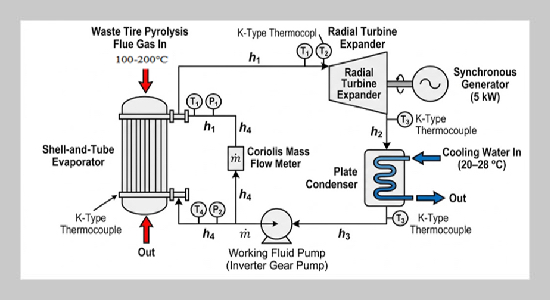
ORC Experimental Setup (with continuous pipeline layout and sensor configuration).
Copyright The Author(s). This is an open access article distributed under the terms of the Creative Commons Attribution License (CC BY 4.0), which permits unrestricted use, distribution, and reproduction in any medium, provided the original author and source are cited.
Download Citation: BibTeX | http://dx.doi.org/10.6180/jase.202610_33.053
20%–30% of total energy consumption in the global industrial sector is lost in the form of low-grade waste heat. The 100–200 ◦C exhaust waste heat generated by the pyrolysis process of waste tires has a remarkably high recovery potential, but its organic Rankine cycle (ORC) system has difficulty in optimizing efficiency due to multi-parameter nonlinear coupling. This study proposes a hybrid optimization framework that integrates a fractional factorial Taguchi Design of Experiments (DOE), a two-layer Stacking Ensemble Learning architecture (SVR+ANN), and a Genetic Algorithm (GA), aiming to solve the inefficiency and poor local convergence of traditional trial-and-error or isolated optimization methods in engineering practice. The results show that by systematically regulating the evaporation temperature, condensation temperature, working fluid mass flow rate, and expansion ratio, the thermal efficiency of the ORC system has significantly improved from the baseline value of 13.2% to 26.9%. In addition, a comprehensive environmental assessment framework with strict system boundaries was introduced. Considering auxiliary energy consumption and working fluid global warming potential (GWP), the evaluation showed that the optimized system could reduce net emissions by 92.5 kg for every ton of waste tires processed based on localized grid emission factors. Experimental verification, backed by an independent validation dataset and uncertainty analysis, shows that the prediction deviation is less than 0.2%, confirming the excellent generalization capability, robustness, and reliability of this framework in industrial low-carbon transformation practice.
Keywords: Organic Rankine Cycle (ORC), Waste tire pyrolysis, Ensemble learning (Stacking), Genetic algorithm (GA), Carbon reduction, Engineering optimization
- [1] S. Quoilin, M. Van Den Broek, S. Declaye, P. Dewallef, and V. Lemort, (2013) “Techno-economic survey of Organic Rankine Cycle (ORC) systems” Renewable and Sustainable Energy Reviews 22: 168–186. DOI: https://doi.org/10.1016/j.rser.2013.01.028. URL: https://www.sciencedirect.com/science/article/pii/S1364032113000592.
- [2] J. Bao and L. Zhao, (2013) “A review of working fluid and expander selections for organic Rankine cycle” Renewable and Sustainable Energy Reviews 24: 325–342. DOI: https://doi.org/10.1016/j.rser.2013.03.040. URL: https://www.sciencedirect.com/science/article/pii/S1364032113001998.
- [3] Z. Chen, D. Wang, C. Li, H. Yang, D. Wang, D. Lai, J. Yu, and S. Gao, (2020) “A tandem pyrolysis-upgrading strategy in an integrated reactor to improve the quality of coal tar” Energy Conversion and Management 220: 113065. DOI: https://doi.org/10.1016/j.enconman.2020.113065. URL: https://www.sciencedirect.com/science/article/pii/S0196890420306099.
- [4] G.-G. Choi, S.-J. Oh, and J.-S. Kim, (2016) “Non-catalytic pyrolysis of scrap tires using a newly developed two-stage pyrolyzer for the production of a pyrolysis oil with a low sulfur content” Applied Energy 170: 140–147. DOI: https://doi.org/10.1016/j.apenergy.2016.02.119. URL: https://www.sciencedirect.com/science/article/pii/S0306261916302756.
- [5] H. Ozcan, A. Ongen, and Y. Pangaliyev, (2016) “An Experimental Study of Recoverable Products from Waste Tire Pyrolysis” Global NEST Journal 18(3): 582–590. DOI: https://doi.org/10.30955/gnj.001907. URL: https://journal.gnest.org/publication/gnest_01907.
- [6] R. Abdallah, A. Juaidi, M. Assad, T. Salameh, and F. Manzano-Agugliaro, (2020) “Energy Recovery from Waste Tires Using Pyrolysis: Palestine as Case of Study” Energies 13(7): 1817. DOI: https://doi.org/10.3390/en13071817. URL: https://www.mdpi.com/1996-1073/13/7/1817.
- [7] D. Czajczyńska, R. Krzyżyńska, H. Jouhara, and N. Spencer, (2017) “Use of pyrolytic gas from waste tire as a fuel: A review” Energy 134: 1121–1131. DOI: https://doi.org/10.1016/j.energy.2017.05.042. URL: https://www.sciencedirect.com/science/article/pii/S0360544217307995.
- [8] Y.-q. Feng, Y.-Z. Liu, X. Wang, Z.-X. He, T.-C. Hung, Q. Wang, and H. Xi, (2020) “Performance prediction and optimization of an organic Rankine cycle (ORC) for waste heat recovery using back propagation neural network” Energy Conversion and Management 226: 113552. DOI: https://doi.org/10.1016/j.enconman.2020.113552. URL: https://www.sciencedirect.com/science/article/pii/S0196890420310815.
- [9] W. Wang, S. Deng, D. Zhao, L. Zhao, S. Lin, and M. Chen, (2020) “Application of machine learning into organic Rankine cycle for prediction and optimization of thermal and exergy efficiency” Energy Conversion and Management 210: 112700. DOI: https://doi.org/10.1016/j.enconman.2020.112700. URL: https://www.sciencedirect.com/science/article/pii/S0196890420302387.
- [10] J. Wang, Z. Yan, M. Wang, M. Li, and Y. Dai, (2013) “Multi-objective optimization of an organic Rankine cycle (ORC) for low grade waste heat recovery using evolutionary algorithm” Energy Conversion and Management 71: 146–158. DOI: https://doi.org/10.1016/j.enconman.2013.03.028. URL: https://www.sciencedirect.com/science/article/pii/S0196890413001714.
- [11] A. Bademlioglu, A. Canbolat, and O. Kaynakli, (2020) “Multi-objective optimization of parameters affecting Organic Rankine Cycle performance characteristics with Taguchi-Grey Relational Analysis” Renewable and Sustainable Energy Reviews 117: 109483. DOI: https://doi.org/10.1016/j.rser.2019.109483. URL: https://www.sciencedirect.com/science/article/pii/S1364032119306914.
- [12] H. Tian, G. Shu, H. Wei, X. Liang, and L. Liu, (2012) “Fluids and parameters optimization for the organic Rankine cycles (ORCs) used inexhaust heat recovery of Internal Combustion Engine (ICE)” Energy 47(1): 125–136. DOI: https://doi.org/10.1016/j.energy.2012.09.021. URL: https://www.sciencedirect.com/science/article/pii/S0360544212006998.
- [13] R. Agromayor and L. O. Nord, (2017) “Fluid selection and thermodynamic optimization of organic Rankine cycles for waste heat recovery applications” Energy Procedia 129: 527–534. DOI: https://doi.org/10.1016/j.egypro.2017.09.180. URL: https://www.sciencedirect.com/science/article/pii/S1876610217340948.
- [14] U. Larsen, L. Pierobon, F. Haglind, and C. Gabrielii, (2013) “Design and optimisation of organic Rankine cycles for waste heat recovery in marine applications using the principles of natural selection” Energy 55: 803–812. DOI: https://doi.org/10.1016/j.energy.2013.03.021. URL: https://www.sciencedirect.com/science/article/pii/S0360544213002090.
- [15] D. H. Wolpert, (1992) “Stacked generalization” Neural Networks 5(2): 241–259. DOI: https://doi.org/10.1016/S0893-6080(05)80023-1. URL: https://www.sciencedirect.com/science/article/pii/S0893608005800231.
- [16] K. Deb, A. Pratap, S. Agarwal, and T. Meyarivan, (2002) “A fast and elitist multiobjective genetic algorithm: NSGA-II” IEEE Transactions on Evolutionary Computation 6(2): 182–197. DOI: 10.1109/4235.996017.
- [17] X. Zhao, H. Chen, S. Li, W. Li, P. Pan, T. Liu, L. Wu, and G. Xu, (2023) “Thermodynamic and economic analysis of a novel design combining waste tire pyrolysis with silicon production waste heat recovery and organic Rankine cycle” Energy 283: 128500. DOI: https://doi.org/10.1016/j.energy.2023.128500. URL: https://www.sciencedirect.com/science/article/pii/S0360544223018947.
- [18] Q. Wu, Q. Zhang, X. Chen, G. Song, and J. Xiao, (2022) “Integrated Assessment of Waste Tire Pyrolysis and Upgrading Pathways for Production of High-Value Products” ACS Omega 7(35): 30954–30966. DOI: 10.1021/acsomega.2c02952. URL: https://doi.org/10.1021/acsomega.2c02952.
- [19] L. Pierobon, M. Rokni, U. Larsen, and F. Haglind, (2013) “Thermodynamic analysis of an integrated gasification solid oxide fuel cell plant combined with an organic Rankine cycle” Renewable Energy 60: 226–234. DOI: https://doi.org/10.1016/j.renene.2013.05.021. URL: https://www.sciencedirect.com/science/article/pii/S0960148113002668.
- [20] Taiwan Power Company. Sustainability Report: Carbon Emission Factor of Electricity Grid in Taiwan. 2024. URL: https://www.taipower.com.tw/.