




Zhu Mingliang1, Zhou Guangjiao1, Zhong Hu2, and Gu Xiuxiu1
1School of Information Engineering, Suqian University, Suqian Jiangsu China
2China Mobile Communications Group Suqian Branch, Suqian Jiangsu China
Received: April 15, 2026
Accepted: June 27, 2026
Publication Date: July 25, 2026
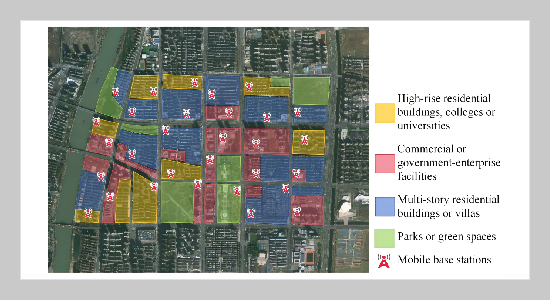
Distribution of Service Points within the Bearing Range of the aggregation room
Copyright The Author(s). This is an open access article distributed under the terms of the Creative Commons Attribution License (CC BY 4.0), which permits unrestricted use, distribution, and reproduction in any medium, provided the original author and source are cited.
Download Citation: BibTeX | http://dx.doi.org/10.6180/jase.202610_33.052
To address the problem of location selection for transmission network aggregation rooms in the information age, this paper develops a carrying cost formula for aggregation rooms based on an analysis of service scenario classification within the aggregation area. The formula incorporates two major factors: equipment cost and lines cost. A location selection method for aggregation rooms is proposed, using the minimum carrying cost as the fitness function. To enhance the scientific rigor of site selection, constraints are specified from three aspects: space availability, location exploitability, and fiber core redundancy. The particle swarm optimization (PSO) algorithm is employed to determine the final coordinates of the aggregation room. To further validate the effectiveness of the proposed method, simulations are conducted on the aggregation room location using case studies. The simulation results demonstrate that the minimum carrying cost-based location selection method can minimize construction investment, reduce resource consumption and construction costs, and achieve scientific site selection of aggregation rooms within the aggregation area, provided that all constraints are satisfied.
Keywords: Transmission Network; Service Aggregation; Minimum Carrying Cost; PSO
- [1] B. Mody, (2016) “Saving the World: A Brief History of Communication for Development and Social Change” Mass Communication and Society 19(6): 820–822. DOI: 10.1080/15205436.2016.1148738.
- [2] B. K. Pattanaik. “Development Communication”. In: Anatomy of Development. 2025, 325–350. DOI: 10.4324/9781003540267-13.
- [3] P. Modekurthy, D. Ismail, M. Rahman, and A. Saiful-lah, (2024) “Extending Coverage Through Integrating Multiple Low-Power Wide-Area Networks: A Latency Minimizing Approach” IEEE Transactions on Mobile Computing 23(12): 13487–13504. DOI: 10.1109/tmc.2024.3428989.
- [4] Y. Ghaderi and M. R. Ghaderi, (2025) “Society 5.0 in the cloud: Harnessing the power of modern information technologies” Metaverse 6(1): 3232. DOI: 10.54517/m3232.
- [5] C.-C. KAO and H.-C. YOUNG, (2022) “Opportunities, Challenges, and Solutions in the 5G Era” IEICE Transactions on Communications E105.B(11): 1291–1298. DOI: 10.1587/transcom.2021tmi0001.
- [6] Y. E. Malashenko and I. A. Nazarova, (2025) “Maximum Flow Characteristics of a Multiuser Communication Network under Changes in Cut Capacity” Journal of Computer and Systems Sciences International 64(4): 631–642. DOI: 10.1134/s1064230725700546.
- [7] Z. Zhang and Y. Li. “Massive MIMO in the 5G Era: Revolutionary Breakthroughs and Future Prospects for Wireless Networks”. In: Information Processing and Network Provisioning. 2025, 171–184. DOI: 10.1007/978-981-96-6462-7_16.
- [8] H. Qiang, (2019) “A Brief Discussion on the Application of VC-OTN Technology in Transport Networks” Telecommunications Engineering Technology and Standardization 32(11): 74–78. DOI: 10.13992/j.cnki.tetas.2019.11.018.
- [9] R. Singh and M. Kumar, (2023) “Performance analysis of NGPON using hybrid GPON-XGPON based robust long-haul passive optical communication network” Journal of Optical Communications 45(s1): s2467–s2474. DOI: 10.1515/joc-2023-0235.
- [10] Y. H. Q. Li Z. Wang, (2025) “Research on the Disaster Resilience of Communication Aggregation Room” Telecommunications Engineering Technology and Standardization 38(11): 49–53. DOI: 10.13992/j.cnki.tetas.2025.11.006.
- [11] H. Qiang, M. Tu, Y. Che, and X. Tang, (2021) “Optical Transmission Network Evolution Scheme of VC-OTN” Journal of Physics: Conference Series 1828(1): 012083. DOI: 10.1088/1742-6596/1828/1/012083.
- [12] X. Yin, (2026) “Design of Transmission Access Networking Scheme Based on C-RAN” China Broadband 22(01): 45–47. DOI: 10.20167/j.cnki.ISSN1673-7911.2026.01.15.
- [13] M. Z. Z. Long, (2018) “Exploration of Special Planning Scheme for Local Transmission Network Aggregation Room” Science and Technology Communication 10(19): 96–97. DOI: 10.16607/j.cnki.1674-6708.2018.19.045.
- [14] H. Zhu, (2021) “Research on the Location Model of Communication Room Based on GIS and ENVI” Telecommunications Engineering Technology and Standardization 34(11): 22–25. DOI: 10.13992/j.cnki.tetas.2021.11.005.
- [15] Y. K. L. Pan, (2022) “Research on the Planning and Site Selection of Operator Convergence Node” Journal of Shijiazhuang University 24(06): 71–75. DOI: 10.13573/j.cnki.sjzxyxb.2022.06.002.
- [16] W. W. K. Qu Y. Lü, (2022) “Research on Resource Operation Methods for 5G Communication Aggregation Data Centers” Electronic Components Information Technology 7(04): 130–133+137. DOI: 10.19772/j.cnki.2096-4455.2023.4.031.
- [17] H. Yang, (2025) “Research on the Layout of DeepSeek Large Model in Operator Data Room under 5G and IoT Deployment” China Broadband 21(10): 166–168. DOI: 10.20167/j.cnki.ISSN1673-7911.2025.10.56.
- [18] Q. Li, W. Yang, Y. Liu, X. Liu, Y. Zhao, J. Chu, H. Zeng, X. Zhao, C. Deng, and J. Feng. “Customer Segment Application of Machine Learning in Business Operation of China Mobile”. In: 2020 IEEE 22nd International Conference on High Performance Computing and Communications; IEEE 18th International Conference on Smart City; IEEE 6th International Conference on Data Science and Systems (HPCC/SmartCity/DSS). 2020, 1344–1349. DOI: 10.1109/hpcc-smartcity-dss50907.2020.00173.
- [19] L. Yu, (2025) “Particle Swarm Optimization Algorithm and Its Application in Image Segmentation” ITM Web of Conferences 70: 02015. DOI: 10.1051/itmconf/20257002015.
- [20] S. Kumar Sunori, S. Jain, and P. Juneja. “Dynamic Spectrum Allocation in 5G Network using Genetic Algorithm and Particle Swarm Optimization”. In: 2024 8th International Conference on I-SMAC (IoT in Social, Mobile, Analytics and Cloud) (I-SMAC). 2024, 527–533. DOI: 10.1109/i-smac61858.2024.10714702.
- [21] P. Kumar and A. S. Rana, (2025) “Optimization of relay coordination in communication-assisted microgrid using hybrid PSO-GWO algorithm” Electrical Engineering 107(9): 11741–11753. DOI: 10.1007/s00202-025-03119-2.
- [22] A. B. Abdulkareem, (2025) “Improved Particles Swarm Optimization Based Clustering Process and Data Transmission for Energy Conservation in Wireless Sensor Networks” Journal Européen des Systèmes Automatisés 58(04): 833–840. DOI: 10.18280/jesa.580417.
- [23] Y. Li, Y. Li, and H. Li. “Data Analysis of Digital Governance Monitoring Platform Based on Improved PSO Algorithm”. In: Proceedings of Fourth International Conference on Computing and Communication Networks. 2025, 563–572. DOI: 10.1007/978-981-96-3247-3_43.