


Wang Yingxue1, Yin Jianjian2, and Guo Bisen1
1Weifang University, Weifang, Shandong, 261061, China
2Shandong Vocational College of Science and Technology, Weifang Shandong, 261053, China
Received: April 16, 2026
Accepted: June 7, 2026
Publication Date: July 21, 2026
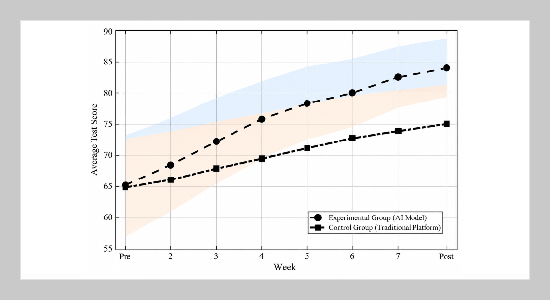
Test Scores
Copyright The Author(s). This is an open access article distributed under the terms of the Creative Commons Attribution License (CC BY 4.0), which permits unrestricted use, distribution, and reproduction in any medium, provided the original author and source are cited.
Download Citation: BibTeX | http://dx.doi.org/10.6180/jase.202610_33.049
Traditional English teaching often lacks integration between intelligent analysis and multimodal teaching principles in digital learning environments. This study proposes an end to-end AI-powered English teaching model that combines multimodal corpora with deep learningtechnologies. A synchronized multimodal teaching corpus was developed to integrate audio, visual, textual, and behavioral data. The model uses a hierarchical deep learning architecture with dedicated encoders and a cross-modal attention fusion mechanism to generate unified representations. A multi-task collaborative learning framework performs four key diagnostic functions simultaneously: pronunciation assessment, grammatical error detection, learning engagement classification, and knowledge tracking. Based on these diagnostic outcomes, a reinforcement learning agent using the proximal
policy optimization algorithm provides personalized learning recommendations. Experimental results show that the proposed model achieves superior performance across multiple tasks and significantly improves learning outcomes, including a 26.2% reduction in learning time for the experimental group. The study offers an effective approach for developing adaptive, precise, and intelligent digital English teaching systems.
Keywords: AI-Powered English Teaching; Multimodal Corpus; Cross-Modal Fusion; Personalized Recommendation
- [1] L. Chen, P. Chen, and Z. Lin, (2020) “Artificial Intelligence in Education: A Review” IEEE Access 8: 75264–75278. DOI: 10.1109/ACCESS.2020.2988510.
- [2] R. La’biran, (2023) “Exploring the Effective Model of Teaching English Speaking Practiced at University” Al-Ishlah: Jurnal Pendidikan 15(4): 5047–5058.
- [3] P. Manurung, S. Rahayu, H. Subagiharti, et al., (2024) “Implementation of Merdeka Belajar-Kampus Merdeka in English Teaching and Linguistics Based on Contextual Teaching and Learning (CTL) Model at Higher Education” English Teaching and Linguistics Journal (ETLiJ) 5(1): 8–18. DOI: 10.30596/etlij.v5i1.18181.
- [4] M. Muliani, S. Sukarni, and J. Jumadil, (2024) “English Teachers’ Technological Knowledge and Some Barriers on It: The Basis for Developing TPACK Teaching Model” JOLLT Journal of Languages and Language Teaching 12(1): 499–510. DOI: 10.33394/jollt.v12i1.9628.
- [5] A. R. Adisti, I. Yuliasri, R. Hartono, et al., (2023) “Developing a Model of English Digital Poster Book for Teaching English in Indonesia’s Early Childhood Education” World Journal of English Language 13(3): 193–209. DOI: 10.5430/wjel.v13n3p193.
- [6] M. Warschauer and D. Healey, (1998) “Computers and Language Learning: An Overview” Language Teaching 31(2): 57–71. DOI: 10.1017/S0261444800012970.
- [7] T. Munawaroh, Y. Ruhiat, and Y. Juniardi, (2024) “Effectiveness of English Teaching Materials Based on the HOTS Integrated Hypertext Model on Students’ Learning Outcomes” Ideguru: Jurnal Karya Ilmiah Guru 9(3): 1897–1902. DOI: 10.51169/ideguru.v9i3.1027.
- [8] A. S. Anggaira and Y. A. Sari, (2023) “An Analysis of English Student Needs in the Development of a Hybrid Learning Teaching Material Model Based on Religious Moderation Values” Anglophile Journal 3(1): 26–35. DOI: 10.51278/anglophile.v3i1.412.
- [9] Y. Chen, (2023) “Analysis of the Core Teaching Ideas of Educational Psychology from the Perspective of Massive Open Online Course” Frontiers in Educational Research 6(10): 80–85. DOI: 10.25236/FER.2023.061013.
- [10] C. Karanjakwut, K. Charunsri, A. Tiang-uan, et al., (2025) “Developing an Instructional Innovation Model for Teaching English Tense Structures: A Grounded Theory Study of Teachers’ Classroom Practice and Perceptions” Journal of Curriculum and Teaching 14(4): 54–64. DOI: 10.5430/jct.v14n4p54.
- [11] D. Wang, (2024) “Design of College English Teaching Model Under the Background of Artificial Intelligence + Big Data” Advances in Educational Technology and Psychology 8(2): 8–17. DOI: 10.23977/aetp.2024.080202.
- [12] F. Febriati and D. Jaya, (2022) “English Teaching Materials with Flipped Learning Model in English Course” Journal of Education Technology 6(4): 643–651. DOI: 10.23887/jet.v6i4.45652.
- [13] H. Mubarok, N. Sofiana, D. Kristina, et al., (2022) “Meaningful Learning Model Through Contextual Teaching and Learning: The Implementation in English Subject” Edulingua: Jurnal Linguistiks Terapan dan Pendidikan Bahasa Inggris 9(1): 23–34. DOI: 10.34001/edulingua.v9i1.3159.
- [14] H. Wei, (2024) “A Research on College Students’ Burnout in Mixed Online and Offline English Teaching Model” International Journal of Education and Humanities 4(2): 157–165. DOI: 10.58557/(ijeh).v4i2.220.
- [15] J. Xue, (2023) “A Study on the Application of Blended Teaching Model in Integrated English Courses” Pacific International Journal 6(1): 28–32. DOI: 10.55014/pij.v6i1.303.