




Xiao Wang1, Huayang Meng2, and Hui Liu1
1School of Intelligent Engineering, Taishan College of Science and Technology, Tai’an 271000, China
2Medical Engineering Department, The Second Affiliated Hospital of Shandong First Medical University, Tai’an 271000, China
Received: April 21, 2026
Accepted: June 2, 2026
Publication Date: July 18, 2026
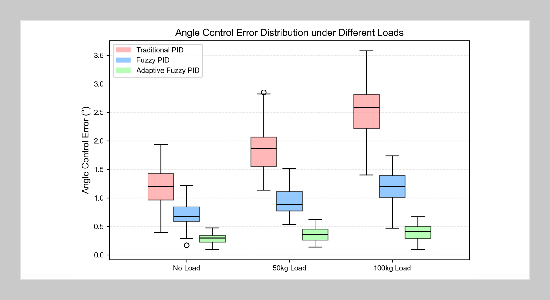
Distribution of angle control error under different load conditions
Copyright The Author(s). This is an open access article distributed under the terms of the Creative Commons Attribution License (CC BY 4.0), which permits unrestricted use, distribution, and reproduction in any medium, provided the original author and source are cited.
Download Citation: BibTeX | http://dx.doi.org/10.6180/jase.202610_33.048
To address high cloud delay, large switching impact, lagging safety response, and insufficient hierarchical protection in traditional bed-chair systems, this paper constructs an edge-computing-based home intelligent nursing bed-chair architecture, establishes a kinematic model and trajectory planning for multi-mode switching, and proposes an adaptive fuzzy PID smooth switching control algorithm with a load-adaptive tuning mechanism
and synchronization strategy, along with a hierarchical safety decision method using improved fuzzy evaluation. Test results show that across six common modes, maximum angle error is below 0.35◦, The peak acceleration is only 0.22 m/s2, and impact acceleration stays within 0.25 m/s2. Under edge deployment, average safety response time is 147 ms, protection success rate 99.2%, false alarm rate below 0.8%, and no fault shutdown after 72 hours. The system maintains excellent stability and robustness under varying loads and scenarios, significantly outperforming traditional PID and cloud-based systems. This study provides a feasible technical path for low-latency control and intelligent upgrading of home rehabilitation aids, suitable for home-based elderly care, community healthcare, and home hospital beds.
Keywords: computer network; edge computing; intelligent maintenance bed and chair; multi-mode switching; adaptive fuzzy PID
- [1] G. S. Rao, A. Ramadevi, and P. S. R. Krishna, (2025) “Smart Mobility and Health Monitoring System: Revolutionizing Wheelchair and Bed”: 335–347. DOI: 10.1007/978-981-96-2697-7_25.
- [2] X. Bai, Y. Liu, Z. Dai, Y. Chen, P. Fang, and J. Ma, (2024) “Determinants of Perceived Comfort: Multi-Dimensional Thinking in Smart Bedding Design” Sensors 24(13): 4058. DOI: 10.3390/s24134058.
- [3] W. Wang, W. Ren, M. Li, and P. Chu, (2024) “A Survey on the Use of Intelligent Physical Service Robots for Elderly or Disabled Bedridden People at Home” International Journal of Crowd Science 8(2): 88–94. DOI: 10.26599/IJCS.2024.9100005.
- [4] Z. Zhang, P. Xu, C. Wu, and H. Yu, (2024) “Smart Nursing Wheelchairs: A New Trend in Assisted Care and the Future of Multifunctional Integration” Biomimetics 9(8): 492. DOI: 10.3390/biomimetics9080492.
- [5] T. Nunes, L. Gaspar, J. N. Faria, D. Portugal, T. Lopes, P. Fernandes, and M. Tavakoli, (2024) “Deployment and Validation of a Smart Bed Architecture for Untethered Patients with Wireless Biomonitoring Stickers” Medical & Biological Engineering & Computing 62(12): 3815–3840. DOI: 10.1007/s11517-024-03155-3.
- [6] N. Menon and S. Nair, (2022) “Technological Evaluation of Design Methodologies and Characteristics of Smart Furniture: A Review” Application of Mechatronics in Hospital Patient Bed 11(6): 3681–3701.
- [7] A. Kumari, H. R. Daksh, A. Abhishek, and A. Utsav. “Smart Chair for Bio-Medical Applications Using Internet of Things (IoT)”. In: 2023 9th International Conference on Advanced Computing and Communication Systems (ICACCS). 1. IEEE, 2023, 629–632. DOI: 10.1109/ICACCS57279.2023.10113070.
- [8] R. Fritz, K. Wuestney, G. Dermody, and D. J. Cook, (2022) “Nurse-in-the-Loop Smart Home Detection of Health Events Associated with Diagnosed Chronic Conditions: A Case-Event Series” International Journal of Nursing Studies Advances 4: 100081. DOI: 10.1016/j.ijnsa.2022.100081.
- [9] M. N. I. Sarkar, L. V. Nguyen, A. D. Kilpatrick, D. G. Lancaster, and S. C. Warren-Smith, (2024) “Dynamic Multimode Fiber Specklegram Sensor Smart Bed Enabled by Deep Learning” Journal of Lightwave Technology 42(18): 6342–6350. DOI: 10.1109/JLT.2024.3400286.
- [10] L. Sawyer, J. Luntz, K. Stark, M. Mojica, and K. Williams, (2025) “Design Process Framework for the Definition and Conceptual Design of Structurally Transforming Multi-Mode Products” Design Science 11: e13. DOI: 10.1017/dsj.2025.5.
- [11] V. Kumar, P. Yadav, and L. S. Indrusiak, (2023) “Resilient Edge: Building an Adaptive and Resilient Multi-Communication Network for IoT Edge Using LPWAN and WiFi” IEEE Transactions on Network and Service Management 20(3): 3055–3071. DOI: 10.1109/TNSM.2022.3228291.
- [12] M. Recmanik, R. Martinek, J. Nedoma, R. Jaros, M. Pelc, R. Hajovsky, J. Velicka, M. Pies, M. Sevcakova, and A. Kawala-Sterniuk, (2024) “A Review of Patient Bed Sensors for Monitoring of Vital Signs” Sensors 24(15): 4767. DOI: 10.3390/s2414767.
- [13] M. A. Mohammed, M. K. Abd Ghani, A. Lakhan, B. AL-Attar, and W. Khaled, (2025) “Federated Learning-Driven IoT and Edge Cloud Networks for Smart Wheelchair Systems in Assistive Robotics” Iraqi Journal for Computer Science and Mathematics 6(1): 9. DOI: 10.52866/2788-7421.1241.
- [14] X. Liu, H. Tong, Y. Zhao, X. Feng, Z. Xu, Z. Wang, C. Tong, J. Hao, S. Mu, X. Zhu, W. Hong, Z. Duan, Q. Hong, and X. Guo, (2025) “Rapid-Response Proximity/Pressure Dual-Mode Sensor Based on Hydroxypropyl Methyl Cellulose-Enhanced PEDOT:PSS/AgNPs Nanocomposites” Materials Today Chemistry 48: 103019. DOI: 10.1016/j.mtchem.2025.103019.
- [15] S. Comai, M. Lambruschi, F. Ravasio, A. Masciadri, L. Pomante, and F. Salice, (2024) “Enhancing Bed Safety: Monitoring Sleeping Positions, Bed-Exits, and Falls Using Grid-EYE Infrared Array Sensors”: 418–430. DOI: 10.1007/978-3-031-77571-0_40.
- [16] D. Jeung, S. Shim, Y.-J. Lee, J. Kim, Y. Lee, and K.-H. Lee, (2025) “AI-Powered Bed Safety-Guard System for Fall Prevention in Elderly and Disabled Patients” Journal of Sensor Science and Technology 34(2): 124–129. DOI: 10.46670/JSST.2025.34.2.124.
- [17] Z. Zhang, Y. Dong, F. Li, X. Huang, Y. Zheng, Z. Dong, H. Zhang, Z. Chen, and X. Li, (2024) “Loss-of-Cooling Tests to Verify Inherent Safety Feature in the World’s First HTR-PM Nuclear Power Plant” Joule 8(7): 2146–2159. DOI: 10.1016/j.joule.2024.06.014.
- [18] N. Chen, Z. Cheng, X. Fan, Z. Liu, B. Huang, Y. Zhao, L. Huang, X. Du, and M. Guizani, (2024) “Integrated Sensing, Communication, and Computing for Cost-Effective Multimodal Federated Perception” ACM Transactions on Multimedia Computing, Communications, and Applications 20(8): 1–28. DOI: 10.1145/3661313.
- [19] S. Zhong, Y. Liu, G. Huang, Y. Chen, and J. Huang, (2025) “A Classroom Student State Perception System Integrating Multimodal Visual Analysis and Edge Intelligence”: 209–213. DOI: 10.1145/3776865.3776901.
- [20] Y. Jani, A. Jani, and K. Prajapati, (2023) “Leveraging Multimodal AI in Edge Computing for Real-Time Decision-Making” International Journal of Core Engineering & Management 7(8):
- [21] M. E. Hossain, M. T. R. Tarafder, and N. Ahmed, (2023) “Integrating AI with Edge Computing and Cloud Services for Real-Time Data Processing and Decision Making” International Journal of Multidisciplinary Sciences and Arts 2(4): 252–261. DOI: 10.47709/ijmdsa.v2i1.2559.
- [22] S. Wang, K. Li, Z. Yan, Z. Guo, S. Zhu, G. Wen, and S. Wen, (2025) “Optimal Parameter Adaptation for Safety-Critical Control via Safe Barrier Bayesian Optimization” IEEE Transactions on Control Systems Technology 33(5): 1953–1959. DOI: 10.1109/TCST.2025.3561059.
- [23] J. Tan, S. Xue, H. Li, Z. Guo, H. Cao, and B. Chen, (2025) “Hierarchical Safe Reinforcement Learning Control for Leader-Follower Systems with Prescribed Performance” IEEE Transactions on Automation Science and Engineering 22: 19568–19581. DOI: 10.1109/TASE.2025.3596912.
- [24] H. Deng, L. Zhu, J. Wang, M. Chen, H. Wu, and C. He, (2022) “Kinematics Modeling and Trajectory Planning of KUKA Manipulator Based on MATLAB” Journal of Physics: Conference Series 2216(1): 012056. DOI: 10.1088/1742-6596/2216/1/012056.
- [25] K. Hu and K. Cheng, (2023) “Trajectory Planning for an Articulated Tracked Vehicle and Tracking the Trajectory via an Adaptive Model Predictive Control” Electronics 12(9): 1988. DOI: 10.3390/electronics12091988.
- [26] M. A. Ahmad, G. Yoganathan, M. I. Mohd Rashid, M. R. Hao, M. H. Suid, and M. Z. Mohd Tumari, (2025) “Improved Smoothed Functional Algorithms-Optimized PID Controller for Efficient Speed Regulation of Wind Turbines” IEEE Transactions on Industry Applications 61(5): 7546–7560. DOI: 10.1109/TIA.2025.3550137.
- [27] M. Aghaseyedabdollah, M. Abedi, and M. Pourgholi, (2022) “Supervisory Adaptive Fuzzy Sliding Mode Control with Optimal Jaya Based Fuzzy PID Sliding Surface for a Planer Cable Robot” Soft Computing 26(17): 8441–8458. DOI: 10.1007/s00500-022-07237-y.
- [28] P. Wang, S. Wang, L. Chi, X. Ren, W. Wu, and W. Cheng, (2022) “Research and Application of the Network Security Monitoring Capability Evaluation Model of Power Control System Based on AHP and Fuzzy Comprehensive Evaluation” Journal of Physics: Conference Series 2246(1): 012046. DOI: 10.1088/1742-6596/2246/1/012046.
- [29] K. Liu and B. Li, (2025) “Cybersecurity Situation Assessment Based on Fuzzy Cluster Analysis and Fuzzy Comprehensive Judgment Decision-Making” The Journal of Supercomputing 81(16): 1–44. DOI: 10.1007/s11227-025-07960-x.