





Kuiyong Chen1, Yingchun Guan2, Haoran Luo2, Shengpeng Liu3, Xin Li4, and Dedi Li4
1Hubei Energy Group Co., Ltd., Wuhan, Hubei Province, 430000, China
2Hubei Energy Group New Energy Development Co., Ltd., Wuhan, Hubei Province, 430000, China
3Hubei Energy Group Huangshi Wind Power Co., Ltd., Huangshi, Hubei Province, 435000, China
4China Electric Power Construction Group East China Survey and Design Research Institute Co., Ltd., Hangzhou, Zhejiang
Province, 310000, China
Received: March 16, 2026
Accepted: May 11, 2026
Publication Date: July 18, 2026
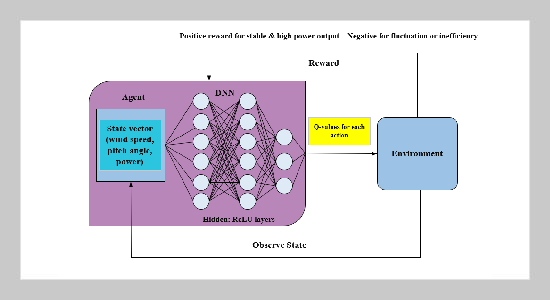
DQN Agent for Wind Turbine Control
Copyright The Author(s). This is an open access article distributed under the terms of the Creative Commons Attribution License (CC BY 4.0), which permits unrestricted use, distribution, and reproduction in any medium, provided the original author and source are cited.
Download Citation: BibTeX | http://dx.doi.org/10.6180/jase.202610_33.045
Wind turbine optimization under variable aerodynamic conditions is challenging, as traditional PID controllers fail to adapt to rapid wind fluctuations, leading to efficiency loss and component wear. To address this, a hybrid adaptive control framework combining Model Predictive Control (MPC), Long Short-Term Memory (LSTM) forecasting, and Reinforcement Learning (RL) with Deep Q-Network (DQN) and Deep Neural Network (DNN) is proposed. MPC provides predictive optimization, LSTM forecasts future turbine states, and RL enables adaptive real-time adjustments. Experimental results demonstrate high prediction accuracy with MAE = 0.0244, RMSE = 0.0011, and R2 = 0.995, confirming the reliability of the system. This integrated
approach enhances turbine efficiency, reduces operational costs, and stabilizes performance under dynamic wind conditions. Scalable and sustainable, the framework offers a high-resolution solution for large wind farms, meeting global demands for renewable energy integration while ensuring robust and efficient turbine operation.
Keywords: Wind Turbine Optimization; Model Predictive Control; Long Short-Term Memory; Reinforcement Learning; Deep Q-Network
- [1] J. Arroyo, C. Manna, F. Spiessens, and L. Helsen, (2022) “Reinforced model predictive control (RL-MPC) for building energy management” Applied Energy 309: 118346. DOI: 10.1016/j.apenergy.2021.118346.
- [2] A. Parvaresh, S. Abrazeh, S.-R. Mohseni, M. J. Zeitouni, M. Gheisarnejad, and M.-H. Khooban, (2020) “A novel deep learning backstepping controller-based digital twins technology for pitch angle control of variable speed wind turbine” Designs 4(2): 15. DOI: 10.3390/designs4020015.
- [3] P. Teimourzadeh Baboli, D. Babazadeh, A. Raeiszadeh, S. Horodyvskyy, and I. Koprek, (2021) “Optimal temperature-based condition monitoring system for wind turbines” Infrastructures 6(4): 50. DOI: 10.3390/infrastructures6040050.
- [4] F. K. Moghadam and A. R. Nejad, (2022) “Online condition monitoring of floating wind turbines drivetrain by means of digital twin” Mechanical Systems and Signal Processing 162: 108087. DOI: 10.1016/j.yssp.2021.108087.
- [5] M. Xu, G. Feng, Q. He, F. Gu, and A. Ball, (2020) “Vibration characteristics of rolling element bearings with different radial clearances for condition monitoring of wind turbine” Applied Sciences 10(14): 4731. DOI: 10.3390/app10144731.
- [6] T.-C. Le, T.-H.-T. Luu, H.-P. Nguyen, T.-H. Nguyen, D.-D. Ho, and T.-C. Huynh, (2022) “Piezoelectric impedance-based structural health monitoring of wind turbine structures: Current status and future perspectives” Energies 15(15): 5459. DOI: 10.3390/en15155459.
- [7] P. Dore, S. Chakkor, A. El Oualkadi, and M. Baghouri, (2023) “Real-time intelligent system for wind turbine monitoring using fuzzy system” e-Prime-Advances in Electrical Engineering, Electronics and Energy 3: 100096. DOI: 10.1016/j.prime.2022.100096.
- [8] J. Xie, H. Dong, and X. Zhao, (2023) “Data-Driven Torque and Pitch Control of Wind Turbines via Reinforcement Learning” Renewable Energy 215: 118893. DOI: 10.1016/j.renene.2023.06.014.
- [9] T. H. B. Huy, H. T. Dinh, D. N. Vo, and D. Kim, (2023) “Real-Time Energy Scheduling for Home Energy Management Systems with an Energy Storage System and Electric Vehicle Based on a Supervised-Learning-Based Strategy” Energy Conversion and Management 292: 117340. DOI: 10.1016/j.enconman.2023.117340.
- [10] B. Desalegn, D. Gebeyehu, B. Tamrat, T. Tadiwose, and A. Lata, (2023) “Onshore versus Offshore Wind Power Trends and Recent Study Practices in Modeling of Wind Turbines’ Life-Cycle Impact Assessments” Cleaner Engineering and Technology 17: 100691. DOI: 10.1016/j.clet.2023.100691.
- [11] I. Ullah, H.-K. Lim, Y.-J. Seok, and Y.-H. Han, (2023) “Optimizing task offloading and resource allocation in edge-cloud networks: a DRL approach” Journal of Cloud Computing 12(1): 112. DOI: 10.1186/s13677-023-00461-3.
- [12] R. Torkan, A. Ilinca, and M. Ghorbanzadeh, (2022) “A Genetic Algorithm Optimization Approach for Smart Energy Management of Microgrids” Renewable Energy 197: 852–863. DOI: 10.1016/j.renene.2022.07.055.
- [13] M. Ahrens, F. Kern, and H. Schmeck, (2021) “Strategies for an adaptive control system to improve power grid resilience with smart buildings” Energies 14(15): 4472. DOI: 10.3390/en14154472.
- [14] K. Krinkin, Y. Shichkina, and A. Ignatyev, (2023) “Co-evolutionary hybrid intelligence is a key concept for the world intellectualization” Kybernetes 52(9): 2907–2923. DOI: 10.1108/K-03-2022-0472.
- [15] B. Erisen. Wind Turbine Scada Dataset. https://www.kaggle.com/datasets/berkerisen/wind-turbine-scada-dataset. 2018.
- [16] F. J. Maseda, I. López, I. Martija, P. Alkorta, A. J. Garrido, and I. Garrido, (2021) “Sensors data analysis in supervisory control and data acquisition (SCADA) systems to foresee failures with an undetermined origin” Sensors 21(8): 2762. DOI: 10.3390/s21082762.
- [17] S. Yalçın and M. S. Herdem, (2024) “Optimizing EV battery management: advanced hybrid reinforcement learning models for efficient charging and discharging” Energies 17(12): 2883. DOI: 10.3390/en17122883.