


Zongchao Wei1,2 and Juntao Li2,3
1School of International Education, Yellow River Conservancy Technical University, kaifeng 475004, China
2North China University of Water Resources and Electric Power, Zhengzhou, 450000, China
3Kaifeng JiaoJian Industrial Investment Co., Ltd., Kaifeng 475004, China
Received: March 6, 2026
Accepted: April 29, 2026
Publication Date: July 12, 2026
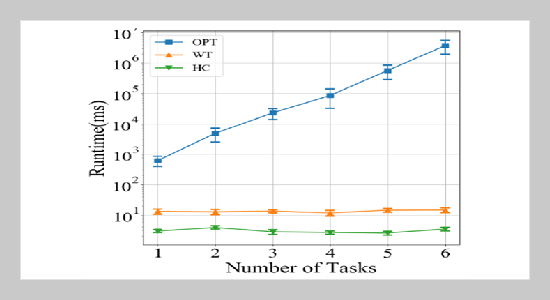
Impact of Task Scale on Algorithm Efficiency
Copyright The Author(s). This is an open access article distributed under the terms of the Creative Commons Attribution License (CC BY 4.0), which permits unrestricted use, distribution, and reproduction in any medium, provided the original author and source are cited.
Download Citation: BibTeX | http://dx.doi.org/10.6180/jase.202610_33.038
To address resource scheduling challenges in the human-machine collaborative environment of the Zhengzhou International Logistics Base, this study formulates the problem as a Simultaneous Resource Scheduling Problem (SRSP) using an integer linear programming model that maximizes timely task completion and proves the problem is NP-hard when the number of resource types |R| ≥ 3. To address this challenge, A priority-based heuristic scheduling framework is proposed for human-machine collaborative supervision, featuring an offline HC algorithm for periodic tasks that dynamically prioritizes using delay risk, critical-path-based deadline partitioning, and successor influence.
Keywords: Human-machine collaborative scheduling; Logistics resource optimization; NPhard problems; Heuristic algorithms; Uncertainty modeling
- [1] W. Yang, S. Li, G. Luo, H. Li, and X. Wen, (2025) “A Real-Time Human–Machine–Logistics Collaborative Scheduling Method Considering Workers’ Learning and Forgetting Effects” Applied System Innovation 8(2): 40. DOI: 10.3390/asi8020040.
- [2] J. Wei, S. Qi, W. Wang, L. Jiang, H. Gao, F. Zhao, and A. Wan, (2025) “Decision-Making in the Age of AI: A Review of Theoretical Frameworks, Computational Tools, and Human-Machine Collaboration” Contemporary Mathematics: 2089–2112. DOI: 10.37256/cm.6220256459.
- [3] M. T. Islam, K. Sepanloo, S. Woo, S. H. Woo, and Y. J. Son, (2025) “A Review of the Industry 4.0 to 5.0 Transition: Exploring the Intersection, Challenges, and Opportunities of Technology and Human–Machine Collaboration” Machines 13(4): 267. DOI: 10.3390/machines13040267.
- [4] S. Rani, D. Jining, K. Shoukat, M. U. Shoukat, and S. A. Nawaz, (2024) “A Human–Machine Interaction Mechanism: Additive Manufacturing for Industry 5.0—Design and Management” Sustainability 16(10): 4158. DOI: 10.3390/su16104158.
- [5] Y. Wang, J. Li, X. Yang, and Q. Peng, (2025) “UAV–Ground Vehicle Collaborative Delivery in Emergency Response: A Review of Key Technologies and Future Trends” Applied Sciences 15(17): 9803. DOI: 10.3390/app15179803.
- [6] W. Zhang, X. Bao, X. Hao, and M. Gen, (2025) “Meta-heuristics for Multi-Objective Scheduling Problems in Industry 4.0 and 5.0: A State-of-the-Arts Survey” Frontiers in Industrial Engineering 3: 1540022. DOI: 10.3389/fieng.2025.1540022.
- [7] N. Dong, (2025) “Financial Resilience through Human-Machine Coevolution: How Autonomous Control Systems Transform Strategic and Financial Decision-Making in Global Supply Chains” Business and Social Sciences Proceedings 2: 90–95. DOI: 10.71222/tw4nxg37.
- [8] W. Wang and L. Liu, (2025) “Advances in the Application of Human-Machine Collaboration in Healthcare: Insights from China” Frontiers in Public Health 13: 1507142. DOI: 10.3389/fpubh.2025.1507142.
- [9] I. F. Ramos, G. Gianini, M. C. Leva, and E. Damiani, (2024) “Collaborative Intelligence for Safety-Critical Industries: A Literature Review” Information 15(11): 728. DOI: 10.3390/info15110728.
- [10] D. Chen, H. J. Yoon, Z. Wan, N. Alluru, S. W. Lee, R. He, and J. H. Cho, (2025) “Advancing Human-Machine Teaming: Concepts, Challenges, and Applications” arXiv: arXiv:2503.16518. DOI: 10.48550/arXiv.2503.16518.
- [11] M. Yang, X. Gao, and J. Qiu, (2024) “Simulation of Worker Collaboration in Production Cell Based on Hybrid Model under Fluctuating Environment” Flexible Services and Manufacturing Journal: 1–24. DOI: 10.1007/s10696-024-09572-8.
- [12] B. Nicoletti and A. Appolloni, (2025) “A Digital Twin Framework for Enhancing Human–Agentic AI–Machine Collaboration” Journal of Intelligent Manufacturing: 1–17. DOI: 10.1007/s10845-025-02637-x.
- [13] P. Karthikeyan, (2021) “Enhanced Case-Based Reasoning with Hybrid Clustering and Evolutionary Algorithms for Multi-Class Workload Forecasting in Autonomic Database Systems” International Journal of HRM and Organization Behavior 9(2): ISSN–2454.
- [14] Y. Zheng, W. Zhang, R. Wang, and R. Ahmad, (2025) “Scheduling in Remanufacturing Systems: A Bibliometric and Systematic Review” Machines 13(9): 762. DOI: 10.3390/machines13090762.
- [15] L. Bukowski and S. Werbinska-Wojciechowska, (2025) “Towards Maintenance 5.0: Resilience-Based Maintenance in AI-Driven Sustainable and Human-Centric Industrial Systems” Sensors 25(16): 5100. DOI: 10.3390/s25165100.
- [16] J. Garcia, L. Rios-Colque, A. Peña, and L. Rojas, (2025) “Condition Monitoring and Predictive Maintenance in Industrial Equipment: An NLP-Assisted Review of Signal Processing, Hybrid Models, and Implementation Challenges” Applied Sciences 15(10): 5465. DOI: 10.3390/app15105465.
- [17] H. Chen, N. Zhang, Y. Dou, and Y. Dai, (2024) “A Robust Human–Machine Framework for Project Portfolio Selection” Mathematics 12(19): 3025. DOI: 10.3390/math12193025.
- [18] Q. Huang, Y. Wei, J. Zhang, X. Xu, M. Guo, F. Xie, and X. Jin, (2025) “A Function Allocation Strategy for Human–Machine Systems in Armored Vehicles Based on Evolutionary Game Theory and System Dynamics” Human Factors and Ergonomics in Manufacturing & Service Industries 35(3): e70014. DOI: 10.1002/hfm.70014.
- [19] L. Guo, Y. He, C. Wan, Y. Li, and L. Luo, (2024) “From Cloud Manufacturing to Cloud–Edge Collaborative Manufacturing” Robotics and Computer-Integrated Manufacturing 90: 102790. DOI: 10.1016/j.rcim.2024.102790.
- [20] C. Zhang, G. Shan, J. Lim, and B.-H. Roh, (2025) “Dynamic Reinforcement Learning for Optimal Go AI Training: Adaptive Adjustment and Optimization” IEEE Transactions on Consumer Electronics 71(1): 292–302. DOI: 10.1109/TCE.2024.3487141.