



Weina Guo1, Hui Xu1, Yuchao Xia2, and Le Yu3
1Hangzhou Polytechnic
2The College of Mathematics and Computer Science, Zhejiang A&F University
3The College of Optical, Mechanical and Electrical Engineering, Zhejiang A&F University
Received: March 16, 2026
Accepted: April 21, 2026
Publication Date: July 12, 2026
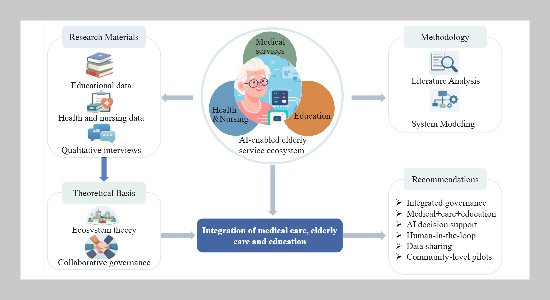
Research framework of the AI-enabled smart elderly education service ecosystem.
Copyright The Author(s). This is an open access article distributed under the terms of the Creative Commons Attribution License (CC BY 4.0), which permits unrestricted use, distribution, and reproduction in any medium, provided the original author and source are cited.
Download Citation: BibTeX | http://dx.doi.org/10.6180/jase.202610_33.037
Population aging is accelerating worldwide, placing increasing pressure on healthcare systems and elderly care services. Although elderly education is recognized as an important component of active and healthy aging, existing services remain fragmented, with limited coordination among medical, care, and educational sectors. Meanwhile, advances in artificial intelligence (AI) offer new opportunities to support personalized and preventive interventions, yet their effective integration into elderly education and care remains insufficiently explored. This study proposes an AI-enabled smart elderly education service ecosystem from an integrated medical, elderly care, and education perspective. Drawing on service ecosystem theory and collaborative governance theory, the study conceptualizes medical services, elderly care, and education as interdependent subsystems and positions elderly education as a central intervention mechanism. A qualitative-oriented approach combining literature analysis and system modeling is adopted to design a layered architecture and an AI-centered operational mechanism. The results present an integrated service ecosystem supported by an AI middle platform that enables data fusion, personalized learning recommendations, and cross-domain coordination. Through mechanism-based analysis and scenario simulation, the proposed model demonstrates clear advantages over traditional fragmented approaches in terms of service integration, personalization, and preventive support. This study provides a conceptual framework and practical insights for developing sustainable and human-centered elderly education services in aging societies.
Keywords: Smart Elderly Education; Integrated Care; Service Ecosystem; Artificial Intelligence; Collaborative Governance
- [1] C. Chen, S. Ding, and J. Wang, (2023) “Digital health for aging populations” Nature medicine 29(7): 1623-1630. DOI: 10.1038/s41591-023-02391-8.
- [2] C. Wang, C. Li, and Y. Wang, (2025) “Population aging, unemployment rate and regional innovation” Finance Research Letters 78: 107187. DOI: 10.1016/j.frl.2025.107187.
- [3] S. Dogra, D. W. Dunstan, T. Sugiyama, A. Stathi, P. A. Gardiner, and N. Owen, (2022) “Active aging and public health: evidence, implications, and opportunities” Annual review of public health 43(1): 439-459. DOI: 10.1146/annurev-publhealth-052620-091107.
- [4] C. W. Eng, P. Gilsanz, E. M. Fletcher, J. Kornak, K. M. George, C. S. DeCarli, L. L. Barnes, M. M. Glymour, and R. A. Whitmer, (2021) “Education, white matter hyperintensities, and cognition in diverse cohorts of older adults” Alzheimer’s & Dementia 17: e056709. DOI: 10.1002/alz.056709.
- [5] N. Arís Redó and M. À. Comas, (2011) “Lifelong Learning in the Context of the European Area of Lifelong Learning” International Journal of Educational Technology in Higher Education 8(2): 172-180. DOI: 10.7238/rusc.v8i2.1049.
- [6] J. Offerman, S. Fristedt, S. M. Schmidt, C. Lofqvist, and S. Iwarsson, (2023) “Attitudes related to technology for active and healthy aging in a national multigenerational survey” Nature aging 3(5): 617-625. DOI: 10.1038/s41587-023-00392-3.
- [7] N. Townsend, A. Timmis, A. Erglis, D. Miličić, P. Perrone-Filardi, F. Weidinger, T. Guzik, and C. P. Gale, (2025) “Challenges in the prevention, treatment and management of cardiovascular disease among older adults” The Lancet Regional Health-Europe 56: 101372. DOI: 10.1016/j.lanepe.2025.101372.
- [8] A. E. Stuck and T. Masud, (2022) “Health care for older adults in Europe: how has it evolved and what are the challenges?” Age and ageing 51(12): afac287. DOI: 10.1093/ageing/afac287.
- [9] M. O. Little and J. E. Morley, (2022) “Healthcare for older adults in North America: challenges, successes and opportunities” Age and ageing 51(10): afac216. DOI: 10.1093/ageing/afac216.
- [10] A. Aboujaoudé, M. Couture, M. Moreau, M. Lussier, C. Laliberté, C. Bottari, S. Giroux, P. Belchior, G. Paré, and N. Bier, (2021) “The challenges of aging in place for older adults at risk of self-neglect and expectations regarding smart environments: Perspectives of older adults and their caregivers” Alzheimer’s & Dementia 17: e054232. DOI: 10.1002/alz.054232.
- [11] M. S. Talukder, G. Sorwar, Y. Bao, J. U. Ahmed, and M. A. S. Palash, (2020) “Predicting antecedents of wearable healthcare technology acceptance by elderly: A combined SEM-Neural Network approach” Technological Forecasting and Social Change 150: 119793. DOI: 10.1016/j.techfore.2019.119793.
- [12] Y. Zhang, Z. Lin, Y. Teerawattananon, K. Akksilp, A. Morton, Y. Wang, T. Prapinvanich, T. Dulsamphan, and W. Chen, (2025) “The value for money of artificial intelligence-empowered precision medicine: a systematic review and regression analysis” npj Digital Medicine 2026(9): 78. DOI: 10.1038/s41746-025-02259-w.
- [13] S. Chen, S. Fan, Z. Qiao, Z. Wu, B. Lin, Z. Li, M. A. Riegler, M. Y. H. Wong, A. Opheim, O. Korostynska, et al., “Transforming healthcare: Intelligent wearable sensors empowered by smart materials and artificial intelligence” Advanced Materials 37(21): 2500412. DOI: 10.1002/adma.202500412.
- [14] D. Sun, G. Cheng, P. L. H. Yu, J. Jia, Z. Zheng, and A. Chen, (2025) “Personalized stem education empowered by artificial intelligence: a comprehensive review and content analysis” Interactive Learning Environments 33(7): 4419-4441. DOI: 10.1080/10494820.2025.2462156.
- [15] T. Jowsey, J. Stokes-Parish, R. Singleton, and M. Todorovic, (2023) “Medical education empowered by generative artificial intelligence large language models” Trends in Molecular Medicine 29(12): 971-973. DOI: 10.1016/j.molmed.2023.08.012.
- [16] A. Fock and H.-S. Siller, (2025) “Generative artificial intelligence in secondary STEM education in the light of Human Flourishing: a scoping literature review” International Journal of STEM Education 2025(12): 67. DOI: 10.1186/s40594-025-00589-5.
- [17] J. W. Carter, J. T. Scott, and J. D. Barrett, (2025) “The Emotional Cost of AI Chatbots in Education: Who Benefits and Who Struggles?” Computers in Human Behavior: Artificial Humans 5: 100181. DOI: 10.1016/j.chbah.2025.100181.
- [18] S. L. Vargo and R. F. Lusch, (2016) “Institutions and axioms: an extension and update of service-dominant logic” Journal of the Academy of marketing Science 44(1): 5-23. DOI: 10.1007/s11747-015-0456-3.
- [19] K. Emerson, T. Nabatchi, and S. Balogh, (2012) “An integrative framework for collaborative governance” Journal of public administration research and theory 22(1): 1-29. DOI: 10.1093/jopart/mur011.
- [20] S. Matayong, K. Jetwanna, C. Choksuchat, S. Choosawang, N. Trakulmaykee, S. Limsuwan, and K. Inthanuchit, (2025) “IoT-based systems and applications for elderly healthcare: a systematic review” Universal Access in the Information Society 24(1): 99-125. DOI: 10.1007/s10209-023-01055-1.