


Wei Du1, Junqian Hao2, and Xue Han3
1Psychological Health Education and Counseling Center, Jiaozuo Normal College, Jiaozuo, 454000, Henan Province, China
2Department of Primary Education, Jiaozuo Normal College, Jiaozuo, 454000, Henan Province, China
3Institute of Marxism, Jiaozuo Normal College, Jiaozuo, 454000, Henan Province, China
Received: April 17, 2026
Accepted: May 29, 2026
Publication Date: July 10, 2026
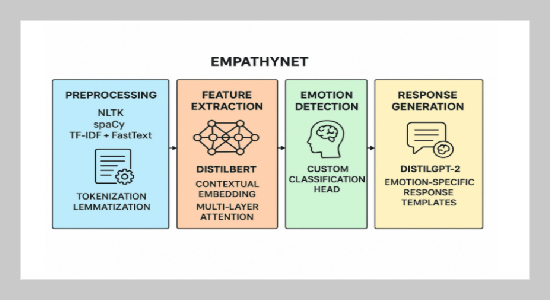
Process workflow diagram of the proposed model
Copyright The Author(s). This is an open access article distributed under the terms of the Creative Commons Attribution License (CC BY 4.0), which permits unrestricted use, distribution, and reproduction in any medium, provided the original author and source are cited.
Download Citation: BibTeX | http://dx.doi.org/10.6180/jase.202610_33.035
Traffic flow (TF) forecasting plays a crucial role in modern urban transportation systems by enabling congestion mitigation and efficient traffic management. With the rapid growth of intelligent transportation systems, robust prediction models are required to process large-scale traffic data in real time. This study presents an enhanced urban traffic forecasting model based on Deep Recurrent Networks (DRN) integrated with Bidirectional Long
ShortTerm Memory (BiLSTM) networks to effectively capture temporal dependencies and spatial correlations in traffic data. Traffic datasets collected from sensors at major intersections include vehicle counts, speed, and congestion information across peak and off-peak periods. Noise reduction is performed using median filtering, followed by Min-Max normalization. Wavelet transform-based feature extraction captures multi-resolution traffic patterns. The proposed Malleable Aquila Optimized DRN-BiLSTM model achieves superior performance, attaining an R2 of 0.97 , RMSE of 12.14, and MAE of 10.04, demonstrating its effectiveness for shortterm urban traffic forecasting and planning.
Keywords: Urban Traffic Flow, Intelligent Transportation Systems, Malleable Aquila Optimized-DRN with BiLSTM, Traffic Management, Predictive Model
- [1] A. M. Vieriu and G. Petrea, (2025) “The Impact of Artificial Intelligence (AI) on Students’ Academic Development” Education Sciences 15(3): 343. DOI: 10.3390/educsci15030343.
- [2] O. O. Ayeni, N. M. Al Hamad, O. N. Chisom, B. Osawaru, and O. E. Adewusi, (2024) “AI in Education: A Review of Personalized Learning and Educational Technology” GSC Advanced Research and Reviews 18(2): 261-271. DOI: 10.30574/gscarr.2024.18.2.0062.
- [3] L. N. Yeganeh, N. S. Fenty, Y. Chen, A. Simpson, and M. Hatami, (2025) “The Future of Education: A Multi-Layered Metaverse Classroom Model for Immersive and Inclusive Learning” Future Internet 17(2): 63. DOI: 10.3390/fi17020063.
- [4] K. Alalawi, R. Athauda, and R. Chiong, (2025) “An Extended Learning Analytics Framework Integrating Machine Learning and Pedagogical Approaches for Student Performance Prediction and Intervention” International Journal of Artificial Intelligence in Education 35(3): 1239-1287. DOI: 10.1007/s40593-024-00429-7.
- [5] Z. Khoudi, N. Hafidi, M. Nachaoui, and S. Lyaqini, (2025) “Leveraging Machine Learning and Clickstream Data to Improve Student Performance Prediction in Virtual Learning Environments” Information Discovery and Delivery: DOI: 10.1108/IDD-08-2024-0120.
- [6] B. Ujkani, D. Minkovska, and N. Hinov, (2024) “Course Success Prediction and Early Identification of At-Risk Students Using Explainable Artificial Intelligence” Electronics 13(21): 4157. DOI: 10.3390/electronics13214157.
- [7] B. Alnasyan, M. Basheri, and M. Alassafi, (2025) “A Comprehensive Comparative Analysis of Deep Learning Models for Student Performance Prediction in Virtual Learning Environments: Leveraging the OULA Dataset and Advanced Resampling Techniques” IEEE Access: DOI: 10.1109/ACCESS.2025.3564719.
- [8] W. C. Choi and C. I. Chang, (2025) “A Survey of Techniques, Design, Applications, Challenges, and Student Perspective of Chatbot-Based Learning Tutoring System Supporting Students to Learn in Education”: DOI: 10.20944/preprints202503.1134.v1.
- [9] S. M. K. Sarkhi and H. Koyuncu, (2024) “Optimization Strategies for Atari Game Environments: Integrating Snake Optimization Algorithm and Energy Valley Optimization in Reinforcement Learning Models” AI 5(3): 1172-1191. DOI: 10.3390/ai5030057.
- [10] A. R. Mishra, A. Rai, D. Nandan, U. Kshirsagar, and M. K. Singh, (2025) “Unveiling Emotions: NLP-Based Mood Classification and Well-Being Tracking for Enhanced Mental Health Awareness” Mathematical Modelling of Engineering Problems 12(2): DOI: 10.18280/mmep.120228.
- [11] R. R. PBV, T. Tejasri, T. S. L. Kalyani, S. Rajiya, P. K. Meher, and S. Siri. “Mental Wellness ChatBot for Students Using NLP”. In: 2025 International Conference on Machine Learning and Autonomous Systems (ICMLAS). IEEE, 2025, 1424-1431. DOI: 10.1109/ICMLAS64557.2025.1096812.
- [12] C. R. Reddy, B. M. Devi, K. P. Reddy, and L. Medarametla. “Enhancing Mental Wellbeing Among College Students Using Autogen”. In: 2025 IEEE International Students’ Conference on Electrical, Electronics and Computer Science (SCEECS). IEEE, 2025, 1-7. DOI: 10.1109/SCEECS64059.2025.10940967.
- [13] A. T. Balkis, L. A. Bilikis, E. Imohimi, and S. Demilade, (2024) “Data-Driven Approaches to Mitigate Academic Stress and Improve Student Mental Health” World Journal of Advanced Research and Reviews 24(3): 2201-2206. DOI: 10.30574/wjarr.2024.24.3.3930.
- [14] S. Gu, (2025) “Deep Learning-Based Prediction and Intervention Model for College Students’ Mental Health Status” International Journal of High Speed Electronics and Systems: DOI: 10.1142/S0129156425405030.
- [15] G. G. Lee, E. Latif, X. Wu, N. Liu, and X. Zhai, (2024) “Applying Large Language Models and Chain-of-Thought for Automatic Scoring” Computers and Education: Artificial Intelligence 6: 100213. DOI: 10.1016/j.caeai.2024.100213.