




Jie Zhang1, Yanghui Tan1, Jundong Zhang2, and Enzhi Zhu1
1Maritime College, Tianjin University of Technology, Tianjin 300384, China
2Marine Engineering College, Dalian Maritime University, Dalian 116026, China
Received: May 12, 2026
Accepted: June 17, 2026
Publication Date: July 10, 2026
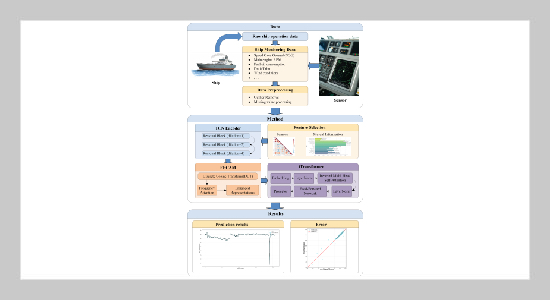
Overall framework of the proposed method.
Copyright The Author(s). This is an open access article distributed under the terms of the Creative Commons Attribution License (CC BY 4.0), which permits unrestricted use, distribution, and reproduction in any medium, provided the original author and source are cited.
Download Citation: BibTeX | http://dx.doi.org/10.6180/jase.202610_33.034
Accurate ship speed prediction in real-world marine operations remains challenging due to noise interference, strong multivariate coupling, non-stationarity, and data distribution shifts. This study proposes TCN-FECAM-iTransformer, a novel hybrid deep learning framework that synergistically integrates Temporal Convolutional Network (TCN), Frequency-Enhanced Channel Attention Mechanism (FECAM), and iTransformer for high precision one-step-ahead ship speed prediction. To address the critical challenges of strong marine environmental noise, non-stationarity, and complex multivariate coupling in real-world ship operations, the framework incorporates feature selection and carefully designed component collaboration. Specifically, Pearson correlation and mutual information (MI)-based feature selection are first applied to improve input quality by capturing
linear and nonlinear dependencies, respectively.
Subsequently, the TCN module extracts multi-scale local temporal features, the FECAM module suppresses noise and enhances channel-wise representations through frequency-domain analysis, and the iTransformer effectively models long-range dependencies across multiple variables. On real voyage data collected from an LPG carrier, the proposed framework achieves the best overall prediction performance, attaining an RMSE of 0.1952 kn andanR2 of 0.9707 under the Pearson Top-12 feature selection strategy. Compared with the strongest baseline model (iTransformer), the proposed approach reduces the RMSE by approximately 13.5%. Ablation studies further verify the effectiveness and complementary roles of the TCN and FECAM modules. Overall, this study provides an efficient and robust solution for ship speed prediction and demonstrates that the combination of appropriate feature selection and hybrid deep learning architectures can significantly improve the modeling of complex multivariate maritime time series.
Keywords: Ship Speed Prediction; Frequency-Enhanced Channel Attention; Inverted Transformer; Mutual Information
- [1] I. C. on Clean Transportation. New IMO study highlights sharp rise in short-lived climate pollution. 2020. URL: https://theicct.org/new-imo-study-highlights-sharp-rise-in-short-lived-climate-pollution/.
- [2] I. M. Organization. 2023 IMO Strategy on Reduction of GHG Emissions from Ships. 2023. URL: https://www.imo.org/en/ourwork/environment/pages/2023-imo-strategy-on-reduction-of-ghg-emissions-from-ships.aspx.
- [3] S. Nguyen, M. Gadel, K. Wang, J. Li, X. Zhang, S.-C. Kong, X. Fu, and Z. Qin, (2025) “Maritime decarbonization through machine learning: A critical systematic review of fuel and power prediction models” Cleaner Logistics and Supply Chain 14: 100210. DOI: 10.1016/j.clscn.2025.100210. URL: https://doi.org/10.1016/j.clscn.2025.100210.
- [4] Y. Kim, P. Gupta, and S. Steen, (2025) “A comprehensive review of data processing for ship performance analysis” Applied Ocean Research 162: 104737. DOI: 10.1016/j.apor.2025.104737. URL: https://doi.org/10.1016/j.apor.2025.104737.
- [5] S. Wang, Y. Li, and H. Xing, (2023) “A novel method for ship trajectory prediction in complex scenarios based on spatio-temporal features extraction of AIS data” Ocean Engineering 281: 114846. DOI: 10.1016/j.oceaneng.2023.114846. URL: https://doi.org/10.1016/j.oceaneng.2023.114846.
- [6] W. Gan, D. Ma, and Y. Duan, (2025) “Comparisons of Machine Learning Methods in Ship Speed Prediction Based on Shipboard Observation” Journal of Marine Science and Engineering 13(6): 1011. DOI: 10.3390/jmse13061011. URL: https://doi.org/10.3390/jmse13061011.
- [7] A. M. Bassam, A. B. Phillips, S. R. Turnock, and P. A. Wilson, (2023) “Artificial neural network based prediction of ship speed under operating conditions for operational optimization” Ocean Engineering 278: 114613. DOI: 10.1016/j.oceaneng.2023.114613. URL: https://doi.org/10.1016/j.oceaneng.2023.114613.
- [8] L. Breiman, (2001) “Random Forests” Machine Learning 45(1): 5–32. DOI: 10.1023/A:1010933404324. URL: https://doi.org/10.1023/A:1010933404324.
- [9] T. Chen and C. Guestrin. “XGBoost: A Scalable Tree Boosting System”. In: Proceedings of the 22nd ACM SIGKDD International Conference on Knowledge Discovery and Data Mining. 2016, 785–794. DOI: 10.1145/2939672.2939785. URL: https://doi.org/10.1145/2939672.2939785.
- [10] L. Prokhorenkova et al. “CatBoost: unbiased boosting with categorical features”. In: Advances in Neural Information Processing Systems. 2018. URL: https://papers.nips.cc/paper_files/paper/2018/hash/14491b756b3a51daac41c24863285549-Abstract.html.
- [11] G. Ke et al. “LightGBM: A Highly Efficient Gradient Boosting Decision Tree”. In: Advances in Neural Information Processing Systems. 2017. URL: https://proceedings.neurips.cc/paper_files/paper/2017/hash/6449f44a102fde848669bdd9eb6b76fa-Abstract.html.
- [12] A. Fan, S. Sun, Z. Hu, N. Vladimir, and W. Mao, (2026) “Enhancing transfer learning strategies for ship fuel consumption prediction under data scarcity” Ocean Engineering 351: 124398. DOI: 10.1016/j.oceaneng.2026.124398. URL: https://doi.org/10.1016/j.oceaneng.2026.124398.
- [13] X. Jiang et al., (2025) “Research on ship speed prediction based on time series imaging and deep convolutional network fusion method” Applied Ocean Research 154: 104384. DOI: 10.1016/j.apor.2024.104384. URL: https://doi.org/10.1016/j.apor.2024.104384.
- [14] X. Zhang et al., (2025) “Ship manoeuvring model identification using mutual information clustering with stepwise regression structural optimisation under small-sample constraints” Ocean Engineering 341: 122594. DOI: 10.1016/j.oceaneng.2025.122594. URL: https://doi.org/10.1016/j.oceaneng.2025.122594.
- [15] H. Zhou, S. Zhang, J. Peng, S. Zhang, J. Li, H. Xiong, and W. Zhang, (2021) “Informer: Beyond Efficient Transformer for Long Sequence Time-Series Forecasting” Proceedings of AAAI 35(12): 11106–11115. DOI: 10.1609/aaai.v35i12.17325. URL: https://doi.org/10.1609/aaai.v35i12.17325.
- [16] H. Wu et al. “Autoformer: Decomposition Transformers with Auto-Correlation for Long-Term Series Forecasting”. In: Advances in Neural Information Processing Systems. 2021. URL: https://proceedings.neurips.cc/paper_files/paper/2021/hash/bcc0d400288793e8bdcd7c19a8ac0c2b – Abstract. html.
- [17] Y. Liu, T. Hu, H. Zhang, H. Wu, S. Wang, L. Ma, and M. Long. “iTransformer: Inverted Transformers Are Effective for Time Series Forecasting”. In: International Conference on Learning Representations. 2024. DOI: 10.48550/arXiv.2310.06625. URL: http://arxiv.org/abs/2310.06625.
- [18] S. Bai, J. Z. Kolter, and V. Koltun. An Empirical Evaluation of Generic Convolutional and Recurrent Networks for Sequence Modeling. 2018. DOI: 10.48550/arXiv.1803.01271. URL: http://arxiv.org/abs/1803.01271.
- [19] M. Jiang, P. Zeng, K. Wang, H. Liu, W. Chen, and H. Liu, (2023) “FECAM: Frequency enhanced channel attention mechanism for time series forecasting” Advanced Engineering Informatics 58: 102158. DOI: 10.1016/j.aei.2023.102158. URL: https://doi.org/10.1016/j.aei.2023.102158.
- [20] A. Vorkapić, R. Radonja, and S. Martinčić-Ipšić, (2021) “Predicting Seagoing Ship Energy Efficiency from the Operational Data” Sensors 21(8): 2832. DOI: 10.3390/s21082832. URL: https://doi.org/10.3390/s21082832.
- [21] P. Karagiannidis and N. Themelis, (2021) “Data-driven modelling of ship propulsion and the effect of data pre-processing on the prediction of ship fuel consumption and speed loss” Ocean Engineering 222: 108616. DOI: 10.1016/j.oceaneng.2021.108616. URL: https://doi.org/10.1016/j.oceaneng.2021.108616.
- [22] S. Hochreiter and J. Schmidhuber, (1997) “Long Short-Term Memory” Neural Computation 9(8): 1735–1780. DOI: 10.1162/neco.1997.9.8.1735. URL: https://doi.org/10.1162/neco.1997.9.8.1735.
- [23] M.-W. Li et al., (2025) “A self-optimised informer-based model for nonlinear ship roll motion forecasting” Transportmetrica A: Transport Science: DOI: 10.1080/23249935.2025.2606152. URL: https://doi.org/10.1080/23249935.2025.2606152.