


School of International Logistics, Hunan Modern Logistics College, Changsha, Hunan 410131, China
Received: March 11, 2026
Accepted: April 26, 2026
Publication Date: July 10, 2026
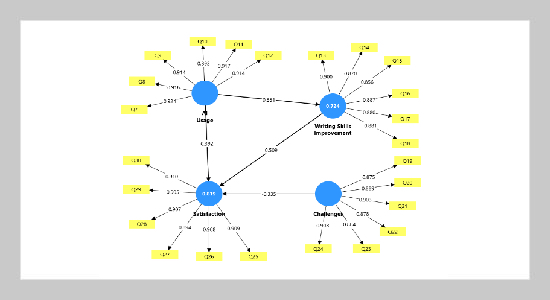
Structural Model Path Diagram
Copyright The Author(s). This is an open access article distributed under the terms of the Creative Commons Attribution License (CC BY 4.0), which permits unrestricted use, distribution, and reproduction in any medium, provided the original author and source are cited.
Download Citation: BibTeX | http://dx.doi.org/10.6180/jase.202610_33.032
The automatic feedback systems which use artificial intelligence (AI) technology now produce instant feedback to academic writers which correct their grammar errors and vocabulary usage and writing coherence problems. The research used a quantitative cross sectional study design which involved 200 undergraduate students at Tsinghua University who completed a structured 30 item questionnaire to provide information about their personal backgrounds and their digital platform usage and their perceived improvements and their difficulties and their overall satisfaction. The research team utilized Partial Least Squares Structural Equation Modeling to analyze data while maintaining methodological standards through the evaluation of reliability and validity and structural relationships. This research employs of quantitative cross-sectional analysis through structured questionnaire and PLS-SEM. Key statistics such as path coefficient (β = 0.851,0.392), effect size (f2 = 2.627,0.234) and capacity (R2 = 0.819).
Keywords: Artificial Intelligence; Feedback Systems; English Writing Skills; PLS-SEM; Academic Satisfaction; Challenges and Concerns
- [1] B. George and O. Wooden, (2023) “Managing the Strategic Transformation of Higher Education through Artificial Intelligence” Administrative Sciences 13(9): 196. DOI: 10.3390/admsci13090196.
- [2] X. H. N. Thi, H. V. H. Thien, K. N. Vuong, and T. T. Nguyen, (2025) “Enhancing Writing Skills through AI-Powered Tools: Perceived Benefits and Challenges among Vietnamese EFL Students” Discover Education 4(1): 472. DOI: 10.1007/s44217-025-00905-9.
- [3] A. K. A. Othman, (2025) “EFL Students’ Perceptions on Using ChatGPT as an AI Tool for Developing Academic Writing Skills: A Case Study at University College of Haql” Journal of Curriculum and Teaching 14(3): 18. DOI: 10.5430/jct.v14n3p18.
- [4] E. e. a. Bauer, (2023) “Using Natural Language Processing to Support Peer-Feedback in the Age of Artificial Intelligence: A Cross-Disciplinary Framework and a Research Agenda” British Journal of Educational Technology 54(5): 1222–1245. DOI: 10.1111/bjet.13336.
- [5] B. e. a. Lund, (2025) “Student Perceptions of AI-Assisted Writing and Academic Integrity: Ethical Concerns, Academic Misconduct, and Use of Generative AI in Higher Education” AI Education 1(1): 2. DOI: 10.3390/aieduc1010002.
- [6] J. Krajka and I. Olszak, (2024) “’AI, Will You Help?’ How Learners Use Artificial Intelligence When Writing” XLinguae 17(1): 34–48. DOI: 10.18355/XL.2024.17.01.03.
- [7] J. J. Jaramillo, A. Chiappe, and F. S. Delgado, (2025) “From Struggle to Mastery: AI-Powered Writing Skills in ESL Education” Applied Sciences 15(14): 8079. DOI: 10.3390/app15148079.
- [8] P. He, A. H. A. Hamid, and M. Y. Mohd Nor, (2025) “Instructional Leadership in the Age of AI: Guiding Effective Use of AI Tools in University English Speaking Practice” Journal of Applied Science, Engineering, Technology, and Education 7(3): 564–580. DOI: 10.35877/454RI.asci4270.