




Hui Zhang1, Lu Qiao1, Weifeng Han2, Benyin Li2, and Yanfen Li3
1Henan Academy of Agricultural Sciences, Institute of Agricultural Economics and Rural Development, Zhengzhou 450002, China
2Henan Academy of Agricultural Sciences, Institute of Plant Nutrition and Resource Environment, Zhengzhou, Henan, China
3Academy of Agricultural and Forestry Sciences (Jiaozuo), Jiaozuo, Henan, China
Received: March 4, 2026
Accepted: May 25, 2026
Publication Date: July 3, 2026
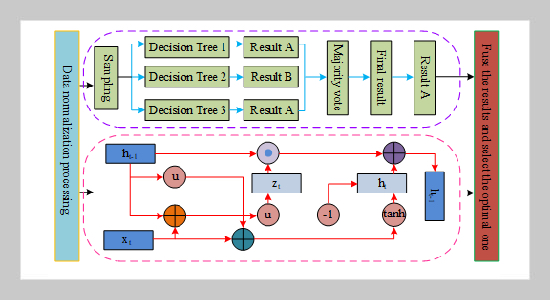
Improved RF operation flow chart
Copyright The Author(s). This is an open access article distributed under the terms of the Creative Commons Attribution License (CC BY 4.0), which permits unrestricted use, distribution, and reproduction in any medium, provided the original author and source are cited.
Download Citation: BibTeX | http://dx.doi.org/10.6180/jase.202610_33.029
This study proposes a composite evaluation model based on improved Elman and mixed optimization strategy to address the core issues of insufficient dynamic sequence modeling ability, incomplete capture of multi factor nonlinear interaction relationships, and model parameters easily falling into local optima in existing methods for assessing heavy metal content in farmland soils. High precision dynamic evaluation of soil heavy metal content has been achieved by integrating gated loop units to improve random forest, convolutional block attention mechanism, and grey wolf optimizer and genetic algorithm to improve particle swarm optimization algorithm. The results showed that the evaluation accuracy of the CRF PGElman model reached 99.7%, with an error rate of 2.5%, an average absolute error of 0.21mg/kg, a root mean square error of 0.33mg/kg, and an R2 of 0.97. In cross regional validation, the model achieved recognition accuracies of 0.99,0.98, and 0.99 for iron, chromium, and mercury, respectively. The research contribution lies in the construction of an intelligent hybrid assessment framework, which provides a new technological path for monitoring heavy metal pollution in farmland soil and quantifiable accuracy improvement for assessing heavy metal content in farmland soil under different geographical regions and pollution backgrounds. It has deployment value in practical monitoring applications.
Keywords: Assessment; Elman; Farmland heavy metal content; GRU; GWO; PSO
- [1] M. Singh, (2024) “Exploring the possibilities to implement metaverse in higher education institutions of India” Education and Information Technologies 29(15): 20715–20728. DOI: 10.1007/s10639-024-12691-2.
- [2] S. P. Suryodiningrat, H. Prabowo, A. Ramadhan, and H. B. Santoso, (2024) “The Essential Components of Metaverse-based Mixed Reality for Machinery Vocational Schools” Journal of Applied Engineering Technology and Science 5(2): 1069–1085. DOI: 10.37385/jaets.v5i2.4117.
- [3] A. M. Farouk, H. Naganathan, R. A. Rahman, and J. Kim, (2024) “Exploring the Economic Viability of Virtual Reality in Architectural, Engineering, and Construction Education” Buildings 14(9): 2655. DOI: 10.3390/buildings14092655.
- [4] G. Lampropoulos, (2025) “Combining Artificial Intelligence with Augmented Reality and Virtual Reality in Education: Current Trends and Future Perspectives” Multimodal Technologies and Interaction 9(2): 11. DOI: 10.3390/mti9020011.
- [5] H. Lee and Y. Hwang, (2022) “Technology-Enhanced Education through VR-Making and Metaverse-Linking to Foster Teacher Readiness and Sustainable Learning” Sustainability 14(8): 4786. DOI: 10.3390/su14084786.
- [6] C. O. Nwamekwe and E. C. Nwabunwanne, (2025) “Immersive Digital Twin Integration in the Metaverse for Supply Chain Resilience and Disruption Management” Journal of Engineering Research and Applied Science 14(1): 95–105. DOI: 10.0000/placeholder-doi.
- [7] P. Onu, A. Pradhan, and C. Mbohwa, (2024) “Potential to use metaverse for future teaching and learning” Education and Information Technologies 29(7): 8893–8924. DOI: 10.1007/s10639-023-12167-9.
- [8] F. Shi et al., (2024) “A new technology perspective of the Metaverse: Its essence, framework and challenges” Digital Communications and Networks 10(6): 1653–1665. DOI: 10.1016/j.dcan.2023.02.017.
- [9] C.-H. Wang, (2025) “Education in the metaverse: Developing virtual reality teaching materials for K–12 natural science” Education and Information Technologies 30(7): 8637–8658. DOI: 10.1007/s10639-024-13156-2.
- [10] M. Muthmainnah, L. Cardoso, A. G. Marzuki, and A. Al Yakin, (2025) “A new innovative metaverse ecosystem: VR-based human interaction enhances EFL learners’ transferable skills” Discover Sustainability 6(1): 156. DOI: 10.1007/s43621-025-00913-7.
- [11] M. Singh, D. Sun, and Z. Zheng, (2024) “Enhancing university students’ learning performance in a metaverse-enabled immersive learning environment for STEM edu-cation: A community of inquiry approach” Future Education Research 2(3): 288–309. DOI: 10.1002/fer3.56.
- [12] J. Lee and Y. Kim, (2023) “Sustainable Educational Metaverse Content and System Based on Deep Learning for Enhancing Learner Immersion” Sustainability 15(16): 12663. DOI: 10.3390/su151612663.
- [13] A. Waqar et al., (2023) “Analyzing the Success of Adopting Metaverse in Construction Industry: Structural Equation Modelling” Journal of Engineering 2023: 1–21. DOI: 10.1155/2023/8824795.
- [14] N. Bartels and K. Hahne, (2023) “Teaching Building Information Modeling in the Metaverse—An Approach Based on Quantitative and Qualitative Evaluation of the Students Perspective” Buildings 13(9): 2198. DOI: 10.3390/buildings13092198.
- [15] Z. Liu, S. Gong, Z. Tan, and P. Demian, (2023) “Immersive Technologies-Driven Building Information Modeling (BIM) in the Context of Metaverse” Buildings 13(6): 1559. DOI: 10.3390/buildings13061559.