




Haifeng Li1, Wei Tan1, Weichun Bu1, Hengshuai Fan1, Weiwei Sun1, Yue Du2, and Yuxuan Guo1
1School of Mathematics and Statistics, Fuyang Normal University, Fuyang 236037, China
2School of Computer and Information Science, Qinghai Institute of Technology, Xining 810016, China
Received: April 14, 2026
Accepted: May 5, 2026
Publication Date: June 29, 2026
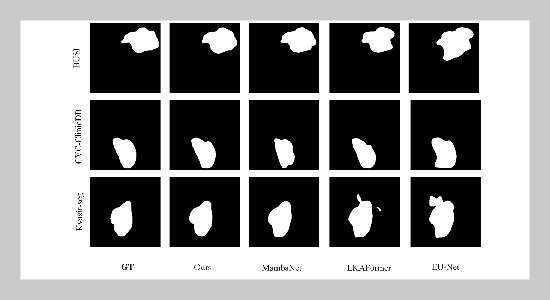
Visualization results of semantic segmentation of four methods on three heterogeneous datasets.
Copyright The Author(s). This is an open access article distributed under the terms of the Creative Commons Attribution License (CC BY 4.0), which permits unrestricted use, distribution, and reproduction in any medium, provided the original author and source are cited.
Download Citation: BibTeX | http://dx.doi.org/10.6180/jase.202610_33.024
Current U-Net based medical image segmentation methods often rely on stacked static nonlinear functions to model inter-pixel relationships, resulting in suboptimal segmentation performance. To address this, we propose a multi-path Mamba fusion-based U-KAN medical image segmentation method. Firstly, the U-Net architecture is reconstructed using Kolmogorov-Arnold Networks to enhance the nonlinear modeling capacity. Then, a dual path encoder is designed to extract multi-granularity semantic representations, and the Mamba is introduced to achieve adaptive cross-path feature fusion. Finally, a multi-stage supervised decoding process generates the precise segmentation results. Experiments on three medical datasets demonstrate that the proposed method outperforms state-of-the-art approaches in both Dice and mIoU metrics, confirming its superiority.
Keywords: Semantic segmentation; U-KAN architecture; Mamba fusion; multi-stage supervised segmentation
- [1] S. Yin, L. Wang, T. Chen, H. Huang, J. Gao, J. Zhang, M. Liu, P. Li, and C. Xu, (2026) “LKAFormer: A lightweight kolmogorov-arnold transformer model for image semantic segmentation” ACM Transactions on Intelligent Systems and Technology 17(3): 1–24. DOI: 10.1145/3759254.
- [2] J. Gao, M. Liu, P. Li, A. A. Laghari, A. R. Javed, N. Victor, and T. R. Gadekallu, (2024) “Deep Incomplete Multiview Clustering via Information Bottleneck for Pattern Mining of Data in Extreme-Environment IoT” IEEE Internet of Things Journal 11(16): 26700–26712. DOI: 10.1109/JIOT.2023.3325272.
- [3] W. Liu, (2024) “Channel Reorganization for Few-Shot Segmentation” Journal of Artificial Intelligence Research 1(1): 36–40. DOI: 10.70891/JAIR.2024.100025.
- [4] J. Gao, M. Liu, P. Li, J. Zhang, and Z. Chen, (2024) “Deep Multiview Adaptive Clustering With Semantic Invariance” IEEE Transactions on Neural Networks and Learning Systems 35(9): 12965–12978. DOI: 10.1109/TNNLS.2023.3265699.
- [5] W. Zhang and J. Wang, (2024) “English text sentiment analysis network based on CNN and U-Net” IFS/ACM Transactions on Machine Learning 1(1): 13–18. DOI: 10.70891/JSE.2024.100009.
- [6] G. Gao, C. Chen, K. Xu, K. Liu, and A. Mashhadi, (2024) “Automatic face detection based on bidirectional recurrent neural network optimized by improved Ebola optimization search algorithm” Scientific Reports 14(1): 27798. DOI: 10.1038/s41598-024-79067-x.
- [7] X. Xue and H. Zhu, (2022) “Matching knowledge graphs with compact niching evolutionary algorithm” Expert Systems with Applications 203: 117371. DOI: 10.1016/j.eswa.2022.117371.
- [8] D. Qian, L. Yu, H. Tang, and J. Zhao, (2020) “Multiview feature fusion optimization method for image retrieval based on matrix correlation” Journal of Electronic Imaging 29(5): 053007–053007. DOI: 10.1117/1.JEI.29.5.053007.
- [9] W. Wang, Q. Dong, and Z. Hu, (2023) “Interactive piecewise planar building reconstruction from a single image based on geometric priors” Expert Systems with Applications 230: 120572. DOI: 10.1016/j.eswa.2023.120572.
- [10] L. Yu, P. Liu, L. Jiang, and Z. Zhao, (2021) “Tensor dispersion-based multi-view feature embedding for dimension reduction” Journal of Electronic Imaging 30(3): 033019–033019. DOI: 10.1117/1.JEI.30.3.033019.
- [11] A. A. Bin-Salem, D. Z. Haider, M. Alzubaidi, Z. U. A. Tariq, and H. Naeem, (2022) “A scoping review on COVID-19’s early detection using deep learning model and computed tomography and ultrasound” Traitement du Signal 39(1): 205. DOI: 10.18280/ts.390121.
- [12] H. Naeem, A. Alsirhani, M. M. Alshahrani, and A. Alomari, (2022) “Android Device Malware Classification Framework Using Multistep Image Feature Extraction and Multihead Deep Neural Ensemble.” Traitement du Signal 39(3): DOI: 10.18280/ts.390326.
- [13] D. liang Zhang, Z. Jiang, F. Mohammadzadeh, S. M. H. Azhdari, L. Abualigah, and T. M. Ghazal, (2024) “FUZ-SMO: A fuzzy slime mould optimizer for mitigating false alarm rates in the classification of underwater datasets using deep convolutional neural networks” Heliyon 10(7): DOI: 10.1016/j.heliyon.2024.e28681.
- [14] L. Yu, D. Zhang, N. Liu, and W. Zhou, (2021) “A multi-view fusion method via tensor learning and gradient descent for image features” IEEE Access 9: 79389–79399. DOI: 10.1109/ACCESS.2021.3079499.
- [15] H. Wang, (2020) “A Synchronous Transmission Method for Array Signals of Sensor Network under Resonance Technology.” Traitement du Signal 37(4): DOI: 10.18280/ts.370405.
- [16] F. Ullah, M. R. Naeem, H. Naeem, X. Cheng, and M. Alazab, (2022) “CroLSSim: Cross-language software similarity detector using hybrid approach of LSA-based AST-MDrep features and CNN-LSTM model” International Journal of Intelligent Systems 37(9): 5768–5795. DOI: 10.1002/int.22813.
- [17] S. Dong, X.-g. Zhang, and W.-g. Zhou, (2020) “A security localization algorithm based on DV-hop against Sybil attack in wireless sensor networks” Journal of Electrical Engineering & Technology 15(2): 919–926. DOI: 10.1007/s42835-020-00361-5.
- [18] H. Naeem, X. Cheng, F. Ullah, S. Jabbar, and S. Dong, (2022) “A deep convolutional neural network stacked ensemble for malware threat classification in internet of things” Journal of Circuits, Systems and Computers 31(17): 2250302. DOI: 10.1142/S0218126622503029.
- [19] K. Abbas, M. K. Hasan, A. Abbasi, U. A. Mokhtar, A. Khan, S. N. H. S. Abdullah, S. Dong, S. Islam, D. Alboaneen, and F. R. A. Ahmed, (2023) “Predicting the future popularity of academic publications using deep learning by considering it as temporal citation networks” IEEE Access 11: 83052–83068. DOI: 10.1109/ACCESS.2023.3290906.
- [20] Z. Wang, T. Tao, Y. Ge, Z. Chen, T. Chen, Z. Ye, and Y. Lei, (2026) “Weak-mamba-unet: Visual mamba makes cnn and vit work better for scribble-based medical image segmentation” IEEE Transactions on Biomedical Engineering: DOI: 10.1109/TBME.2026.3668882.
- [21] X. Shu, J. Wang, A. Zhang, J. Shi, and X.-J. Wu, (2024) “CSCA U-Net: A channel and space compound attention CNN for medical image segmentation” Artificial Intelligence in Medicine 150: 102800. DOI: 10.1016/j.artmed.2024.102800.
- [22] M. M. Rahman, M. Munir, and R. Marculescu. “Emcad: Efficient multi-scale convolutional attention decoding for medical image segmentation”. In: Proceedings of the IEEE/CVF conference on computer vision and pattern recognition. 2024, 11769–11779. DOI: 10.1109/CVPR52733.2024.01118.
- [23] D. Dai, C. Dong, Q. Yan, Y. Sun, C. Zhang, Z. Li, and S. Xu, (2024) “I2u-net: A dual-path u-net with rich information interaction for medical image segmentation” Medical Image Analysis 97: 103241. DOI: 10.1016/j.media.2024.103241.
- [24] A. Lin, B. Chen, J. Xu, Z. Zhang, G. Lu, and D. Zhang, (2022) “Ds-transunet: Dual swin transformer u-net for medical image segmentation” IEEE Transactions on Instrumentation and Measurement 71: 1–15. DOI: 10.1109/TIM.2022.3178991.
- [25] A. Hatamizadeh, V. Nath, Y. Tang, D. Yang, H. R. Roth, and D. Xu. “Swin unetr: Swin transformers for semantic segmentation of brain tumors in mri images”. In: International MICCAI brainlesion workshop. 2021, 272–284. URL: https://arxiv.org/abs/2201.01266.
- [26] R. Wu, Y. Liu, P. Liang, and Q. Chang, (2025) “H-vmunet: High-order vision mamba unet for medical image segmentation” Neurocomputing 624: 129447. DOI: 10.1016/j.neucom.2025.129447.
- [27] P. Liang, L. Shi, B. Pu, R. Wu, J. Chen, L. Zhou, L. Xu, Z. Chen, Q. Chang, and Y. Li, (2025) “Mambasam: A visual mamba-adapted sam framework for medical image segmentation” IEEE journal of biomedical and health informatics: DOI: 10.1109/JBHI.2025.3544548.
- [28] X. Huang, Z. Deng, D. Li, X. Yuan, and Y. Fu, (2022) “Missformer: An effective transformer for 2d medical image segmentation” IEEE transactions on medical imaging 42(5): 1484–1494. DOI: 10.1109/TMI.2022.3230943.
- [29] X. Kui, S. Jiang, Q. Li, Y. Peng, Z. Hu, and B. Zou, (2025) “Gl-MambaNet: A global-local hybrid Mamba network for medical image segmentation” Neurocomputing 626: 129580. DOI: 10.1016/j.neucom.2025.129580.
- [30] T. D. Q. Dang, H. H. Nguyen, and A. Tiulpin. “LoG-VMamba: local-global vision mamba for medical image segmentation”. In: Proceedings of the Asian Conference on Computer Vision. 2024, 548–565. DOI: 10.1007/978-981-96-0901-7_14.