




School of International Trade and Economics, Shandong University of Finance and Economics, Jinan 250014, China
Received: April 7, 2026
Accepted: May 21, 2026
Publication Date: June 27, 2026
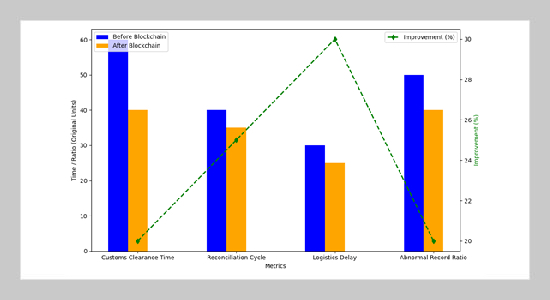
Trade efficiency before and after blockchain adoption
Copyright The Author(s). This is an open access article distributed under the terms of the Creative Commons Attribution License (CC BY 4.0), which permits unrestricted use, distribution, and reproduction in any medium, provided the original author and source are cited.
Download Citation: BibTeX | http://dx.doi.org/10.6180/jase.202610_33.019
This study investigates the application of data-driven blockchain technology in the international trade industry value chain. To address issues of lag, fragmentation, and low credibility in traditional multi-agent data systems, we construct a unified sample integrating trade data, on-chain records, and enterprise operational metrics. Core indices measuring blockchain adoption and value chain division are established. Employing regression analysis,
machine learning models, and moderation effect models, we quantify the impact of on-chain activities. Results demonstrate that blockchain’s transparent and immutable data structure enhances inter-firm collaborative stability, leading to a sustained rise in the value chain division index. Furthermore, synchronized on-chain recording significantly improves trade efficiency, reducing customs clearance time, reconciliation cycles, and
logistics node delays by 15% to 48%. The effect is more pronounced in high-tech industries. This work elucidates the functional pathway of blockchain within international trade systems, providing a verifiable, repeatable, and extensible analytical framework to inform trade governance and corporate digital strategy.
Keywords: Statistics; Block chain; International trade; Value chain division of labor; Trade efficiency; Data-driven model
- [1] J. Galbraith, P. B. Thomas, C. O’Hare, and M. Bourgeois, (2025) “A novel responsible innovation framework in the context of a blockchain analysis platform” Journal of Responsible Innovation 12(1): 2519883. DOI: 10.1080/23299460.2025.2519883.
- [2] X. Luo and Y. Xiao, (2025) “Digital trade rules and division of labour in global value chains” Finance Research Letters: 108164. DOI: 10.1016/j.frl.2025.108164.
- [3] Y. Tu, M. Xu, and W. Hu, (2025) “International trade disputes, trade protection, and corporate export resilience” Finance Research Letters: 108201. DOI: 10.1016/j.frl.2025.108201.
- [4] M. Du, C. Huang, and L. Liao, (2025) “Trade liberalization and energy efficiency: Quasi-natural experiment evidence from the pilot free trade zones in China” Economic Analysis and Policy 85: 1739–1751. DOI: 10.1016/j.eap.2025.02.019.
- [5] J. Xiao, H. Ding, and H. Zhang, (2025) “How chief data officers promote data-driven innovation: an empirical investigation” European Journal of Innovation Management 28(8): 3920–3937. DOI: 10.1108/EJIM-12-2023-1046.
- [6] L. Zavolokina, I. Bauer-Hänsel, J. Hacker, and G. Schwabe, (2024) “Organizing for value creation in blockchain information systems” Information and Organization 34(3): 100522. DOI: 10.1016/j.infoandorg.2024.100522.
- [7] J. P. Meltzer, (2024) “The impact of foundational AI on international trade, services and supply chains in Asia” Asian Economic Policy Review 19(1): 129–147. DOI: 10.1111/aepr.12451.
- [8] J. Kang, C. Yang, and Y. Ning, (2023) “Analysis of regional division of labor in value chain patterns and driving factors in the Yangtze River Delta region using the electronic information manufacturing industry as an example” Sustainability 15(19): 14393. DOI: 10.3390/su151914393.
- [9] X. Zhao, X. Yang, G. Peng, and S. Yue, (2023) “International trade and carbon emissions: Evaluating the role of trade rule uncertainty” Sustainability 15(15): 11662. DOI: 10.3390/su151511662.
- [10] Y. Xie, P. Zhang, Z. Yang, and W. Cheng, (2023) “Redistributive capacity and international trade: A cross-country analysis” Global Economic Review 52(2): 167–186. DOI: 10.1080/1226508X.2023.2215786.
- [11] A. Coveri and A. Zanfei, (2023) “Functional division of labour and value capture in global value chains: a new empirical assessment based on FDI data” Review of International Political Economy 30(5): 1984–2011. DOI: 10.1080/09692290.2022.2152074.
- [12] J. Tang, Y. Ren, Y. Zhao, and X. Zhang, (2023) “Analysis on the motivation and welfare of international conflicts in trade dependence” Emerging Markets Finance and Trade 59(3): 737–753. DOI: 10.1080/1540496X.2022.2119812.
- [13] J. Xu, W. Zhou, S. Zhang, and J. Fu, (2021) “A review of the technology and application of deposit and traceability based on blockchain” Journal of High Speed Networks 27(4): 335–359. DOI: 10.3233/JHS-210671.
- [14] P. Bhaskar, C. K. Tiwari, and A. Joshi, (2021) “Blockchain in education management: present and future applications” Interactive Technology and Smart Education 18(1): 1–17. DOI: 10.1108/ITSE-07-2020-0102.
- [15] W. Li, M. He, and S. Haiquan. “An overview of blockchain technology: applications, challenges and future trends”. In: 2021 IEEE 11th International Conference on Electronics Information and Emergency Communication (ICEIEC). 2021, 31–39. DOI: 10.1109/ICEIEC51955.2021.9463842.
- [16] S. Markus and P. Buijs, (2022) “Beyond the hype: how blockchain affects supply chain performance” Supply Chain Management: An International Journal 27(7): 177–193. DOI: 10.1108/SCM-03-2022-0109.
- [17] Y. R. Kim, (2022) “Blockchain initiatives for tax administration” UCLA Law Review 69: 240. DOI: 10.2139/ssrn.3798136.
- [18] E. R. Sanguinet, C. R. Azzoni, M. Atienza, and A. M. Alvim, (2022) “Skill-based functional specialization in trade: an input–output analysis of multiscalar value chains in Brazil” Spatial Economic Analysis 17(4): 471–498. DOI: 10.1080/17421772.2022.2081714.
- [19] A. Visvizi, O. Troisi, M. Grimaldi, and F. Loia, (2022) “Think human, act digital: activating data-driven orientation in innovative start-ups” European Journal of Innovation Management 25(6): 452–478. DOI: 10.1108/EJIM-04-2021-0206.
- [20] J. B. B. Clausen and H. Li, (2022) “Big data driven order-up-to level model: Application of machine learning” Computers & Operations Research 139: 105641. DOI: 10.1016/j.cor.2021.105641.
- [21] D. B. Karakoc and M. Konar, (2021) “A complex network framework for the efficiency and resilience trade-off in global food trade” Environmental Research Letters 16(10): 105003. DOI: 10.1088/1748-9326/ac1a9b.
- [22] E. Bracci, M. Tallaki, R. Ievoli, and S. Diplotti, (2021) “Knowledge, diffusion and interest in blockchain technology in SMEs” Journal of Knowledge Management 26(5): 1386–1407. DOI: 10.1108/JKM-02-2021-0099.
- [23] C. Kaiser, A. Stocker, G. Viscusi, M. Fellmann, and A. Richter, (2021) “Conceptualising value creation in data-driven services: The case of vehicle data” International Journal of Information Management 59: 102335. DOI: 10.1016/j.ijinfomgt.2021.102335.
- [24] A. I. Sanka, M. Irfan, I. Huang, and R. C. Cheung, (2021) “A survey of breakthrough in blockchain technology: Adoptions, applications, challenges and future research” Computer Communications 169: 179–201. DOI: 10.1016/j.comcom.2020.12.028.
- [25] M. J. Grodzicki and J. Skrzypek, (2020) “Cost-competitiveness and structural change in value chains—vertically-integrated analysis of the European automotive sector” Structural Change and Economic Dynamics 55: 276–287. DOI: 10.1016/j.strueco.2020.08.009.
- [26] B. Knüsel, C. Baumberger, M. Zumwald, D. N. Bresch, and R. Knutti, (2020) “Argument-based assessment of predictive uncertainty of data-driven environmental models” Environmental Modelling & Software 134: 104754. DOI: 10.1016/j.envsoft.2020.104754.
- [27] C. Staboulis, D. Natos, E. Tsakiridou, and K. Mattas, (2020) “International trade costs in OECD countries” Operational Research 20(3): 1177–1187. DOI: 10.1007/s12351-018-0388-z.