





Wei Yin1, Jun Wang1, Ming Tong1, Zhijun Chen1, Ke Zhang1, Qian Hu2, and Meiqing Huang2
1Suzhou Power Supply Company, State Grid Jiangsu Electric Power Company, Suzhou 215000, China
2College of Electrical and Power Engineering, Hohai University, Nanjing 211106, China
Received: December 30, 2025
Accepted: May 16, 2026
Publication Date: June 15, 2026
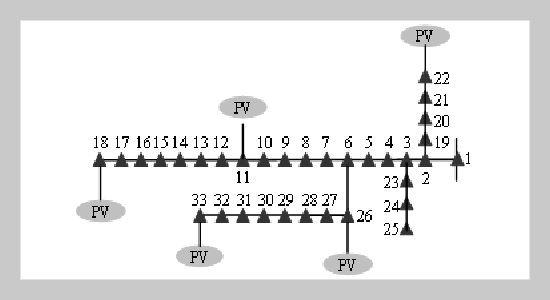
Topology Diagram of High Proportion Photovoltaic Grid-Connected Power Grid
Copyright The Author(s). This is an open access article distributed under the terms of the Creative Commons Attribution License (CC BY 4.0), which permits unrestricted use, distribution, and reproduction in any medium, provided the original author and source are cited.
Download Citation: BibTeX | http://dx.doi.org/10.6180/jase.202610_33.008
Identifying weak nodes in power grids with a high proportion of photovoltaic generation (PPVG) often faces challenges such as reliance on single one-sided indicators, coupled subjective biases, and insufficient risk quantification. The voltage sensitivity and probabilistic risk coupling model proposed herein effectively addresses these issues by integrating multi-dimensional indicators, adapting to dynamic uncertainties, balancing weights scientifically, and enabling accurate probabilistic characterization. This approach precisely locates nodes with high sensitivity and high risk, thereby enhancing the identification of nodes prone to cascading failures. This paper presents a weak node identification method for PPVG power grids based on a voltage sensitivity and probabilistic risk coupling model. A voltage sensitivity analytical model is constructed to quantify the static response characteristics of nodes to PV power disturbances, and the entropy weight method is used to identify highly sensitive nodes. The semi-invariant method combined with Gram-Charlier series expansion is employed to determine the nodal voltage probability distribution, facilitating the risk assessment of voltage violation probability and severity for these highly sensitive nodes. A coupled indicator system integrating sensitivity and probabilistic risk is established. The comprehensive vulnerability of nodes is then calculated using a combination weighting method and the TOPSIS algorithm, enabling the accurate identification and classification of weak nodes. Results demonstrate that the method accurately identifies core weak nodes, such as Node 18 (comprehensive vulnerability 0.892) and Node 33 (comprehensive vulnerability 0.773). The identified weak nodes align well with actual grid conditions, providing an effective solution for safety prevention and control in PPVG power grids.
Keywords: Voltage Sensitivity; Voltage Violation; Probabilistic Risk; Coupling Model; High Photovoltaic Penetration; Power Grid Weak Nodes
- [1] R. K. Sahu, B. Bag, and N. S. Lakra, (2024) “Energy management in power distribution network via volt-var-watt control” Journal of The Institution of Engineers (India): Series B 105(6): 1729–1742. DOI: 10.1007 / s40031-024-01077-0.
- [2] K. Nareshkumar, N. B. Roy, and D. Das, (2025) “A novel distributed zero bus model for optimal sizing and siting of distributed generators in an active distribution network” Electrical Engineering 107(3): 3403–3424. DOI: 10.1007/s00202-024-02669-1.
- [3] N. U. Ain, F. Mahmood, C. Tong, C. R. Vagasky, and M. E. M. Rizk, (2024) “Lightning nowcasting using fuzzy logic—a risk assessment framework for resilience of microgrids” Electric Power Systems Research 230(5): 1–8. DOI: 10.1016/j.epsr.2024.110253.
- [4] K. Khanna and M. Govindarasu, (2024) “Resiliency-driven cyber–physical risk assessment and investment planning for power substations” IEEE Transactions on Control Systems Technology 32(5): 1743–1754. DOI: 10.1109/TCST.2024.3378990.
- [5] S. Awasthi, G. Singh, and N. Ahamad, (2024) “Fault identification in distributed generation system using shallow ANN model” Journal of The Institution of Engineers (India): Series B 105(1): 131–145. DOI: 10.1007 / s40031-023-00942-8.
- [6] G. S. Garika and P. Kottala, (2024) “Wavelet analysis and machine learning approach for improved protection of PV-wind-SVC integrated smart power system” Journal of The Institution of Engineers (India): Series B 105(5): 1357–1372. DOI: 10.1007/s40031-024-01056-5.
- [7] I. A. Metwally and M. Eladawy, (2024) “Presaturated iron-core fault current limiters for MVDC power system applications” IET Electric Power Applications 18(12): 1978–1990. DOI: 10.1049/elp2.12524.
- [8] S. Stock, D. Babazadeh, C. Becker, and S. Chatzivasileiadis, (2024) “Bayesian physics-informed neural networks for system identification of inverter-dominated power systems” Electric Power Systems Research 235(10): 1–10. DOI: 10.1016/j.epsr.2024.110860.
- [9] A. Ebtia, M. Ghafouri, M. Debbabi, M. Kassouf, and A. Mohammadi, (2025) “Power distribution network topology detection using dual-graph structure graph neural network model” IEEE Transactions on Smart Grid 16(2): 1833–1850. DOI: 10.1109/TSG.2024.3512456.
- [10] F. J. Gonzalez, (2024) “System identification based on characteristic curves: A mathematical connection between power series and Fourier analysis for first-order nonlinear systems” Nonlinear Dynamics 112(18): 16167–16197. DOI: 10.1007/s11071-024-09890-4.
- [11] A. Mohanty, B. Rout, C. Prusty, and S. Panda, (2025) “Islanding detection using SCHO-NN method for distributed generation system” Electrical Engineering 107(9): 11773–11787. DOI: 10.1007/s00202-025-03121-8.
- [12] L. M. Putranto and I. F. Azhar, (2025) “Voltage stability and critical bus detection using a decision tree approach based on PMU measurements” Electrical Engineering 107(9): 11971–11985. DOI: 10.1007/s00202-025-03134-3.
- [13] U. Kumar and S. Mishra, (2025) “A data-driven global sensitivity analysis of output power to electrical faults in different SPV array topologies” IEEE Transactions on Industry Applications 61(1): 618–628. DOI: 10.1109/TIA.2024.3473897.
- [14] M. Chitra and P. Sakthivel, (2025) “Power quality optimization in hybrid renewable energy system using MDNSOGI-based predictive control” Electrical Engineering 107(11): 14735–14754. DOI: 10.1007/s00202-025-03291-5.
- [15] J. Kumar, S. Ansari, O. H. Gupta, and A. K. Singh, (2024) “A Champernowne adaptive filter-based control of grid interactive solar PV with power quality enrichment” IETE Journal of Research 70(11): 8354–8371. DOI: 10.1080/03772063.2024.2382777.
- [16] M. Badoni, S. Pandey, P. Chittora, A. Singh, and S. K. Singla, (2025) “Fractional-order multiple notch filter-cross feedback network for multi-operational grid-connected solar photovoltaic system” Electric Power Systems Research 239(2): 1–12. DOI: 10.1016/j.epsr.2024.111241.
- [17] R. Li, S. Liu, Z. Zhou, and H. Zhi, (2024) “Optimal simulation of overload risk assessment in distribution network based on digital twins” Computer Simulation 41(6): 157–161, 215.
- [18] A. Elshafei, A. C. Ferreira, M. Sanchez, and A. Zeghib, (2024) “Lie groups with all left-invariant semi-Riemannian metrics complete” Transactions of the American Mathematical Society 377(8): 5837–5862. DOI: 10.1090/tran/9160.
- [19] V. Singh, T. Moger, and D. Jena, (2023) “Probabilistic load flow for wind integrated power system considering node power uncertainties and random branch outages” IEEE Transactions on Sustainable Energy 14(1): 482–489. DOI: 10.1109/TSTE.2022.3216914.
- [20] R. Karagiannis and G. Karagiannis, (2025) “Distance-based weighting methods for composite indicators, with applications related to energy sustainability” International Transactions in Operational Research 32(1): 478–501. DOI: 10.1111/itor.13287.