



School of Humanities and Law, Zhengzhou Technology and Business University, Zhengzhou 450018, China
Received: March 10, 2026
Accepted: April 14, 2026
Publication Date: June 8, 2026
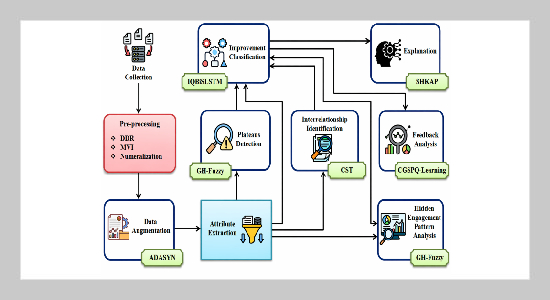
Structure of the Proposed Work
Copyright The Author(s). This is an open access article distributed under the terms of the Creative Commons Attribution License (CC BY 4.0), which permits unrestricted use, distribution, and reproduction in any medium, provided the original author and source are cited.
Download Citation: BibTeX | http://dx.doi.org/10.6180/jase.202609_32.073
English is widely used globally, but traditional methods fail to analyse hidden engagement patterns, leading to inaccurate interpretation of learner behaviour. Hidden engagement reflects implicit interactions that distinguish productive learning, involving active participation and measurable improvement, from passive usage with limited outcomes. To address this, a feedback-driven adaptive English learning framework is proposed using
GH-Fuzzy and CGSPQ-Learning. The process begins with data collection, preprocessing, augmentation, and attribute extraction, followed by learning plateau detection and interrelationship analysis. GH-Fuzzy is employed to analyse hidden engagement patterns and differentiate learner behaviours. Student improvement is then classified using IQBiSLSTM for enhanced stability and efficiency. Finally, CGSPQ-Learning generates personalized feedback to improve learning outcomes. The proposed model outperforms existing methods, achieving improved performance with reduced rule generation time.
Keywords: Feedback-Driven Model, Adaptive English Language Learning, Productive and Passive Learning, Student
- [1] X. Lei, J. Fathi, S. Noorbakhsh, and M. Rahimi, (2022) “The Impact of Mobile-Assisted Language Learning on English as a Foreign Language Learners’ Vocabulary Learning Attitudes and Self-Regulatory Capacity” Frontiers in Psychology 13: 872922. DOI: 10.3389/fpsyg.2022.872922.
- [2] A. Ni and A. Cheung, (2023) “Understanding secondary students’ continuance intention to adopt AI-powered intelligent tutoring system for English learning” Education and Information Technologies 28: 3191–3216.
- [3] J. C. Lawrence, P. Sambath, C. Shiny, M. Vazhangal, S. Prema, and B. K. Bala. “Developing an AI-Assisted Multilingual Adaptive Learning System for Personalized English Language Teaching”. In: 2024 10th International Conference on Advanced Computing and Communication Systems (ICACCS). 2024, 428–434. DOI: 10.1109/ICACCS60874.2024.10716887.
- [4] K. I. Hossain, (2024) “Reviewing the role of culture in English language learning: Challenges and opportunities for educators” Social Sciences Humanities Open 9: 100781. DOI: 10.1016/j.ssaho.2023.100781.
- [5] J. M. Gayed, M. K. J. Carlon, A. M. Oriola, and J. S. Cross, (2022) “Exploring an AI-based writing Assistant’s impact on English language learners” Computers and Education: Artificial Intelligence 3: 100055. DOI: 10.1016/j.caeai.2022.100055.
- [6] N. Annamalai, R. Ab Rashid, U. Munir Hashmi, M. Mohamed, M. Harb Alqaryouti, and A. Eddin Sadeq, (2023) “Using chatbots for English language learning in higher education” Computers and Education: Artificial Intelligence 5: 100153. DOI: 10.1016/j.caeai.2023.100153.
- [7] M. H. Al-khresheh, (2024) “Bridging technology and pedagogy from a global lens: Teachers’ perspectives on integrating ChatGPT in English language teaching” Computers and Education: Artificial Intelligence 6: 100218. DOI: 10.1016/j.caeai.2024.100218.
- [8] Y. L. Chen, C. C. Hsu, C. Y. Lin, and H. H. Hsu, (2022) “Robot-Assisted Language Learning: Integrating Artificial Intelligence and Virtual Reality into English Tour Guide Practice” Education Sciences 12(7): 437. DOI: 10.3390/educsci12070437.
- [9] T. Ganesan, M. V. Devarajan, A. R. G. Yallamelli, V. Mamidala, R. K. M. K. Yalla, and V. K. R, (2025) “Anomaly Detection in HR data using variational autoencoders: A deep learning approach to fraud detection and performance outliers” World Journal of Advanced Engineering Technology and Sciences 14(3): 267–274. DOI: 10.30574/wjaets.2025.14.3.0133.
- [10] F. Jia, D. Sun, Q. Ma, and C. K. Looi, (2022) “Developing an AI-Based Learning System for L2 Learners’ Authentic and Ubiquitous Learning in English Language” Sustainability 14(23): 15527. DOI: 10.3390/su142315527.
- [11] Y. Ma, X. J. Tang, and X. Huang, (2025) “AI-Powered Adaptive English Language Learning Systems: Leveraging Deep Learning Algorithms and Natural Language Processing for Personalized Teaching Approaches” IEEE Access 13: 153189–153198. DOI: 10.1109 / ACCESS.2025.3603602.