





Intelligent Manufacturing College of Guangxi Vocational & Technical College, Nanning City, Guangxi Province, 530226, China
Received: June 28, 2025
Accepted: March 31, 2026
Publication Date: June 4, 2026
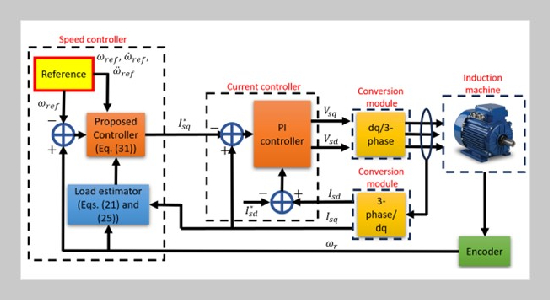
The structure of suggested controller for induction motor drive system.
Copyright The Author(s). This is an open access article distributed under the terms of the Creative Commons Attribution License (CC BY 4.0), which permits unrestricted use, distribution, and reproduction in any medium, provided the original author and source are cited.
Download Citation: BibTeX | http://dx.doi.org/10.6180/jase.202609_32.071
In this work, a hybrid control strategy derived from the control literature for induction machines is proposed, where a sliding-mode controller paired with an estimator from the same function is incorporated to provide fast, robust speed regulation while minimizing chattering. The controller operates using a fast integral terminal sliding surface that accelerates the convergence rate of tracking error after entering the sliding surface. A newsuper-twisting reaching law is provided which incorporates an integral term designed to suppress high frequency switching actions associated with chattering. The estimator that accompanies the controller also implements the same sliding surface coupled with the reaching law to estimate load torque and send the estimate to the controller to improve performance during sudden changes in load or when models are uncertain. Experimental results demonstrate the proposed method successfully (i) reduced convergence time (ii) reduced quaternion-like oscillations (chattering) (iii) improved performance robustness to time-varying load time, and where models were uncertain. From the results, it can be seen that the proposed approach improves chattering substantially (around 7% lower chattering), and convergence times are reduced to approximately 0.15- 0.25 sec, as opposed to the 0.8- 0.9 sec convergence times found with the reference. Speed tracking is better, on average, by around 9%, and transient torque errors went down to about 1- 2 rpm. Overall, it can be said that performance is better when compared to the reference.
Keywords: Induction machine, sliding mode Control, super-twisting, speed, chattering, integral terminal sliding surface, fast convergence.
- [1] Y. R. Konda, V. K. Ponnaganti, P. V. S. Reddy, R. R. Singh, P. Mercorelli, E. Gundabattini, and D. G. Solomon, (2024) “Thermal analysis and cooling strategies of high-efficiency three-phase squirrel-cage induction motors—A review” Computation 12: 6. DOI: 10.3390/computation12010006.
- [2] U. Sengamalai, G. Anbazhagan, T. M. T. Thentral, P. Vishnuram, T. Khurshaid, and S. Kamel, (2022) “Three phase induction motor drive: a systematic review on dynamic modeling, parameter estimation, and control schemes” Energies 15: 8260. DOI: 10.3390/en15218260.
- [3] S. Zhang, J. Kang, and J. Yuan, (2021) “Analysis and suppression of oscillation in V/F controlled induction motor drive systems” IEEE Transactions on Transportation Electrification 8: 1566–1574. DOI: 10.1109/TTE.2021.3113396.
- [4] N. H. Mugheri and M. U. Keerio, (2021) “An Optimal Fuzzy Logic-based PI Controller for the Speed Control of an Induction Motor using the V/F Method” Engineering, Technology Applied Science Research 11: 7399–7404. DOI: 10.48084/etasr.4255.
- [5] A. R. Miles and D. W. Novotny, (1979) “Transfer functions of the slip-controlled induction machine” IEEE Transactions on Industry Applications: 54–62. DOI: 10.1109/TIA.1979.4503612.
- [6] D. Zellouma, Y. Bekakra, and H. Benbouhenni, (2023) “Field-oriented control based on parallel proportional–integral controllers of induction motor drive” Energy Reports 9: 4846–4860. DOI: 10.1016/j.egyr.2023.04.008.
- [7] M. I. Abdelwanis, F. F. M. El-Sousy, and M. M. Ali, (2023) “A fuzzy-based proportional–integral–derivative with space-vector control and direct thrust control for a linear induction motor” Electronics 12: 4955. DOI: 10.3390/electronics12244955.
- [8] O. Gulbudak, M. Gokdag, and H. Komurcugil, (2022) “Model predictive control strategy for induction motor drive using Lyapunov stability objective” IEEE Transactions on Industrial Electronics 69: 12119–12128. DOI: 10.1109/TIE.2021.3139237.
- [9] M. Ayala, J. Doval-Gandoy, J. Rodas, O. Gonzalez, R. Gregor, and M. Rivera, (2020) “A novel modulated model predictive control applied to six-phase induction motor drives” IEEE Transactions on Industrial Electronics 68: 3672–3682. DOI: 10.1109/TIE.2020.2984425.
- [10] C. Lascu, A. Argeseanu, and F. Blaabjerg, (2019) “Supertwisting sliding-mode direct torque and flux control of induction machine drives” IEEE Transactions on Power Electronics 35: 5057–5065. DOI: 10.1109/TPEL.2019.2944124.
- [11] N. E. Ouanjli, A. Derouich, A. E. Ghzizal, S. Motahhir, A. Chebabhi, Y. E. Mourabit, and M. Taoussi, (2019) “Modern improvement techniques of direct torque control for induction motor drives-a review” Protection and Control of Modern Power Systems 4: 1–12. DOI: 10.1186/s41601-019-0125-5.
- [12] A. Ammar, A. Bourek, and A. Benakcha, (2020) “Robust SVM-direct torque control of induction motor based on sliding mode controller and sliding mode observer” Frontiers in Energy 14: 836–849. DOI: 10.1007/s11708-017-0444-z.
- [13] M. Aktas, K. Awaili, M. Ehsani, and A. Arisoy, (2020) “Direct torque control versus indirect field-oriented control of induction motors for electric vehicle applications” Engineering Science and Technology, an International Journal 23: 1134–1143. DOI: 10.1016/j.jestch.2020.04.002.
- [14] Z. Yang, D. Wang, X. Sun, and J. Wu, (2022) “Speed sensorless control of a bearingless induction motor with combined neural network and fractional sliding mode” Mechatronics 82: 102721. DOI: 10.1016/j.mechatronics.2021.102721.
- [15] M. Bahloul, L. Chrifi-Alaoui, S. Drid, M. Souissi, and M. Chaabane, (2018) “Robust sensorless vector control of an induction machine using multiobjective adaptive fuzzy luenberger observer” ISA transactions 74: 144–154. DOI: 10.1016/j.isatra.2018.01.019.
- [16] E. Zerdali, (2018) “Adaptive extended Kalman filter for speed-sensorless control of induction motors” IEEE Transactions on Energy Conversion 34: 789–800. DOI: 10.1109/TEC.2018.2866383.
- [17] E. Ilten, (2022) “Conformable fractional order controller design and optimization for sensorless control of induction motor” COMPEL-The international journal for computation and mathematics in electrical and electronic engineering 41: 1528–1541. DOI: 10.1108/COMPEL-09-2021-0334.
- [18] S. M. Gadoue, D. Giaouris, and J. W. Finch, (2009) “Artificial intelligence-based speed control of DTC induction motor drives—A comparative study” Electric Power Systems Research 79: 210–219. DOI: 10.1016/j.epsr.2008.05.024.
- [19] M. Z. Ali, M. N. S. K. Shabbir, S. M. K. Zaman, and X. Liang, (2020) “Single-and multi-fault diagnosis using machine learning for variable frequency drive-fed induction motors” IEEE Transactions on Industry Applications 56: 2324–2337. DOI: 10.1109/TIA.2020.2974151.
- [20] Q. Abdullah, N. Farah, M. S. Ahmed, N. S. M. Shah, Ö. Aydoğdu, M. H. N. Talib, Y. M. Al-Moliki, A. Uğurenver, M. A. A. Al-Mekhalfi, and M. Z. Aihsan, (2024) “Sensorless speed control of induction motor drives using reinforcement learning and self-tuning simplified fuzzy logic controller” IEEE Access 12: 136485–136501. DOI: 10.1109/ACCESS.2024.3435529.
- [21] M. Zelechowski, (2005) “Space vector modulated–direct torque controlled (dtc–svm) inverter–fed induction motor drive” Warsaw University of Technology Faculty of Electrical Engineering Institute of Control and Industrial Electronics:
- [22] H. Sudheer, S. F. Kodad, and B. Sarvesh, (2016) “Regular paper Improved Fuzzy Logic based DTC of Induction machine for wide range of speed control using AI based controllers” J. Electr. Syst 12: 301–314.
- [23] A. Alwadie, (2018) “A concise review of control techniques for reliable and efficient control of induction motor” International journal of power electronics and drive systems 9: 1124. DOI: 10.11591/ijpeds.v9.i3.pp1124-1139.
- [24] G. Chen, J. Xia, J. H. Park, H. Shen, and G. Zhuang, (2021) “Robust sampled-data control for switched complex dynamical networks with actuators saturation” IEEE Transactions on Cybernetics 52: 10909–10923. DOI: 10.1109/TCYB.2021.3069813.
- [25] G. Chen, G. Du, J. Xia, X. Xie, and J. H. Park, (2023) “Controller synthesis of aperiodic sampled-data networked control system with application to interleaved flyback module integrated converter” IEEE Transactions on Circuits and Systems I: Regular Papers 70: 4570–4580. DOI: 10.1109/TCSI.2023.3295940.
- [26] G. Zhuang, J. Xia, J.-e. Feng, B. Zhang, J. Lu, and Z. Wang, (2019) “Admissibility analysis and stabilization for neutral descriptor hybrid systems with time-varying delays” Nonlinear Analysis: Hybrid Systems 33: 311–321. DOI: 10.1016/j.nahs.2019.03.009.
- [27] J. Zhao, Y. Yuan, Z.-y. Sun, and X. Xie, (2023) “Applications to the dynamics of the suspension system of fast finite time stability in probability of p-norm stochastic nonlinear systems” Applied Mathematics and Computation 457: 128221. DOI: 10.1016/j.amc.2023.128221.
- [28] L. Wang, J. Mishra, Y. Zhu, and X. Yu, (2019) “An improved sliding-mode current control of induction machine in presence of voltage constraints” IEEE Transactions on Industrial Informatics 16: 1182–1191. DOI: 10.1109/TII.2019.2944228.
- [29] X. Che, Z. Ma, X. Qi, W. Li, H. Niu, and C. Yan, (2024) “Barrier-function-based adaptive fast-terminal sliding-mode control for a PMSM speed-regulation system” Electronics 13: 1091. DOI: 10.3390/electronics13061091.