


Department of Visual Communication of the Academy of Fine Arts, Harbin Normal University; Harbin 150080, China
Received: March 3, 2026
Accepted: April 17, 2026
Publication Date: June 4, 2026
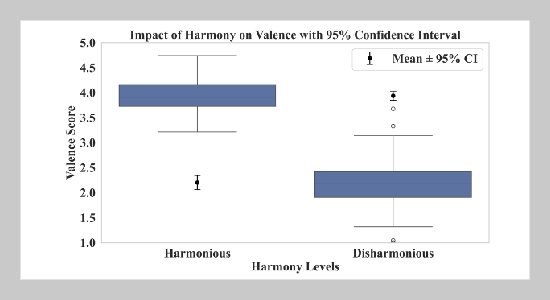
Impact of Harmony Levels on Valence. Boxplot Comparison
Copyright The Author(s). This is an open access article distributed under the terms of the Creative Commons Attribution License (CC BY 4.0), which permits unrestricted use, distribution, and reproduction in any medium, provided the original author and source are cited.
Download Citation: BibTeX | http://dx.doi.org/10.6180/jase.202609_32.070
Introduction: design, significantly shaping human emotions and perceptions. Understanding how different color properties influence emotional responses can improve the effectiveness and emotional impact of design. Objectives: This study examines how hue, saturation, brightness, and harmony influence emotional responses measured by valence, arousal, and dominance. The goal is to develop evidence-based insights for emotionally
engaging design strategies. Methods: A mixed-methods approach was employed, combining secondary data from a Kaggle dataset with primary data collected via surveys. Participants rated emotional responses to visual stimuli using a Likert scale. Results: Hue significantly affected valence (F = 12.45, p = 0.001), saturation influenced arousal (F = 10.89, p = 0.002), and brightness impacted dominance (F = 8.76, p = 0.003). Harmonious colors contributed 50.5% to positive valence, with red showing high arousal and dominance, while blue indicated calmness and positive valence. Conclusion: Color properties have a measurable impact on emotional responses. These findings offer data-driven guidelines for enhancing emotional engagement in visual communication design.
Keywords: Color Attributes, Emotional Dimensions, Valence, Arousal, Dominance.
- [1] M. Sokolova and A. Fernández-Caballero, (2015) “A Review on the Role of Color and Light in Affective Computing” Applied Sciences 5(3): 275–293. DOI: 10.3390/app5030275.
- [2] M. Ding, L. Zhao, H. Pei, and M. Song, (2021) “An XGBoost based evaluation methodology of product color emotion design” Journal of Advanced Mechanical Design, Systems, and Manufacturing 15(6): JAMDSM0075–JAMDSM0075. DOI: 10.1299/jamdsm.2021jamdsm0075.
- [3] S. K. Yang, W. J. Chung, and F. Yang, (2024) “Analyzing the packaging design evaluation based on image emotion perception computing” Heliyon 10(10): e31408. DOI: 10.1016/j.heliyon.2024.e31408.
- [4] G. Yu, S. Akhter, T. Kumar, G. G. R. Ortiz, and K. Saddhono, (2022) “Innovative application of new media in visual communication design and resistance to innovation” Frontiers in Psychology 13: 940899. DOI: 10.3389/fpsyg.2022.940899.
- [5] R. Duan, A. Zwickle, and B. Takahashi, (2022) “Refining the Application of Construal Level Theory: Egocentric and Nonegocentric Psychological Distances in Climate Change Visual Communication” Environmental Communication 16(1): 92–107. DOI: 10.1080 / 17524032.2021.1964999.
- [6] X. Zhang, (2026) “Smart Home Product Creation Under Emotional Design Principles and Consumer Perceptions” International Journal of Human-Computer Interaction 42(2): 1084–1094. DOI: 10.1080/10447318.2025.2518351.
- [7] Y. M. Putra, S. M. N. Restaty, and F. Mahliza, (2025) “Community Empowerment through Product Branding and Digital Marketing Techniques to Improve Economic Competitiveness and Entrepreneurship of Urban Families” Journal of Social Welfare and Community Development 2(1): 13–19. DOI: 10.70550/sowel.v2i1.233.
- [8] S. Wang, M. Yao, J. Liu, Y. Jiang, and W. Jiang, (2022) “Human perceptual responses to multiple colors II: A study of the correlation between multiple colors and emotion” Color Research & Application 47(6): 1242–1258. DOI: 10.1002/col.22801.
- [9] M. Mushtaq, F. Wei, and Bushra, (2025) “Integrating Cognitive Psychology and Computational Design: A Real-World, Cross-Cultural Analysis of Color Perception and Consumer Engagement in Digital Media” European Journal of Arts, Humanities and Social Sciences 2(6): 150–159. DOI: 10.59324/ejahss.2025.2(6).16.
- [10] L. Ou, M. R. Luo, A. Woodcock, and A. Wright, (2024) “A study of colour emotion and colour preference. Part I: Colour emotions for single colours” Color Research & Application 29(3): 232–240. DOI: 10.1002/col.20010.
- [11] G. Xia et al., (2021) “Aroused and Impulsive Effects of Colour Stimuli on Lateral and Logical Abilities” Behavioral Sciences 11(2): 24. DOI: 10.3390/bs11020024.
- [12] A. J. Elliot, (2015) “Color and psychological functioning: a review of theoretical and empirical work” Frontiers in Psychology 6: 00368. DOI: 10.3389/fpsyg.2015.00368.
- [13] B. R. Conway, S. Malik-Moraleda, and E. Gibson, (2023) “Color appearance and the end of Hering’s Opponent-Colors Theory” Trends in Cognitive Sciences 27(9): 791–804. DOI: 10.1016/j.tics.2023.06.003.
- [14] C. Taylor, K. Schloss, S. E. Palmer, and A. Franklin, (2013) “Color preferences in infants and adults are different” Psychonomic Bulletin & Review 20(5): 916–922. DOI: 10.3758/s13423-013-0411-6.
- [15] J. Maule, A. E. Skelton, and A. Franklin, (2023) “The Development of Color Perception and Cognition” Annual Review of Psychology 74(1): 87–111. DOI: 10.1146/annurev-psych-032720-040512.
- [16] A. D. Enwin, T. D. Ikiriko, and G. O. Jonathan-Ihua, (2023) “The Role of Colours in Interior Design of Liveable Spaces” European Journal of Theoretical and Applied Sciences 1(4): 242–262. DOI: 10.59324/ejtas.2023.1(4).25.
- [17] R. M. Amawi and M. J. Murdoch, (2022) “Understanding Color Associations and Their Effects on Expectations of Drugs’ Efficacies” Pharmacy 10(4): 82. DOI: 10.3390/pharmacy10040082.
- [18] H.-S. Seo, L. Rockers, and Y.-G. Kim, (2023) “The Effect of Response Conditions on Food Images-Evoked Emotions Measured Using the Valence x Arousal Circumplex-Inspired Emotion Questionnaire (CEQ)” Foods 12(11): 2250. DOI: 10.3390/foods12112250.
- [19] M. L. Weijs, D. Jonauskaite, R. Reutimann, C. Mohr, and B. Lenggenhager, (2023) “Effects of environmental colours in virtual reality: Physiological arousal affected by lightness and hue” Royal Society Open Science 10(10): 230432. DOI: 10.1098/rsos.230432.
- [20] J. Quiles-Rodríguez and R. Palau, (2024) “New Evidence on the Influence of Coloured Lighting on Students’ Cognitive Processes” Electronics 13(15): 3005. DOI: 10.3390/electronics13153005.
- [21] L. Wilms and D. Oberfeld, (2018) “Color and emotion: effects of hue, saturation, and brightness” Psychological Research 82(5): 896–914. DOI: 10.1007/s00426-017-0880-8.