




School of Culture and Media, Zhengzhou College of Finance and Economics, Zhengzhou, China
Received: March 30, 2026
Accepted: May 18, 2026
Publication Date: June 4, 2026
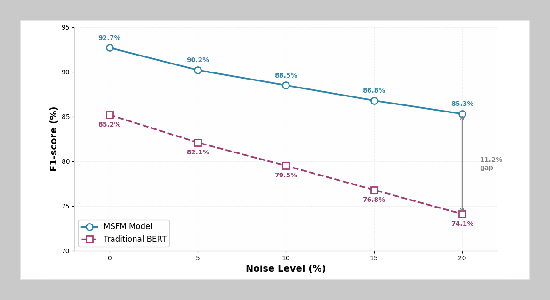
Robustness test results of the MSFM model.
Copyright The Author(s). This is an open access article distributed under the terms of the Creative Commons Attribution License (CC BY 4.0), which permits unrestricted use, distribution, and reproduction in any medium, provided the original author and source are cited.
Download Citation: BibTeX | http://dx.doi.org/10.6180/jase.202609_32.069
Classical Chinese literary texts are the core carrier of Chinese excellent traditional culture, bearing profound philosophical connotations and cultural values. However, due to the archaic language style, complex semantic system, and significant cultural differences between East and West, the accurate semantic parsing and effective cross-cultural dissemination of these texts face severe challenges. In response to the limitations of traditional semantic analysis methods (such as insufficient contextual understanding and over-reliance on manual annotation) and the lack of a systematic evaluation system for cross-cultural dissemination effects, this study proposes a deep learning-based integrated framework for semantic analysis and dissemination effect evaluation of classical Chinese literary texts. First, a Multidimensional Semantic Fusion Model (MSFM) based on improved BERT is constructed, which integrates lexical, syntactic, and cultural knowledge features to realize accurate parsing of implicit and explicit semantics in classical texts. Second, combining cultural dimension theory and communication effectiveness evaluation, a Cross-Cultural Dissemination Effect Evaluation Index System (CCDEIS) is established, which quantifies the dissemination effect from three dimensions: information fidelity, emotional resonance, and cultural identity. Third, experimental verification is carried out using a self-built corpus of classical Chinese literary texts (including The Analects, Tao Te Ching, and Book of Songs) and cross-cultural dissemination data from multiple regions. The results show that the MSFM model achieves an F1-score of 92.7% in semantic similarity and 89.3% in cultural connotation extraction, which is 8.5% and 10.2% higher than the traditional BERT and LSTM models, respectively. The CCDEIS index system can effectively evaluate the dissemination effect of different texts in different cultural contexts, with an evaluation consistency of 0.87. This study not only provides a new technical path for the digital protection and semantic mining of classical Chinese literary texts but also offers a scientific evaluation method for promoting the cross-cultural communication of Chinese traditional culture, which has important theoretical value and practical significance for cultural inheritance and global cultural exchanges.
Keywords: Classical Chinese literary texts; Deep learning; Semantic analysis; Cross-cultural dissemination; Effect evaluation; BERT model
- [1] F. Su and S. Zhao, (2025) “Analysis of Chinese classical literature texts and prediction of internet language trends based on natural language processing” Journal of Computational Methods in Sciences and Engineering 25(2): 1246–1260. DOI: 10.1177/14727978241298488.
- [2] B. Zhang and Z. Haoxuan, (2025) “The study of classic Chinese literature from the perspective of historical poetics” Neohelicon 52(1): 77–89. DOI: 10.1007/s11059-025-00798-5.
- [3] X. Wei, (2024) “The Use of large language models for translating Buddhist texts from classical Chinese to modern English: An analysis and evaluation with ChatGPT 4, ERNIE Bot 4, and Gemini advanced” Religions 15(12): 1559. DOI: 10.3390/rel15121559.
- [4] Q. Ding, (2026) “Sentiment Analysis of Classical Chinese Poetry Using Natural Language Processing: Multimodal Fusion and Diachronic Semantic Alignment” Journal of Cases on Information Technology (JCIT) 28(1): 1–14. DOI: 10.4018/JCIT.402398.
- [5] X. Yu and J. Wang, (2025) “Sentiment analysis of classical Chinese literature: An unsupervised deep learning model with BERT and graph attention networks” Plos one 20(9): e0330919. DOI: 10.1371/journal.pone.0330919.
- [6] J. Yu, L. Zhao, S. Yin, and M. Ivanović, (2024) “News recommendation model based on encoder graph neural network and bat optimization in online social multimedia art education” Computer Science and Information Systems 21(3): 989–1012. DOI: 10.2298/CSIS231225025Y.
- [7] L. Teng, Y. Qiao, M. Shafiq, G. Srivastava, A. R. Javed, T. R. Gadekallu, and S. Yin, (2023) “FLPK-BiSeNet: Federated learning based on priori knowledge and bilateral segmentation network for image edge extraction” IEEE Transactions on Network and Service Management 20(2): 1529–1542. DOI: 10.1109/TNSM.2023.3273991.
- [8] H. Yu, C. Gao, X. Li, and L. Zhang, (2024) “Ancient Chinese Poetry Collation Based on BERT” Procedia Computer Science 242: 1171–1178. DOI: 10.1016/j.procs.2024.08.179.
- [9] M. Li, Y. Qin, and W. Huangfu. “Roberta: An efficient dating method of ancient chinese texts”. In: Workshop on Chinese Lexical Semantics. Springer. 2022, 293–301. DOI: 10.1007/978-3-031-28956-9_23.
- [10] X. Bao, Z. Wang, J. Gu, and C.-R. Huang. “Revisiting classical Chinese event extraction with ancient literature information”. In: Proceedings of the 63rd Annual Meeting of the Association for Computational Linguistics (Volume 1: Long Papers). 2025, 8440–8451. DOI: 10.18653/v1/2025.acl-long.414.
- [11] W. Wu and X. Yang. “Analysis of the dissemination effects of VR audiovisual arts on local culture in cross-cultural contexts: A case study of the broadcasting and television industry”. In: International Conference on Human-Computer Interaction. Springer. 2024, 60–73. DOI: 10.1007/978-3-031-60913-8_5.
- [12] Y. Zhao, H. Li, and S. Yin, (2022) “A multi-channel character relationship classification model based on attention mechanism” Int. J. Math. Sci. Comput.(IJMSC) 8: 28–36. DOI: 10.5815/ijmsc.2022.01.03.
- [13] P. Palttala and M. Vos, (2012) “Quality indicators for crisis communication to support emergency management by public authorities” Journal of Contingencies and Crisis Management 20(1): 39–51. DOI: 10.1111/j.1468-5973.2011.00654.x.
- [14] X. Huang and X. Zhang, (2025) “Translating culture: the rise and resonance of Chinese contemporary literature in the Portuguese-speaking world” Humanities and Social Sciences Communications 12(1): 168. DOI: 10.1057/s41599-025-04457-z.
- [15] W. Zhang, H. Wang, M. Song, and S. Deng, (2023) “A method of constructing a fine-grained sentiment lexicon for the humanities computing of classical chinese poetry” Neural Computing and Applications 35(3): 2325–2346. DOI: 10.1007/s00521-022-07690-8.
- [16] Y. Zhang, S. Deng, Q. Zhang, D. Wang, and H. Gong. “Comparative analysis of language models for linguistic examination of ancient chinese classics: A case study of zuozhuan corpus”. In: 2023 International Conference on Asian Language Processing (IALP). IEEE. 2023, 154–161. DOI: 10.1109/IALP61005.2023.1033714.
- [17] F. Yuan. “Quantifying Stylistic Evolution in Classical Chinese Literature Using Word Embeddings and Trajectory Analysis”. In: 2025 2nd International Conference on Intelligent Computing and Robotics (ICICR). IEEE. 2025, 224–228. DOI: 10.1109/ICICR65456.2025.00046.
- [18] H. Qiuyang, (2026) “Big data and AI in the cross-cultural dissemination of Jingdezhen ceramic culture” Cogent Arts & Humanities 13(1): 2630566. DOI: 10.1080/23311983.2026.2630566.
- [19] S. Zhao and H. Zhao, (2025) “Optimization-Driven Deep Learning Framework for Ethnic Instrumental Music Style Recognition and Cross-Cultural Semantic Dissemination” Informatica 49(14): DOI: 10.31449/inf.v49i14.1015.