




Received: March 26, 2026
Accepted: April 28, 2026
Publication Date: June 4, 2026
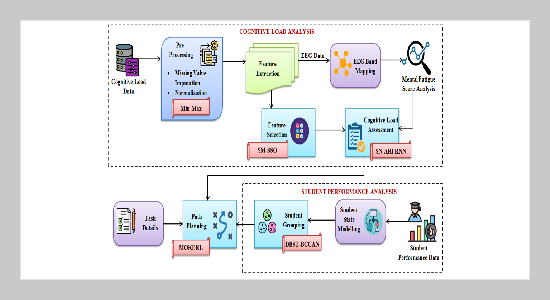
Block diagram of the proposed framework
Copyright The Author(s). This is an open access article distributed under the terms of the Creative Commons Attribution License (CC BY 4.0), which permits unrestricted use, distribution, and reproduction in any medium, provided the original author and source are cited.
Download Citation: BibTeX | http://dx.doi.org/10.6180/jase.202609_32.066
Assessment of Cognitive Load (CL) is important in music education but current approaches do not take into account the performance of students. This work proposes SN-ARi-RNN for CL prediction based on performance aware personalization. The CL is pre-processed; features are extracted and selected with the help of SM-SSO algorithm along with EEG band mapping and MF analysis. SN-ARi-RNN predicts CL, whereas the student performance models states and clusters. Eventually, MOLERL conduct adaptive path planning with considering CL, group and task, achieving its convergence in 6412 ms.
Keywords: : Music Education, Cognitive Load (CL), student’s performance, ElectroEncephaloGram (EEG), Mental Fatigue (MF) score, Multi-Objective Reinforcement Learning (MORL).
- [1] S. Bishara, (2022) “Linking Cognitive Load, Mindfulness, and Self-Efficacy in College Students with and without Learning Disabilities” European Journal of Special Needs Education 37(3): 494–510. DOI: 10.1080/08856257.2021.1911521.
- [2] L. Zhang, X. Wang, T. He, and Z. Han, (2022) “A Data-Driven Optimized Mechanism for Improving Online Collaborative Learning: Taking Cognitive Load into Account” International Journal of Environmental Research and Public Health 19(12): 6984. DOI: 10.3390/ijerph19126984.
- [3] T. S. S. Rao, A. S. Tiwari, U. Mitra, and K. K. Bhagat. “Effectiveness of Marker-Based Augmented Reality Game on Computational Thinking Skills and Cognitive Load for Middle School Students”. In: 2024 IEEE International Conference on Advanced Learning Technologies (ICALT). 2024, 222–226. DOI: 10.1109/ICALT61570.2024.00071.
- [4] J. Pengelley, P. R. Whipp, and A. Malpique, (2025) “A Testing Load: A Review of Cognitive Load in Computer and Paper-Based Learning and Assessment” Technology, Pedagogy and Education 34(1): 1–17. DOI: 10.1080/1475939X.2024.2367517.
- [5] B. Şimşek, B. Direkci, B. Koparan, M. Canbulat, M. Gülmez, and E. Nalçacıgil, (2025) “Examining the Effect of Augmented Reality Experience Duration on Reading Comprehension and Cognitive Load” Education and Information Technologies 30(2): 1445–1464. DOI: 10.1007/s10639-024-12864-z.
- [6] X. Liu and Y. Cui, (2025) “Eye Tracking Technology for Examining Cognitive Processes in Education: A Systematic Review” Computers & Education 229: 105263. DOI: 10.1016/j.compedu.2025.105263.
- [7] W. Chen, (2023) “A Novel Long Short-Term Memory Network Model for Multimodal Music Emotion Analysis in Affective Computing” Journal of Applied Science and Engineering 26(3): 367–376. DOI: 10.6180/jase.202303_26(3).0008.
- [8] G. Zhu, F. Zong, H. Zhang, B. Wei, and F. Liu, (2021) “Cognitive Load during Multitasking Can Be Accurately Assessed Based on Single Channel Electroencephalography Using Graph Methods” IEEE Access 9: 33102–33109. DOI: 10.1109/ACCESS.2021.3058271.
- [9] X. Pei, (2025) “Research on Multi-Objective Optimization Algorithm for Optimal Design of Art Education Curriculum Based on Emotional Learning Model” Journal of Combinatorial Mathematics and Combinatorial Computing 127: 8765–8781. DOI: 10.61091/jcmcc127a-486.
- [10] Q. W. Fu, Q. H. Liu, and T. Hu, (2024) “Multi-Objective Optimization Research on VR Task Scenario Design Based on Cognitive Load” Facta Universitatis, Series: Mechanical Engineering 22(2): 293–313. DOI: 10.22190/FUME240122029F.
- [11] G. Yoo, H. Kim, and S. Hong, (2023) “Prediction of Cognitive Load from Electroencephalography Signals Using Long Short-Term Memory Network” Bioengineering 10(3): 361. DOI: 10.3390/bioengineering10030361.
- [12] N. Jamil and A. N. Belkacem, (2024) “Advancing Real-Time Remote Learning: A Novel Paradigm for Cognitive Enhancement Using EEG and Eye-Tracking Analytics” IEEE Access 12: 93116–93132. DOI: 10.1109/ACCESS.2024.3422926.
- [13] J. Yedukondalu, K. Sunkara, V. Radhika, S. Kondaveeti, M. Anumothu, and Y. Murali Krishna, (2025) “Cognitive Load Detection through EEG Lead Wise Feature Optimization and Ensemble Classification” Scientific Reports 15(1): 842. DOI: 10.1038/s41598-024-84429-6.
- [14] Y. Zhou, J. Jiang, L. Wang, S. Liang, and H. Liu, (2025) “Enhanced Cognitive Load Detection in Air Traffic Control Operators Using EEG and a Hybrid Deep Learning Approach” IEEE Access 13: 12127–12137. DOI: 10.1109/ACCESS.2025.3530091.