



Received: March 2, 2026
Accepted: April 14, 2026
Publication Date: June 1, 2026
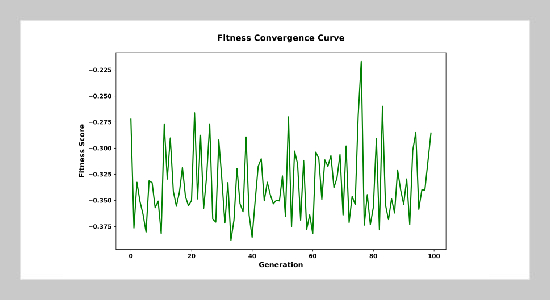
Fitness convergence curve
Copyright The Author(s). This is an open access article distributed under the terms of the Creative Commons Attribution License (CC BY 4.0), which permits unrestricted use, distribution, and reproduction in any medium, provided the original author and source are cited.
Download Citation: BibTeX | http://dx.doi.org/10.6180/jase.202609_32.065
Efficient distribution of rural cultural resources is essential for sustainable development under China’s rural revitalization strategy. This study presents a scalarized multi-objective genetic algorithm optimizing utilization, tourism appeal, costs, and sustainability under constraints. Tested on 30 simulated resources, it outperforms heuristics, improving utilization by 14.47%, reducing costs by 19.72%, and increasing sustainability scores by
1.18 points.
Keywords: Rural cultural resource allocation, Genetic algorithm optimization, Sustainable rural tourism, Multi-objective decision support, China rural revitalization
- [1] W. Knapik and K. Król, (2023) “Inclusion of Vanishing Cultural Heritage in a Sustainable Rural Development Strategy–Prospects, Opportunities, Recommendations” Sustainability 15(4): 3656. DOI: 10.3390/su15043656.
- [2] Y. Yu, D. Appiah, B. Zulu, and K. A. Adu-Poku, (2024) “Integrating Rural Development, Education, and Management: Challenges and Strategies” Sustainability 16(15): 6474. DOI: 10.3390/su16156474.
- [3] Y. Chen, Q. Zhang, D. Zhao, S. Folinas, and W. Zhang, (2022) “Optimization Approaches of Multi-Dimensional Environments in Rural Space Reproduction Driven by Tourism” Applied Sciences 12(24): 12527. DOI: 10.3390/app122412527.
- [4] Y. Li, Y. Liu, and Y. A. Solangi, (2024) “Analysis of Factors and Strategies for the Implementation of Sustainable Tourism in a Green Economic Structure in China” Journal of Cleaner Production 434: 140011. DOI: 10.1016/j.jclepro.2023.140011.
- [5] H. Fu, J. Liu, X. Dong, Z. Chen, and M. He, (2024) “Evaluating the Sustainable Development Goals within Spatial Planning for Decision-Making: A Major Function-Oriented Zone Planning Strategy in China” Land 13(3): 390. DOI: 10.3390/land13030390.
- [6] B. V. Natesha and R. M. R. Guddeti, (2021) “Adopting Elitism-Based Genetic Algorithm for Minimizing Multi-Objective Problems of IoT Service Placement in Fog Computing Environment” Journal of Network and Computer Applications 178: 102972. DOI: 10.1016/j.jnca.2020.102972.
- [7] H. Tunga, S. Kar, D. Giri, and I. Pan, (2024) “Efficacy Analysis of NSGAII and Multi-Objective Particle Swarm Optimization (MOPSO) in Agent Based Weapon Target Assignment Model” International Journal of Information Technology 16(3): 1347–1356. DOI: 10.1007/s41870-023-01674-0.
- [8] M. Arabasy and R. S. Ghoneim, (2025) “Enhancing Sustainable Urban Design Using Machine Learning: Comparative Analysis of Seven Metaheuristic Algorithms in Energy-Efficient Digital Architecture” Frontiers in Built Environment 11: DOI: 10.3389/fbuil.2025.1526209.