


Xiangge Liu, Bingquan Yin, Yali Hou, Benzhuo Fu, Qi Chen, and Haijuan Zhou
Qinhuangdao Vocational and Technical College, Qinhuangdao 066000, China
Received: March 1, 2026
Accepted: April 6, 2026
Publication Date: June 1, 2026
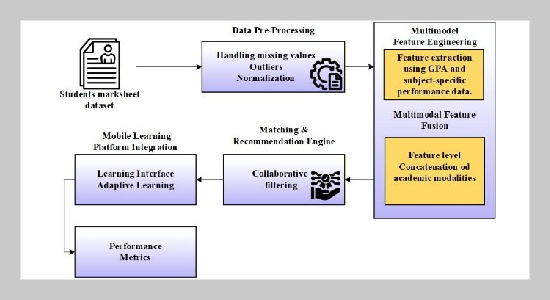
System Architecture for Collaborative Filtering-Based Project Recommendation
Copyright The Author(s). This is an open access article distributed under the terms of the Creative Commons Attribution License (CC BY 4.0), which permits unrestricted use, distribution, and reproduction in any medium, provided the original author and source are cited.
Download Citation: BibTeX | http://dx.doi.org/10.6180/jase.202609_32.063
University innovation projects are increasingly complex and require personalized recommendation systems that align students’ academic strengths with appropriate project opportunities. Existing recommendation methods typically rely on limited academic criteria, which fail to capture the full diversity of student learning characteristics, resulting in suboptimal matching. To address this, the research proposes an integrated mobile learning-based system that utilizes structured academic data from students’ marksheets. The framework distinguishes multiple modalities, including overall academic performance (GPA, weighted GPA), subject domain proficiency (subject-wise scores), and temporal learning trends (semester-wise performance variations). Although these features originate from a single dataset, they represent distinct perspectives on student learning. Each modality is transformed into a feature representation, and these heterogeneous representations are combined into a unified multimodal student profile through vector-level fusion. A collaborative filtering based recommendation engine, powered by cosine similarity, then generates personalized project suggestions. The system’s effectiveness is evaluated using standard recommender metrics such as Precision@5, Recall@5, F1@5, NDCG@5, MAP@5, hit rate, and coverage. Experimental results demonstrate the proposed method outperforms baseline approaches, achieving improvements of 12.6% in Precision@5 and 9.8% in NDCG@5, indicating enhanced ranking accuracy and recommendation relevance. Overall, the findings confirm that multimodal academic representations significantly improve personalized and large-scale innovation project recommendations in higher education.
Keywords: Multimodal Recommendation, Mobile Learning, Collaborative Filtering, Innovation Project Matching, Educational Data Mining
- [1] O. O. Ayeni, N. M. Al-Hamad, O. N. N. Chisom, B. Osawaru, and O. E. Adewusi, (2024) “AI in education: A review of personalized learning and educational technology” GSC Advanced Research Review 18(2): 261–271. DOI: 10.30574/gscarr.2024.18.2.0062.
- [2] R. A. Hurst, (2024) “Analysis of the impact of personalized learning paths in mobile learning platforms on the development of self-directed learning strategies among Brazilian college students” Research Advances in Education 3(3): 9–14. DOI: 10.56397/rae.2024.03.02.
- [3] T. Köpeczi-Bócz, (2024) “The impact of a combination of flipped classroom and project-based learning on the learning motivation of university students” Education Sciences 14(3): 240. DOI: 10.3390/educsci14030240.
- [4] M. Z. I. Pranjol, P. Oprandi, and S. Watson, (2024) “Project-based learning in biomedical sciences: Using the collaborative creation of revision resources to consolidate knowledge, promote cohort identity and develop transferable skills” Journal of Biological Education 58(5): 1048–1064. DOI: 10.1080/00219266.2022.2147576.
- [5] H. Liao et al., (2025) “Aspect-enhanced explainable recommendation with multi-modal contrastive learning” ACM Transactions on Intelligent Systems and Technology 16(1): 8:1–8:24. DOI: 10.1145/3673234.
- [6] A. Khelloufi et al., (2024) “A multimodal latent-features-based service recommendation system for the social internet of things” IEEE Transactions on Computational Social Systems 11(4): 5388–5403. DOI: 10.1109/TCSS.2024.3360518.
- [7] R. Alijani and F. Leonforte, (2025) “Performance analysis of multi-source heat pumps: A regression-based approach to energy performance estimation” Sustainability 17(15): 6804. DOI: 10.3390/su17156804.
- [8] H. M. R. U. Rehman, M. Saleem, M. Z. Jhandir, E. S. Alvarado, H. Garay, and I. Ashraf, (2025) “Detecting hate in diversity: A survey of multilingual code-mixed image and video analysis” Journal of Big Data 12(1): 109. DOI: 10.1186/s40537-025-01167-w.
- [9] R. Nimri, M. J. H. Yang, C. L. Yang, and C. Arcodia, (2024) “Investigating student engagement of online experiential learning: A comparison of virtual and in-person winery field trips” Journal of Teaching in Travel & Tourism 24(4): 405–425. DOI: 10.1080/15313220.2024.2402987.
- [10] X. Ji, L. Sun, and K. Huang, (2025) “The construction and implementation direction of personalized learning model based on multimodal data fusion in the context of intelligent education” Cognitive Systems Research 92: 101379. DOI: 10.1016/j.cogsys.2025.101379.
- [11] Y. Ye et al., (2025) “Harnessing multimodal large language models for multimodal sequential recommendation” Proceedings of the AAAI Conference on Artificial Intelligence 39(12): 13069–13077. DOI: 10.1609/aaai.v39i12.33426.
- [12] R. Whitehead, A. Nguyen, and S. Järvelä, (2025) “Utilizing multimodal large language models for video analysis of posture in studying collaborative learning: A case study” Journal of Learning Analytics 12(1): 186–200. DOI: 10.18608/jla.2025.8595.
- [13] M. Ogrizović, D. Drašković, and D. Bojić, (2024) “Quality assurance strategies for machine learning applications in big data analytics: An overview” Journal of Big Data 11(1): 156. DOI: 10.1186/s40537-024-01028-y.
- [14] X. Yang, (2025) “Research on personalized distance education recommendation system based on deep learning” Scientific Reports 15(1): 42158. DOI: 10.1038/s41598-025-26020-1.
- [15] C. Cohn, C. Snyder, J. H. Fonteles, J. Montenegro, and G. Biswas, (2025) “A multimodal approach to support teacher, researcher and AI collaboration in STEM+C learning environments” British Journal of Educational Technology 56(2): 595–620. DOI: 10.1111/bjet.13518.
- [16] D. Malitesta, G. Cornacchia, C. Pomo, F. A. Merra, T. Di Noia, and E. Di Sciascio, (2025) “Formalizing multimedia recommendation through multimodal deep learning” ACM Transactions on Recommender Systems 3(3): 1–33. DOI: 10.1145/3662738.
- [17] P. Liu, Y. Cao, and L. Wang, (2022) “A multimodal fusion online music education system for universities” Computational Intelligence and Neuroscience 2022: 652911. DOI: 10.1155/2022/652911.
- [18] U. B. Qushem, A. Christopoulos, S. S. Oyelere, H. Ogata, and M.-J. Laakso, (2021) “Multimodal technologies in precision education: Providing new opportunities or adding more challenges?” Education Sciences 11(7): 338. DOI: 10.3390/educsci11070338.
- [19] Y. Zheng, (2025) “Research on recommendation algorithms in short video platforms: From traditional methods to deep learning and multimodal fusion” Journal of Computer Signal Systems Research 2(5): 88–100. DOI: 10.71222/j5082f38.
- [20] J. Chen, R. Yang, J. Guo, H. Wang, K. Wu, and L. Zhang, (2025) “Reliable service recommendation: A multi-modal adversarial method for personalized recommendation under uncertain missing modalities” IEEE Transactions on Services Computing 18(3): 1724–1728. DOI: 10.1109/TSC.2025.3556640.
- [21] E. Wang and Z. Sun, (2025) “Research on personalized course resource recommendation method based on GEM-Rec” Applied Sciences 15(3): 1075. DOI: 10.3390/app15031075.
- [22] C. Li, X. Weng, Y. Li, and T. Zhang, (2025) “Multi-modal learning engagement assessment system: An innovative approach to optimizing learning engagement” International Journal of Human–Computer Interaction 41(5): 3474–3490. DOI: 10.1080/10447318.2024.2338616.
- [23] Y. Huang, W. Xu, P. Sukjairungwattana, and Z. Yu, (2024) “Learners’ continuance intention in multimodal language learning education: An innovative multiple linear regression model” Heliyon 10(6): e28104. DOI: 10.1016/j.heliyon.2024.e28104.
- [24] X. Cui and M. Chen, (2024) “A novel learning framework for vocal music education: An exploration of convolutional neural networks and pluralistic learning approaches” Soft Computing 28(4): 3533. DOI: 10.1007/s00500-023-09618-3.
- [25] Y. Zhao, J. Guo, L. Wen, and L. Wang, (2025) “METRIC: Multiple preferences learning with refined item attributes for multimodal recommendation” Journal of Information Intelligence 3(3): 242–256. DOI: 10.1016/j.jiixd.2025.04.001.
- [26] Y. Chen, C. Huang, S. Gao, Y. Lyu, X. Chen, S. Liu, and C. Lv, (2025) “A multimodal deep learning approach for legal English learning in intelligent educational systems” Sensors 25(11): 3397. DOI: 10.3390/s25113397.
- [27] J. Duan, M. Zhang, M. Song, X. Xu, and H. Lu, (2025) “Eye Tracking-Enhanced Deep Learning for Medical Image Analysis: A Systematic Review on Data Efficiency, Interpretability, and Multimodal Integration” Bioengineering 12(9): 954. DOI: 10.3390/bioengineering12090954.
- [28] S. Algarni and F. T. Sheldon, (2025) “Personalized Course Recommendations Leveraging Machine and Transfer Learning Toward Improved Student Outcomes” Machine Learning and Knowledge Extraction 7(4): 138. DOI: 10.3390/make7040138.
- [29] F. Li, (2022) “Research on the management system of college students’ innovation and entrepreneurship education based on b/s architecture” Journal of Applied Science and Engineering 26(5): 597–604. DOI: 10.6180/jase.202305_26(5).0002.