




Lin Teng1, Yulong Qiao1, Yang Sun2, and Hang Li2
1School of Information and Communication Engineering, Harbin Engineering University, 150001 China
2College of Artificial Intelligence, Shenyang Normal University, 110034 China
Received: April 5, 2026
Accepted: May 1, 2026
Publication Date: June 1, 2026
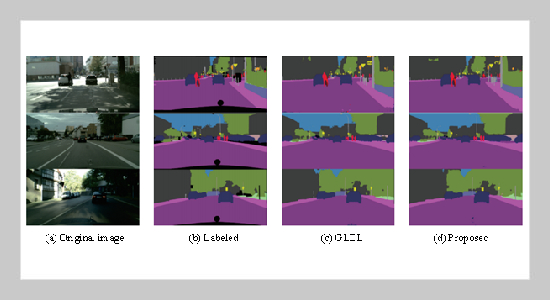
Visualized segmentation results
Copyright The Author(s). This is an open access article distributed under the terms of the Creative Commons Attribution License (CC BY 4.0), which permits unrestricted use, distribution, and reproduction in any medium, provided the original author and source are cited.
Download Citation: BibTeX | http://dx.doi.org/10.6180/jase.202609_32.059
We introduce an efficient segmentation framework that integrates multi-scale cues in real time, avoiding the need for overly deep architectures. A Separable Pyramid Module (SPM) is introduced to harvest rich context at 1/4 and 1/8 resolutions by combining depthwise-separable, factorized and dilated convolutions in a bottleneck layout, cutting parameters while preserving receptive fields. To guide the fusion of high-level semantics into low-level detail, a Context Channel Attention (CCA) block is proposed. It re-weights shallow feature channels by exploiting the inter-channel correlations learned from deep feature maps, refining edges without extra heavy computation. The overall encoder-decoder is deliberately kept shallow, so that the deepest feature map remains at 1/8 scale, ensuring fast inference. Extensive experiments on PASCAL VOC2012 demonstrate that the new method achieves competitive accuracy against deeper counterparts while maintaining superior speed, validating the effectiveness of the SPM and CCA designs for balancing precision and real-time performance in semantic segmentation tasks.
Keywords: Image semantic segmentation, feature information fusion, lightweight ResNet, context channel attention
- [1] S. Yin, L. Wang, T. Chen, H. Huang, J. Gao, J. Zhang, M. Liu, P. Li, and C. Xu, (2026) “LKAFormer: A lightweight kolmogorov-arnold transformer model for image semantic segmentation” ACM Transactions on Intelligent Systems and Technology 17(3): 1–24. DOI: 10.1145/3759254.
- [2] Y. Lu, Y. Chen, D. Zhao, and J. Chen. “Graph-FCN for image semantic segmentation”. In: International symposium on neural networks. Springer. 2019, 97–105. DOI: 10.1007/978-3-030-22796-8_11.
- [3] A. Garcia-Garcia, S. Orts-Escolano, S. Oprea, V. Villena-Martinez, P. Martinez-Gonzalez, and J. Garcia-Rodriguez, (2018) “A survey on deep learning techniques for image and video semantic segmentation” Applied Soft Computing 70: 41–65. DOI: 10.1016/j.asoc.2018.05.018.
- [4] K. Wang, J. H. Liew, Y. Zou, D. Zhou, and J. Feng. “Panet: Few-shot image semantic segmentation with prototype alignment”. In: proceedings of the IEEE/CVF international conference on computer vision. 2019, 9197–9206. DOI: 10.1109/ICCV.2019.00929.
- [5] W. Sun and R. Wang, (2018) “Fully convolutional networks for semantic segmentation of very high resolution remotely sensed images combined with DSM” IEEE Geoscience and Remote Sensing Letters 15(3): 474–478. DOI: 10.1109/LGRS.2018.2795531.
- [6] C. Peng, Y. Li, L. Jiao, Y. Chen, and R. Shang, (2019) “Densely based multi-scale and multi-modal fully convolutional networks for high-resolution remote-sensing image semantic segmentation” IEEE Journal of Selected Topics in Applied Earth Observations and Remote Sensing 12(8): 2612–2626. DOI: 10.1109/JSTARS.2019.2906387.
- [7] W. Zhao, Y. Chen, S. Xiang, Y. Liu, and C. Wang, (2023) “Image semantic segmentation algorithm based on improved DeepLabv3+” Journal of System Simulation 35(11): 2333–2344. DOI: 10.16182/j.issn1004731x.joss.22-0690.
- [8] M. M. Memon, M. A. Hashmani, A. Z. Junejo, S. S. Rizvi, and K. Raza, (2022) “Unified DeepLabV3+ for semi-dark image semantic segmentation” Sensors 22(14): 5312. DOI: 10.3390/s22145312.
- [9] D. Jiang, H. Qu, J. Zhao, J. Zhao, and W. Liang, (2021) “Multi-level graph convolutional recurrent neural network for semantic image segmentation” Telecommunication Systems 77(3): 563–576. DOI: 10.1007/s11235-021-00769-y.
- [10] W. Wang, S. Wang, Y. Li, and Y. Jin, (2021) “Adaptive multi-scale dual attention network for semantic segmentation” Neurocomputing 460: 39–49. DOI: 10.1016/j.neucom.2021.06.068.
- [11] Z. Wang, Z.-H. You, N. Xu, C. Zhang, and D.-S. Huang, (2024) “UAVSeg: Dual-encoder cross-scale attention network for UAV images’ semantic segmentation” IEEE Transactions on Geoscience and Remote Sensing 63: 1–17. DOI: 10.1109/TGRS.2024.3502401.
- [12] Z. An, J. Zhang, Z. Sheng, X. Er, and J. Lv, (2021) “RBDN: Residual bottleneck dense network for image super-resolution” IEEE Access 9: 103440–103451. DOI: 10.1109/ACCESS.2021.3096548.
- [13] L. Chen, X. Xu, L. Pan, J. Cao, and X. Li, (2021) “Real-time lane detection model based on non bottleneck skip residual connections and attention pyramids” Plos one 16(10): e0252755. DOI: 10.1371/journal.pone.0252755.
- [14] L. Teng, Y. Qiao, M. Shafiq, G. Srivastava, A. R. Javed, T. R. Gadekallu, and S. Yin, (2023) “FLPK-BiSeNet: Federated learning based on priori knowledge and bilateral segmentation network for image edge extraction” IEEE Transactions on Network and Service Management 20(2): 1529–1542. DOI: 10.1109/TNSM.2023.3273991.
- [15] X. Li, X. Yong, T. Li, Y. Tong, H. Gao, X. Wang, Z. Xu, Y. Fang, Q. You, and X. Lyu, (2024) “A spectral–spatial context-boosted network for semantic segmentation of remote sensing images” Remote Sensing 16(7): 1214. DOI: 10.3390/rs16071214.
- [16] M. Luo, Y. Zan, K. Khoshelham, and S. Ji, (2025) “Domain generalization for semantic segmentation of remote sensing images via vision foundation model fine-tuning” ISPRS Journal of Photogrammetry and Remote Sensing 230: 126–146. DOI: 10.1016/j.isprsjprs.2025.09.004.
- [17] L. Wang, D. Li, S. Dong, X. Meng, X. Zhang, and D. Hong, (2025) “PyramidMamba: Rethinking pyramid feature fusion with selective space state model for semantic segmentation of remote sensing imagery” International Journal of Applied Earth Observation and Geoinformation 144: 104884. DOI: 10.1016/j.jag.2025.104884.
- [18] J. Liu, H. Zhang, J. Chen, R. Meng, C. Gao, L. Han, Y. Song, Y. Tian, and Y. Wang, (2025) “Automated detection and segmentation of dental caries using a novel cascaded learning approach” Biomedical Signal Processing and Control 102: 107344. DOI: 10.1016/j.bspc.2024.107344.
- [19] Z. Rui, L. Han, Y. Li, and G. Liu. “Semantic segmentation of building floor plans based on improved Deeplabv3+”. In: Second International Conference on Remote Sensing Technology and Survey Mapping (RSTSM 2025). 13802. SPIE. 2025, 301–307. DOI: 10.1117/12.3067853.
- [20] Z. Wu, M. Li, Y. Han, and X. Feng, (2025) “Semantic segmentation of 3D point cloud for sewer defect detection using an integrated global and local deep learning network” Measurement 253: 117434. DOI: 10.1016/j.measurement.2025.117434.