




Ren Peng, Song Jun, Ji Hongwei, Ren Peng, Yang Yong, and Chen Jie
Shandong Luruan Digital Technology Co., LTD. No. 2008, Xinluo Street, High-tech Industrial Development Zone, Jinan City,
Shandong Province, Yinhe Building, China
Received: December 24, 2025
Accepted: April 1, 2026
Publication Date: May 27, 2026
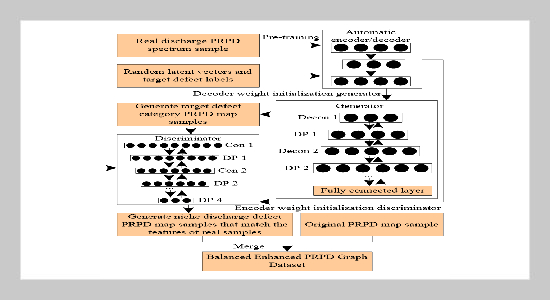
Overall Architecture of BAGAN Model
Copyright The Author(s). This is an open access article distributed under the terms of the Creative Commons Attribution License (CC BY 4.0), which permits unrestricted use, distribution, and reproduction in any medium, provided the original author and source are cited.
Download Citation: BibTeX | http://dx.doi.org/10.6180/jase.202609_32.058
Partial discharge (PD) in high-voltage cables often includes rare defect types, while field collected pulse phase analysis (PRPD) spectra typically exhibit sparsity and class imbalance. Limited representative samples and weakly discriminative features hinder accurate extraction of deep time-frequency characteristics, leading to misclassification of defect types. To address this issue, this study proposes a generative diagnostic framework based on sparse data augmentation. An attention-enhanced BAGAN model is applied to augment sparse PRPD spectra, producing a balanced dataset across defect categories. The enhanced dataset is then processed using VMD-MSE to extract low-redundancy, high-discriminative time-frequency features. These features are subsequently input into an IKHA-optimized Deep Belief Network (IKHA-DBN) for defect classification. Experimental results show that generative augmentation increases rare defect samples by 700%, effectively eliminating class imbalance. The synthesized PRPD spectra exhibit strong consistency with genuine spectra in phase distribution and amplitude characteristics, confirming physical plausibility. In testing on 64 multi-class samples, only one misclassification occurred, demonstrating high diagnostic accuracy and sensitivity to minority defects. The results validate the robustness and effectiveness of the proposed method for intelligent diagnosis of rare PD defects in high voltage cables.
Keywords: Sparse Data Augmentation, High-Voltage Cable, Partial Discharge, Defect Type Diagnosis, Generative Adversarial Network
- [1] O. Arikan, C. C. Uydur, and C. F. Kumru, (2023) “Insulation Evaluation of MV Underground Cable with Partial Discharge and Dielectric Dissipation Factor Measurements” Electric Power Systems Research 220: 109338. DOI: 10.1016/j.epsr.2023.109338.
- [2] M. Rajamayil and V. Basharan, (2025) “A Novel Semi-Supervised Power Transformer Defect Monitoring Technique Using Unreliable Pseudo-Labels with Highly Imbalanced Partial Discharge Signals” Electrical Engineering 107(4): 4939–4957. DOI: 10.1007/s00202-024-02793-y.
- [3] P. Ranjan, M. Oancea, Q. Han, F. O. Bahdad, C. Onoufriou, and M. Seltzer-Grant, (2024) “Partial Discharge Monitoring of C3F7CN/CO2 Mixture Retrofilled in Gas Insulated Busbar” IEEE Transactions on Power Delivery 39(6): 3212–3222. DOI: 10.1109/TPWRD.2024.3454440.
- [4] I. A. Devi, R. V. Maheswari, and R. Rajesh, (2023) “Recognition of Fused Partial Discharge Patterns in High Voltage Insulation Systems: A Hybrid DCNN and SVM Based Approach” IETE Journal of Research 69(10): 7553–7568. DOI: 10.1080/03772063.2022.2038702.
- [5] S. Mishra, P. P. Singh, and P. C. Bordin, (2024) “Diagnostics Analysis of Partial Discharge Events of the Power Cables at Various Voltage Levels Using Ramping Behavior Analysis Method” Electric Power Systems Research 227: 109988. DOI: 10.1016/j.epsr.2023.109988.
- [6] M. H. Saad, S. Hashima, A. I. Omar, M. M. Fouda, and A. Saied, (2025) “Deep Learning Approach for Cable Partial Discharge Pattern Identification” Electrical Engineering 107(2): 1525–1540. DOI: 10.1007/s00202-024-02571-w.
- [7] F. Serttas and F. O. Hocaoglu, (2025) “A Novel Partial Discharge Signal Detection and Estimation Method: Mycielski Algorithm” Electrical Engineering 107(3): 2829–2843. DOI: 10.1007/s00202-024-02656-6.
- [8] M. Fikri and Z. Abdul-Malek, (2023) “Partial Discharge Diagnosis and Remaining Useful Lifetime in XLPE Extruded Power Cables under DC Voltage: A Review” Electrical Engineering 105(6): 4195–4212. DOI: 10.1007/s00202-023-01935-y.
- [9] J. M. Park, J. Y. Kang, Y. C. Moon, J. Lee, and J. C. Jeon, (2023) “Analysis on the Partial Discharge Characteristics of 22.9kV CN-CV Power Cable Termination Defect” Transactions of the Korean Institute of Electrical Engineers 72(11): 1546–1553. DOI: 10.5370/KIEE.2023.72.11.1546.
- [10] N. V. Edward, A. Jenefa, T. M. Thiyagu, A. Lincy, and A. Taurshia, (2024) “DeepGAN: Utilizing Generative Adversarial Networks for Improved Deep Learning” International Journal of Knowledge and Intelligent Engineering Systems 28(4): 732–748. DOI: 10.3233/KES-230326.
- [11] R. K. Mandal, H. Devarajan, S. Nandi, T. B. Shanker, and M. Ghassemi, (2025) “An Underdetermined Single-Channel Blind-Source-Separation for Multisource Acoustic-Emission-Based Partial Discharge Signals in Power Transformers” IEEE Transactions on Plasma Science 53(4): 788–797. DOI: 10.1109 / TPS.2025.3538746.
- [12] N. S. Allur, (2020) “Phishing Website Detection Based on Multidimensional Features Driven by Deep Learning: Integrating Stacked Autoencoder and SVM” Journal of Science Technology 5(6):
- [13] M. Carioni, A. I. José, and D. Walter, (2025) “Extremal Points and Sparse Optimization for Generalized Kantorovich–Rubinstein Norms” Foundations of Computational Mathematics 25(1): 103–144. DOI: 10.1007/s10208-023-09634-7.
- [14] S. K. Hamed, M. J. A. Aziz, and M. R. Yaakub, (2025) “A Data Augmentation Approach Based on Various GAN Models to Address Class Imbalance in Fine-Grained Multimodal Fake News Datasets” Computing 107(1): 1–43. DOI: 10.1007/s00607-025-01413-2.
- [15] K. G. Kim and B. T. Lee, (2025) “Graph Structure Based Data Augmentation Method” Biomedical Engineering Letters 15(2): 283–289. DOI: 10.1007/s13534-024-00446- 4.
- [16] X. Meng, X. Wang, S. Yin, and H. Li, (2023) “Few-shot Image Classification Algorithm Based on Attention Mechanism and Weight Fusion” Journal of Engineering and Applied Science 70(1): 14. DOI: 10.1186/s44147-023-00186-9.
- [17] X. Yu, J. Gu, X. Zhang, and J. Mao, (2023) “GAN-based Semi-Supervised Learning Method for Identification of the Faulty Feeder in Resonant Grounding Distribution Networks” International Journal of Electrical Power & Energy Systems 144: 108535. DOI: 10.1016/j.ijepes.2022.108535.
- [18] X. Lv, Z. Lu, Z. Huang, and Z. Wei, (2025) “Improving Fault Diagnosis in Elevator Systems with GAN-based Synthetic Data” International Journal of Sensor Networks 47(1): 26–35. DOI: 10.1504 / IJSNET.2025.143899.
- [19] Y. Li, J. Liu, X. Tang, J. Pan, W. Liu, Y. Huang, and Z. Li, (2025) “Fault Diagnosis Methods for Electromechanical Special Equipment: Review and Prospects” Measurement Science and Technology 36(7): 076115. DOI: 10.1088/1361-6501/adeacf.
- [20] D. Kim, S. Park, and S. B. H. Hwang, (2023) “Fair Classification by Loss Balancing via Fairness-Aware Batch Sampling” Neurocomputing 518: 231–241. DOI: 10.1016/j.neucom.2022.11.018.
- [21] R. Li, Z. Zhou, S. Liu, and T. Wang, (2024) “Simulation of Online Monitoring Method for Partial Discharge at High-Voltage Power Cable Terminals” Computer Simulation 41(4): 80–84.
- [22] J. Yeo, H. Jin, A. R. Mor, C. Yuen, N. Pattanadech, and W. Tushar, (2023) “Localisation of Partial Discharge in Power Cables through Multi-Output Convolutional Recurrent Neural Network and Feature Extraction” IEEE Transactions on Power Delivery 38(1): 177–188. DOI: 10.1109/TPWRD.2022.3183588.
- [23] V. Souza, G. Xavier, J. Cruz, A. Oliveira, A. Serres, and P. Lazaridis, (2023) “The Practical Application of Bio-Inspired PMA for the Detection of Partial Discharges in High Voltage Equipment” Sensors 23(23): 9307. DOI: 10.3390/s23239307.
- [24] W. Hassan, M. Shafiq, M. Choudhary, I. Pal, and G. A. Hussain, (2023) “Investigating the Progression of Insulation Degradation in Power Cable Based on Partial Discharge Measurements” Electric Power Systems Research 221: 1–12. DOI: 10.1016/j.epsr.2023.109452.