





Dong Xiaoou1, Guan Xinru2, Feng Yongxu1, and Lu Jiawei1
1School of Physical Education, Jiamusi University, Jiamusi 154007, China
2College of Information and Electronic Technology, Jiamusi University, Jiamusi 154007, China
Received: April 26, 2026
Accepted: May 18, 2026
Publication Date: May 27, 2026
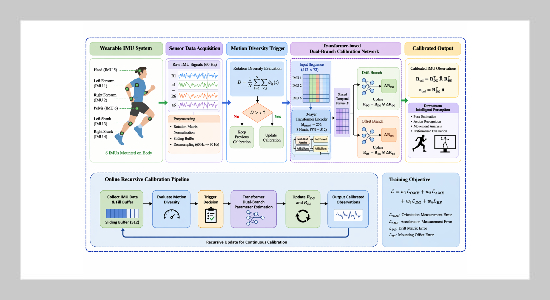
System Architecture
Copyright The Author(s). This is an open access article distributed under the terms of the Creative Commons Attribution License (CC BY 4.0), which permits unrestricted use, distribution, and reproduction in any medium, provided the original author and source are cited.
Download Citation: BibTeX | http://dx.doi.org/10.6180/jase.202609_32.056
In intelligent perception of high-dynamic sports-like motions, inertial measurement units (IMUs) are susceptible to sensor slippage, mounting misalignment, and global drift during prolonged high-intensity motion, which progressively degrades the validity of one-time static calibration. To address this issue, this paper proposes an adaptive IMU dynamic calibration method for high-dynamic sports-like motion perception. The proposed
framework takes rotation matrices and acceleration sequences from six body-worn IMUs as input and constructs an online calibration architecture based on a Transformer Encoder backbone. Through sliding-buffer inference, motion-diversity-triggered updating, and dual-branch parameter estimation, the method recursively updates the drift matrix RDG and the mounting offset matrix RBS. Compared with static-only calibration, the proposed method is better suited for continuous correction under motion-intensive patterns such as turning, punching-like arm swings, jumping-like bursts, and abrupt direction changes. Experimental results indicate stable convergence and effective parameter estimation. The experimental protocol includes static baseline comparison, original dynamic calibration reproduction, validation on a high-dynamic sports-like proxy subset constructed from the TIC test set, trigger ablation, and downstream proxy action recognition verification. These results demonstrate that the proposed framework provides a practical solution for online calibration in intelligent sensing systems for motion-intensive sports-like movements.
Keywords: high-dynamic sports-like motions; IMU dynamic calibration; Transformer; online calibration; intelligent perception
- [1] A. Ç. Seçkin, B. Ateş, and M. Seçkin, (2023) “Review on wearable technology in sports: concepts, challenges and opportunities” Applied Sciences 13(18): 10399. DOI: 10.3390/app131810399.
- [2] P. Picerno, M. Iosa, C. D’Souza, M. G. Benedetti, S. Paolucci, and G. Morone, (2021) “Wearable inertial sensors for human movement analysis: a five-year update” Expert Review of Medical Devices 18(sup1): 79–94. DOI: 10.1080/17434440.2021.1988849.
- [3] W. Hailong, G. Xinru, J. Sheng, and Z. Lijun, (2026) “Multi-Task Learning for Sports Training Monitoring Via Multimodal Fusion of IMU and Human-Body Capacitance Signals” Journal of Applied Science and Engineering 31: 1–13. DOI: 10.6180/jase.202608_31.038.
- [4] M. Ekdahl, A. Loewen, A. Erdman, S. Sahin, and S. Ulman, (2023) “Inertial measurement unit sensor-to-segment calibration comparison for sport-specific motion analysis” Sensors 23(18): 7987. DOI: 10.3390/s23187987.
- [5] Y.-t. Zhao, X. Wang, K.-x. Yang, L.-d. Wang, C. Yang, R. Feng, L.-l. Zheng, and Z.-p. Zhou, (2025) “Effects of various static calibration postures on knee mechanics during locomotor tasks using statistical parametric mapping analysis” Scientific Reports 15(1): 29833. DOI: 10.1038/s41598-025-15311-2.
- [6] J. Wu, Z. Mo, X. Gao, W. Xin, W. Shi, and J. Park, (2025) “Artificial intelligence assisted wearable flexible sensors for sports: research progress in technology integration and application” International Journal of Smart and Nano Materials 16(3): 510–548. DOI: 10.1080/19475411.2025.2519582.
- [7] J. Ok, S. Park, Y. H. Jung, and T.-i. Kim, (2024) “Wearable and implantable cortisol-sensing electronics for stress monitoring” Advanced Materials 36(1): 2211595. DOI: 10.1002/adma.202211595.
- [8] X. Xuan, C. Chen, A. Molinero-Fernandez, E. Ekelund, D. Cardinale, M. Swarén, L. Wedholm, M. Cuartero, and G. A. Crespo, (2023) “Fully integrated wearable device for continuous sweat lactate monitoring in sports” ACS Sensors 8(6): 2401–2409. DOI: 10.1021/acssensors.3c00708.
- [9] F. Criscuolo, I. N. Hanitra, S. Aiassa, I. Taurino, N. Oliva, S. Carrara, and G. De Micheli, (2021) “Wearable multifunctional sweat-sensing system for efficient healthcare monitoring” Sensors and Actuators B: Chemical 328: 129017. DOI: 10.1016/j.snb.2020.129017.
- [10] A. Bonfiglio, D. Tacconi, R. M. Bongers, and E. Farella, (2024) “Effects of IMU sensor-to-segment calibration on clinical 3D elbow joint angles estimation” Frontiers in Bioengineering and Biotechnology 12: 1385750. DOI: 10.3389/fbioe.2024.1385750.
- [11] S. Chidambaram, Y. Maheswaran, K. Patel, V. Sounderajah, D. A. Hashimoto, K. P. Seastedt, A. H. McGregor, S. R. Markar, and A. Darzi, (2022) “Using artificial intelligence-enhanced sensing and wearable technology in sports medicine and performance optimisation” Sensors 22(18): 6920. DOI: 10.3390/s22186920.
- [12] C. Yi, S. Zhang, F. Jiang, J. Liu, Z. Ding, C. Yang, and H. Zhou, (2021) “Enable fully customized assistance: A novel IMU-based motor intent decoding scheme” IEEE Transactions on Cognitive and Developmental Systems 15(4): 2089–2098. DOI: 10.1109/tcds.2021.3126001.
- [13] T. Li and H. Yu, (2023) “Upper body pose estimation using a visual–inertial sensor system with automatic sensor-to-segment calibration” IEEE Sensors Journal 23(6): 6292–6302. DOI: 10.1109/jsen.2023.3241084.
- [14] J. Ghattas and D. N. Jarvis, (2024) “Validity of inertial measurement units for tracking human motion: a systematic review” Sports Biomechanics 23(11): 1853–1866. DOI: 10.1080/14763141.2021.1990383.
- [15] J. Zhu, Z. Ye, R. Liu, and J. Liu, (2026) “Inertial measurement units (IMUs) for biomechanical analysis in sport: A review of applications, challenges and future directions” Sensor Review 46(1): 88–104. DOI: 10.1108/SR-04-2025-0261.
- [16] M. McInne, D. Blana, A. Starkey, and E. K. Chadwick, (2025) “A practical sensor-to-segment calibration method for upper limb inertial motion capture in a clinical setting” IEEE Journal of Translational Engineering in Health and Medicine: DOI: 10.1109/JTEHM.2025.3565986.
- [17] L. Wolski, M. Halaki, C. E. Hiller, E. Pappas, and A. Fong Yan, (2024) “Validity of an inertial measurement unit system to measure lower limb kinematics at point of contact during incremental high-speed running” Sensors 24(17): 5718. DOI: 10.3390/s24175718.
- [18] M. V. Potter, (2025) “Simulating effects of sensor-to-segment alignment errors on IMU-based estimates of lower limb joint angles during running” Sports Engineering 28(1): 1. DOI: 10.1007/s12283-024-00483-3.
- [19] B. Fan, L. Zhang, S. Cai, M. Du, T. Liu, Q. Li, and P. Shull, (2025) “Influence of sampling rate on wearable IMU orientation estimation accuracy for human movement analysis” Sensors 25(7): 1976. DOI: 10.3390/s25071976.
- [20] S. Suh, V. F. Rey, and P. Lukowicz, (2023) “Tasked: transformer-based adversarial learning for human activity recognition using wearable sensors via self-knowledge distillation” Knowledge-Based Systems 260: 110143. DOI: 10.1016/j.knosys.2022.110143.
- [21] X. Guo, Y. Kim, X. Ning, and S. D. Min, (2025) “Enhancing the transformer model with a convolutional feature extractor block and vector-based relative position embedding for human activity recognition” Sensors 25(2): 301. DOI: 10.3390/s25020301.
- [22] D. Kim, Y. Jin, H. Cho, T. Jones, Y. M. Zhou, A. Fadaie, D. Popov, K. Swaminathan, and C. J. Walsh, (2025) “Learning-based 3D human kinematics estimation using behavioral constraints from activity classification” Nature communications 16(1): 3454. DOI: 10.1038/s41467-025-58624-6.
- [23] D. Fruet, A. Tauro, D. Di Liberto, C. Pedrotti, I. Bracci, G. Martinelli, and G. Nollo. “Comparing IMU and Optical Motion Capture System for Sport Biomechanics: Static and Dynamic Analysis”. In: 2025 IEEE International Workshop on Sport, Technology and Research (STAR). IEEE. 2025, 43–48. DOI: 10.1109/star66750.2025.11264765.
- [24] C. Zuo, J. Huang, X. Jiang, Y. Yao, X. Shi, R. Cao, X. Yi, F. Xu, S. Guo, and Y. Qin, (2025) “Transformer IMU calibrator: dynamic on-body IMU calibration for inertial motion capture” ACM Transactions on Graphics (TOG) 44(4): 1–14. DOI: 10.1145/3730937.