





Xueli Guo , Jie Wang, Haijun Wang, Wanke Ma, Feng Zheng, and Kai Li
State Grid Nanyang Power Supply Company Economic and Technical Research Institute, Nanyang, 473000, China.
Received: March 2, 2026
Accepted: April 8, 2026
Publication Date: May 21, 2026
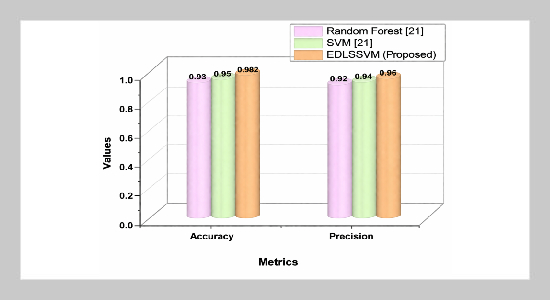
Comparison of Accuracy and Precision
Copyright The Author(s). This is an open access article distributed under the terms of the Creative Commons Attribution License (CC BY 4.0), which permits unrestricted use, distribution, and reproduction in any medium, provided the original author and source are cited.
Download Citation: BibTeX | http://dx.doi.org/10.6180/jase.202609_32.051
The operation of wireless power systems (WPS) requires temperature monitoring because accurate temperature measurements help to detect overheating which serves as a fault warning. This research introduces an early fault detection system that uses multiple temperature sensing algorithms to analyze data for equipment failures. The Internet of Things (IoT) network gathers thermal measurements from various sensor units which undergo pre-processing through Savitzky-Golay filtering for noise reduction and principal component analysis for feature extraction. The Efficient Decision-tuned Least Squares Support Vector Machine (EDLSSVM) conducts fault detection while the Decision Tree (DT) model produces understandable rules to analyze threshold-crossing patterns. The two models combine their outputs through a consensus process which decreases false positive results and enhances overall system trustworthiness. The hybrid system combines nonlinear modeling with understandable rules to boost classification results which creates a dependable system that detects system faults and performs predictive maintenance in current WPS systems. The proposed consensus mechanism uses adaptive weights based on model confidence and decision consistency, which distinguishes it from traditional ensemble methods. The system automatically resolves conflicts by treating all models as equal. The research used both simulated data and real-time data to conduct their tests under different environmental conditions which included both STC and CEC testing scenarios. The multi-algorithm approach outperforms single-model methods, achieving 0.982 accuracy, 0.96 precision, 0.98 recall, and 0.97 F1-score. The results show that IoT monitoring systems combined with collaborative machine learning enable efficient real-time fault detection and predictive maintenance capabilities for modern WPS systems.
Keywords: Wireless power systems (WPS), temperature sensing, early fault detection, Internet of Things (IoT), Efficient Decision-tuned Least Squares Support Vector Machines (EDLSSVM).
- [1] A. Harish, A. Prince, and M. V. Jayan, (2022) “Fault detection and classification for wide area backup protection of power transmission lines using weighted extreme learning machine” IEEE Access 10: 82407–82417. DOI: 10.1109/ACCESS.2022.3196769.
- [2] M. Irfan et al., (2025) “Design of a novel noise-resilient algorithm for fault detection in wind turbines on a supervisory control and data acquisition system” Scientific Reports 15: 13308. DOI: 10.1038/s41598-025-97663-3.
- [3] D. Thomas, (2024) “Unveiling wind turbine failures: causes, detection, and prevention for enhanced reliability” Journal of Failure Analysis and Prevention 24: 2051–2053. DOI: 10.1007/s11668-024-02026-1.
- [4] L. Cao, Z. Wang, and Y. Yue, (2022) “Analysis and prospect of the application of wireless sensor networks in ubiquitous power Internet of Things” Computational Intelligence and Neuroscience 20: 9004942. DOI: 10.1155/2022/9004942.
- [5] J. Liu, Z. Zhao, J. Ji, and M. Hu, (2020) “Research and application of wireless sensor network technology in the power transmission and distribution system” Intelligent and Converged Networks 1: 199–220. DOI: 10.23919/ICN.2020.0016.
- [6] G. W. Sun et al., (2022) “A wireless sensor network node fault diagnosis model based on a belief rule base with power set” Heliyon 8: e10879. DOI: 10.1016/j.heliyon.2022.e10879.
- [7] X. Zou et al., (2023) “Current status and prospects of research on sensor fault diagnosis of agricultural Internet of Things” Sensors 23(5): 2528. DOI: 10.3390/s23052528.
- [8] T. Mahmood et al., (2022) “An intelligent fault detection approach based on a reinforcement learning system in a wireless sensor network” The Journal of Supercomputing 78: 3646–3675. DOI: 10.1007/s11227-021-04001-1.
- [9] N. Nathiya, C. Rajan, and K. Geetha, (2025) “A hybrid optimization and ML-based energy-efficient clustering algorithm with self-diagnosis data fault detection and prediction for WSN-IoT application” Peer-to-Peer Network-ing and Applications 18: 13. DOI: 10.1007/s12083-024-01892-8.
- [10] M. S. Salhi et al., (2024) “On the use of wireless sensor nodes for agricultural smart fault detection” Wireless Personal Communications 134: 95–117. DOI: 10.1007/s11277-024-10889-8.
- [11] S. Lavanya et al., (2021) “A tuned classification approach for efficient heterogeneous fault diagnosis in IoT-enabled WSN applications” Measurement 183: 109771. DOI: 10.1016/j.measurement.2021.109771.
- [12] R. Prasad and K. B. Baghel, (2021) “A novel fault diagnosis technique for wireless sensor networks using a feedforward neural network” IEEE Sensors Letters 6: 1–4. DOI: 10.1109/LSENS.2021.3136590.
- [13] F. Fan et al., (2023) “An optimized ML technology scheme and its application in fault detection in wireless sensor networks” Journal of Applied Statistics 50: 592–609. DOI: 10.1080/02664763.2021.1929089.
- [14] D. Dong and H. Feng, (2024) “Design and use of a wireless temperature measurement network system integrating artificial intelligence and blockchain in electrical power engineering” PLoS One 19: e0296398. DOI: 10.1371/journal.pone.0296398.
- [15] M. Li et al., (2020) “A data-driven method for fault detection and isolation of the integrated energy-based district heating system” IEEE Access 8: 23787–23801. DOI: 10.1109/ACCESS.2020.2970273.
- [16] G. Wang et al., (2021) “Power transformer fault diagnosis system based on Internet of Things” EURASIP Journal on Wireless Communications and Networking 2021(21): 1–21. DOI: 10.1186/s13638-020-01871-6.
- [17] A. Quispe-Astorga et al., (2025) “Data-driven fault detection and diagnosis in cooling units using sensor-based ML classification” Sensors 25: 3647. DOI: 10.13390/s25123647.
- [18] H. Ruan et al., (2022) “Deep learning-based fault prediction in wireless sensor network embedded cyber-physical systems for industrial processes” IEEE Access 10: 10867–10879. DOI: 10.1109/ACCESS.2022.3144333.
- [19] S. Yao et al., (2021) “Intelligent and data-driven fault detection of photovoltaic plants” Processes 9: 1711. DOI: 10.3390/pr9101711.
- [20] B. Feng et al., (2024) “Distributed chaotic bat algorithm for sensor fault diagnosis in AHUs based on a decentralized structure” Journal of Building Engineering 95: 110031. DOI: 10.1016/j.jobe.2024.110031.
- [21] U. Shah, (2024) “Fault detection and diagnosis in electric vehicle systems using IoT and ML: A support vector machine approach” Journal of Electrical Systems 20: 990–999. DOI: 10.52783/jes.1414.
- [22] C.-Y. Lu et al., (2025) “Development and validation of an explainable hybrid deep learning model for multiple-fault diagnosis in intelligent automotive electronic systems” Electronics 14(22): 4488. DOI: 10.3390/electronics14224488.