




Bin Wang1, Xiaojuan Guo1, Shiru Sun2, and Zhaofang Du1
1Modern Information Technology College, Henan Industry and Trade Vocational College, Zhengzhou, China
2School of Electronics and Electrical Engineering, Zhengzhou University of Science and Technology, 450064, Zhengzhou, China
Received: April 4, 2026
Accepted: April 27, 2026
Publication Date: May 21, 2026
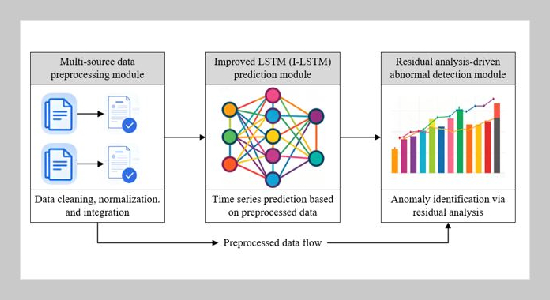
Overall architecture of proposed model
Copyright The Author(s). This is an open access article distributed under the terms of the Creative Commons Attribution License (CC BY 4.0), which permits unrestricted use, distribution, and reproduction in any medium, provided the original author and source are cited.
Download Citation: BibTeX | http://dx.doi.org/10.6180/jase.202609_32.050
Accurate detection of water abnormal states is critical for aquatic environmental protection and ecological security. Traditional methods suffer from low prediction accuracy, poor multi-source data fusion capability, and insufficient residual-based anomaly discrimination. This paper proposes a residual analysis-driven water abnormal state detection framework based on an improved LSTM multi-source data fusion prediction model. First, a multi-source data preprocessing module is designed to integrate water quality parameters, meteoro-logical data, and hydrological data with CEEMDAN (complete ensemble empirical mode decomposition with adaptive noise) decomposition and wavelet denoising for noise reduction. Second, an improved LSTM (I-LSTM) with frequency-enhanced channel attention (FECA) and bidirectional structure is proposed to capture long term temporal dependencies and multi-scale features, enhancing prediction accuracy for non-stationary water quality sequences. Third, a residual analysis module is constructed to calculate prediction residuals, establish adaptive thresholds via 3σ criterion and kernel density estimation (KDE), and realize accurate abnormal state detection. Experiments on real-world aquatic environment datasets show that the proposed model achieves R2 of 0.96−0.99, MAE reduction of 25.3%−32.7%, and abnormal detection accuracy of 94.2%, outperforming baseline models (LSTM, Bi-LSTM, CNN-LSTM). This framework provides a reliable technical approach for real-time water abnormal state monitoring.
Keywords: Water abnormal state detection; Improved LSTM; Multi-source data fusion; Residual analysis; Frequency-enhanced channel attention; Aquatic environment monitoring
- [1] C. Shi, Z. Liu, B. Yu, Y. Zhang, H. Yang, Y. Han, B. Wang, Z. Liu, and H. Zhang, (2024) “Emergence of nanoplastics in the aquatic environment and possible impacts on aquatic organisms” Science of the Total Environment 906: 167404. DOI: 10.1016/j.scitotenv.2023.167404.
- [2] D. Guo, D. Yang, H. Zhang, J. Song, P. Wang, Q. Zhu, R. Xu, R. Zhang, S. Ma, X. Bi, et al., (2025) “Deepseek-r1: Incentivizing reasoning capability in llms via reinforcement learning” arXiv preprint arXiv:2501.12948: DOI: 10.48550/arXiv.2501.12948.
- [3] A. Singh, S. G. Pratap, and A. Raj, (2024) “Occurrence and dissemination of antibiotics and antibiotic resistance in aquatic environment and its ecological implications: a review” Environmental Science and Pollution Research 31(35): 47505–47529. DOI: 10.1007/s11356-024-34355-x.
- [4] S. M. Basha, Y. Zhenning, D. S. Rajput, R. D. Caytiles, and N. C. S. Iyengar, (2017) “Comparative study on performance analysis of time series predictive models” International Journal of Grid and Distributed Computing 10(8): 37–48. DOI: 10.14257/ijgdc.2017.10.8.04.
- [5] B. Bichescu and G. G. Polak, (2023) “Time series modeling and forecasting by mathematical programming” Computers & Operations Research 151: 106079. DOI: 10.1016/j.cor.2022.106079.
- [6] S. Yin, L. Wang, T. Chen, H. Huang, J. Gao, J. Zhang, M. Liu, P. Li, and C. Xu, (2026) “LKAFormer: A lightweight kolmogorov-arnold transformer model for image semantic segmentation” ACM Transactions on Intelligent Systems and Technology 17(3): 1–24. DOI: 10.1145/3759254.
- [7] L. Wang, Y. Shoulin, H. Alyami, A. A. Laghari, M. Rashid, J. Almotiri, H. J. Alyamani, and F. Alturise. A novel deep learning-based single shot multibox detector model for object detection in optical remote sensing images. 2024. DOI: 10.1002/gdj3.162.
- [8] C. Hu, L. Zhou, Y. Gong, Y. Li, and S. Deng, (2023) “Research on water level anomaly data alarm based on CNN-BiLSTM-DA model” Water 15(9): 1659. DOI: 10.3390/w15091659.
- [9] M. N. PV and G. Urkude, (2025) “An Approach to Forecast Quality of Water Effectively Using Machine Learning Algorithms” Recent Advances in Electrical & Electronic Engineering 18(2): 161–175. DOI: 10.2174/0123520965267326231115071849.
- [10] B. A. Tsegay and N. M. Peleato, (2025) “Enhancing long-term water quality modeling by addressing base demand, demand patterns, and temperature uncertainty using unsupervised machine learning techniques” Water Research 268: 122701. DOI: 10.1016/j.watres.2024.122701.
- [11] S. Khosravi, M. R. Nikoo, M. G. Zamani, R. Barzegar, P. Najafipour, and A. H. Gandomi, (2026) “Enhancing long-term water quality forecasting with a hybrid deep-learning approach integrating MODWT, CNN, and GRU” Hydrological Sciences Journal 71(2): 270–293. DOI: 10.1080/02626667.2025.2581264.
- [12] K. Kapula, S. Thirumala, M. Srilatha, A. Vijjapu, and A. S. Peddinti, (2025) “An adaptive Laplace enhancement method for underwater image dehazing” Signal, Image and Video Processing 19(14): 1264. DOI: 10.1007/s11760-025-04786-1.
- [13] Y. Gu, (2026) “Edge statistics for singular values of products of rectangular complex Gaussian matrices” Statistics & Probability Letters: 110748. DOI: 10.1016/j.spl.2026.110748.
- [14] S. D. Mohamed, M. T. Ismail, and M. K. B. M. Ali, (2025) “Improving detectability of the indicator saturation approach through winsorization: an empirical study in the cryptocurrency market” Statistics in Transition new series 26(1): 155–181. DOI: 10.59139/stattrans-2025-009.
- [15] J. Gao, L. Ma, C. Qing, T. Zhao, Z. Wang, J. Geng, and Y. Li, (2024) “A health monitoring model for circulation water pumps in a nuclear power plant based on graph neural network observer” Sensors 24(14): 4486. DOI: 10.3390/s24144486.
- [16] J. Malisaba, E. B. Omer, E. Bubu, and P. Mukasa, (2026) “A review of advanced machine learning and deep learning technologies for water quality management” Discover Applied Sciences: DOI: 10.1007/s42452-026-08687-x.
- [17] P. G. Arepalli and K. J. Naik, (2025) “Water quality classification framework for IoT-enabled aquaculture ponds using deep learning based flexible temporal network model” Earth Science Informatics 18(2): 351. DOI: 10.1007/s12145-025-01857-2.
- [18] Y. Zhao, L. Yang, H. Pan, Y. Li, Y. Shao, J. Li, and X. Xie, (2025) “Spatio-temporal prediction of groundwater vulnerability based on CNN-LSTM model with self-attention mechanism: A case study in Hetao Plain, northern China” Journal of Environmental Sciences 153: 128–142. DOI: 10.1016/j.jes.2024.03.052.